Startup GTM Strategy: How to Launch and Get Your First 100 Customers
A complete guide to go-to-market strategy for early-stage startups — choosing your model, pricing, distribution channels, and building a growth engine from scratch.
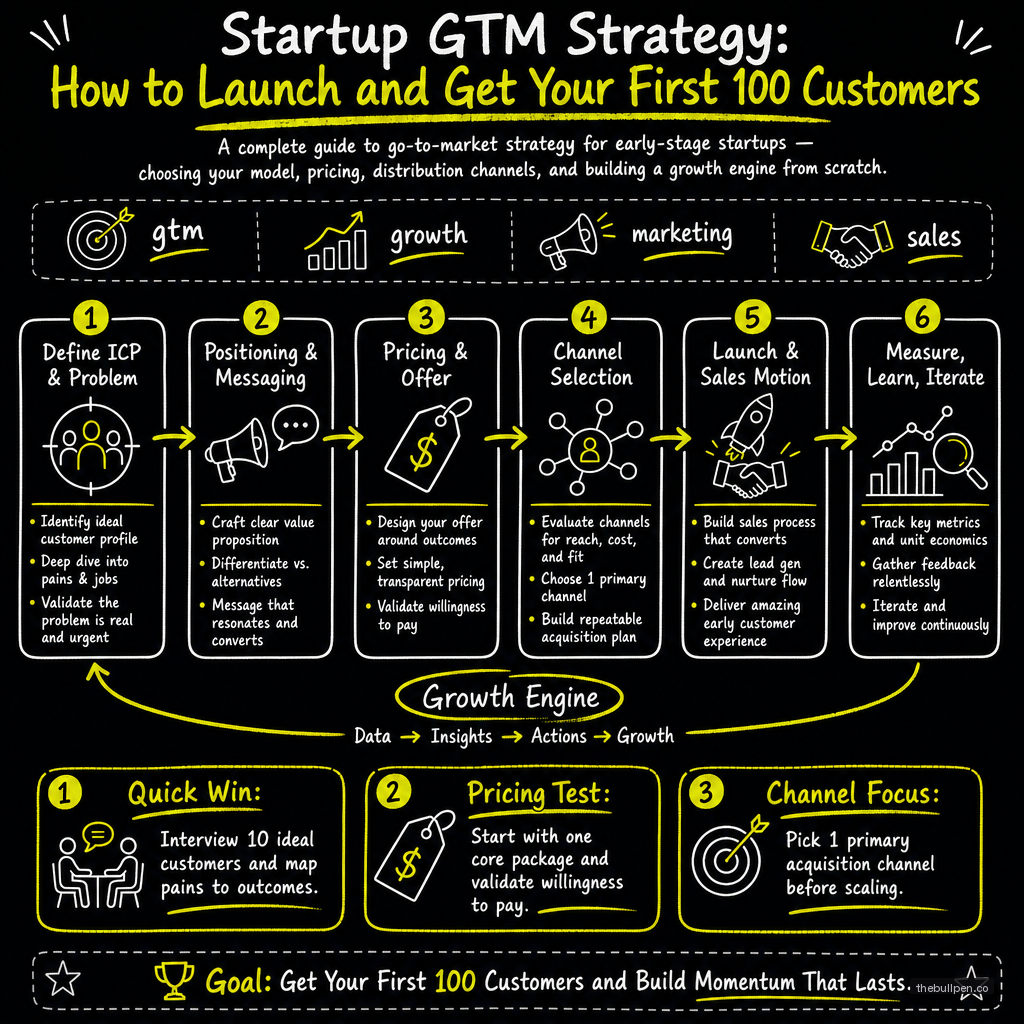
Most startups fail not because they couldn't build a product, but because they couldn't get anyone to buy it. GTM execution is the hardest part of building a company, and it's the part first-time founders are least prepared for.
A go-to-market strategy is not a marketing plan. It's the answer to a specific question: given our product, our customers, and our constraints, what is the most efficient path to revenue? The answer changes based on who you're selling to, what you charge, and how complex your product is.
This guide walks through every major GTM model, how to choose yours, and how to execute it from zero to your first 100 customers.
Choosing Your GTM Model
The most consequential decision you'll make is which GTM model to use. Pick wrong and you'll burn through cash chasing the wrong channel.
Product-Led Growth (PLG)
The user tries the product before talking to a salesperson. Freemium, free trial, or self-service onboarding. Works best for low-complexity products with clear individual value. Slack, Dropbox, Notion, Canva — all PLG.
PLG advantages: lower CAC, viral potential, faster time-to-value. PLG challenges: harder to monetize enterprise, longer sales cycles for high-value deals, requires excellent onboarding.
Related: Product-Led Growth Playbook for SaaS, SaaS Free Trial Strategy (Coming soon — October 20, 2026)
Sales-Led Growth
A human sells the product. Outbound prospecting, demos, proposals, negotiations. Works best for high-ACV products ($20K+), complex sales with multiple stakeholders, and enterprise buyers.
Sales-led advantages: higher ACV, more predictable revenue per deal, better enterprise relationships. Challenges: high CAC, longer ramp time for reps, difficult to scale efficiently.
Related: PLG vs. Sales-Led Growth: Choosing Your Model, Sales Playbooks for Early-Stage Startups
Hybrid Models
Most successful startups end up hybrid. They use PLG for top-of-funnel (free product, self-serve) and sales for high-value conversions. The product handles the bottom of the market; the sales team handles the top.
The transition from pure PLG to hybrid is tricky. Add sales too early and you add cost without revenue. Add sales too late and you leave money on the table.
Community-Led Growth
Build a community, turn members into customers, and let the community drive acquisition. Works best for developer tools, creator platforms, and niche B2B verticals where trust and peer recommendations drive purchase decisions.
Related: Community-Led Growth Strategy
Partner-Led Growth
Rely on channel partners, resellers, or technology partners to distribute your product. Works well when your product complements existing platforms or when your target market requires local partners.
Related: Partnership-Led Growth (Coming soon — November 19, 2026), Channel Partnerships for Early-Stage Startups
Getting Your First 100 Customers
The first 100 customers are fundamentally different from the next 100,000. They require manual effort, personal relationships, and non-scalable tactics.
The Founder-Led Sales Sprint
For your first 100 customers, the founder is the only salesperson. This is not optional. You learn more from 10 rejected sales calls than from 100 surveys. Every objection is product feedback. Every lost deal is positioning data.
Define your ICP as a specific person at a specific company type. "SaaS founders raising their seed round" is too broad. "AI startup founders in FinTech with 3-10 employees who just graduated from YC" is specific enough to target.
Related: How to Get Your First 100 Customers, First 90 Days of a Startup Launch
Manual Outreach That Works
Cold email still works if done right. Personal research, relevant value prop, short email, clear next step. The goal is a meeting, not a sale. The sale happens in the meeting.
Don't automate until you've manually dialed in your messaging. The founders who automate a broken process just break faster.
Related: Cold Email Startup Playbook
The Waitlist Playbook
A waitlist does two things: validates demand and builds anticipation. The best waitlists create FOMO (early access, exclusive tiers) and capture feedback. Ship your product to waitlist users quickly — a 6-month waitlist burns goodwill.
Related: Startup Waitlist Strategy (Coming soon — September 20, 2026)
Distribution Channels
Most startups should pick one primary channel and one secondary channel. Trying to be everywhere at once means succeeding nowhere.
Content Marketing
The highest ROI long-term channel. Write about what your customers need to know. SEO compounds — content written today generates traffic for years. Early-stage startups should prioritize content over paid ads.
The playbook: write 30-50 articles targeting SEO keywords your ICP searches for. Cross-post on LinkedIn, Medium, and industry newsletters. Repurpose into Twitter threads and videos.
Related: Content Marketing for Early-Stage Startups, SEO for Startups Guide
Paid Ads
Paid acquisition works when you know your unit economics. Before you know CAC and LTV, paid ads are a black box. Best used after you've validated organic channels and have a clear repeatable playbook.
Founder-run paid ads (small budgets, tight targeting) can work for niche B2B. Broad brand awareness campaigns are a waste at this stage.
Related: Founder's Guide to Paid Ads (Coming soon — November 25, 2026)
Social Media (B2B)
LinkedIn is the highest-ROI social channel for B2B founders. Post valuable content, not marketing. Engage in relevant conversations. Build a following that trusts you. When you launch, those followers convert.
Twitter/X is high-effort, high-variance. Great for building an audience in developer tools and creator spaces. Lower ROI for traditional B2B.
Related: LinkedIn for B2B Founders, B2B Startup Social Media Strategy
Product Hunt
A strong Product Hunt launch can generate thousands of signups in 24 hours. But the traffic is spikey and most users won't convert to paying customers. Use Product Hunt for awareness, not revenue.
The playbook: build a following before you launch, prepare your listing materials in advance, coordinate with friends who'll upvote, and have a plan for the traffic spike.
Related: Product Hunt Launch Strategy
Webinars and Events
Live events (virtual or in-person) are high-touch, high-conversion channels. Host a webinar about a problem your ICP faces, not about your product. Build trust first, pitch second.
Conference speaking is even better — it positions you as an authority and generates inbound interest.
Related: B2B Webinar Strategy (Coming soon — November 13, 2026), Conference Speaking Guide for Startups (Coming soon — November 7, 2026)
Email Marketing
Build an email list from day one. Every signup, every trial, every download goes on the list. Send a weekly or bi-weekly newsletter with genuine value, not promotional content. The email list is the only distribution channel you own.
Related: Startup Email Marketing
Referral Programs
Your happiest customers are your best acquisition channel. Build a referral program that rewards them for sharing. Cash works better than discounts for B2B. Double-sided rewards (referrer gets $100, referee gets $100) outperform single-sided.
Related: Startup Referral Program Guide
Pricing: The Unsung GTM Lever
Pricing is GTM. Your pricing model determines who buys, how they buy, and how much they'll pay.
Pricing Models
Tiered pricing (monthly/annually, basic/pro/enterprise) is the most common and the most predictable. Usage-based pricing (per-seat, per-API-call, per-storage) aligns cost with value but adds unpredictability. Hybrid (base subscription + usage overage) offers the best of both.
Related: Startup Pricing Strategy, Pricing: Tiered vs. Usage-Based (Coming soon — October 8, 2026)
Finding Your Price Point
Price too low and you signal low quality and leave money on the table. Price too high and you limit your market. The sweet spot is usually higher than you think — most founders underprice by 30-50%.
Run price tests. Try different price points with different customer segments. The data will tell you what works.
Growth Systems and Loops
Once you have your first 100 customers, it's time to build systems that scale.
Growth Loops
A growth loop is a closed system where output feeds back into input. The most powerful loop: customer uses product → gets value → tells someone → that person signs up → repeats. Every successful startup has at least one growth loop working.
Related: Growth Loops in SaaS: A Taxonomy
Retention Systems
Acquiring customers you can't retain is like filling a bathtub without a drain plug. Build retention systems early: onboarding sequences, health scoring, customer success outreach, win-back campaigns.
Your retention rate is the single biggest lever on long-term growth. A 5% improvement in retention can double LTV.
Related: Retention Marketing for SaaS (Coming soon — October 2, 2026)
Data-Driven GTM
Track everything. CAC by channel, LTV by cohort, conversion rates at every funnel stage. The companies that win are the ones that make decisions based on data, not gut feelings.
Build a simple GTM dashboard: traffic by channel, signups, activations, paid conversions, revenue, churn. Review weekly. Adjust channels based on unit economics, not volume.
Related: Data-Driven GTM Strategy (Coming soon — October 14, 2026), GTM Quarterly Review Framework (Coming soon — January 1, 2027)
Special Cases
API-First Products
Your customers are developers. Your GTM is developer-relations, documentation quality, and community. Free tier first, self-serve upgrade, enterprise sales later.
Related: API-First GTM Strategy (Coming soon — November 1, 2026)
Marketplaces
You have two-sided GTM — supply and demand. The chicken-and-egg problem is real. Common solutions: seed one side manually, use a wedge product to attract one side, or subsidize the harder side until critical mass.
Related: Marketplace GTM Strategy
International Expansion
Going global too early is a common mistake. Nail your home market first. Then expand one country at a time, starting with the most similar market to your home base.
Related: SaaS International Expansion (Coming soon — September 26, 2026)
FAQ
What's the best GTM channel for a B2B SaaS startup?
Content marketing + LinkedIn for most early-stage B2B. It's the highest ROI because it compounds over time. Cold email is a close second for quick validation. Paid ads should wait until you know your unit economics.
How long does it take to get the first 100 customers?
3-6 months if you're doing it right. Faster if you have an existing audience or network. Slower if you're building in a crowded space without differentiation. The first 100 should take 80% manual effort and 20% automated.
Should I hire a salesperson before or after PMF?
After. Your first salesperson without a repeatable sales process is a gamble. The founder should validate the sales process first, document it, then hire a rep to execute the playbook.
Related: Hiring Your First Salesperson (Coming soon — October 26, 2026)
What's the biggest GTM mistake early-stage founders make?
Picking too many channels. Founders try to do content marketing, paid ads, cold email, partnerships, events, and social media all at once. None of them work because none of them get enough attention. Pick one primary channel, make it work, then add a second.
How do I know when it's time to switch GTM models?
When unit economics deteriorate. If your PLG growth is slowing and your enterprise pipeline is growing, it's time to add a sales layer. If your outbound sales CAC is higher than LTV, it's time to try PLG. Let the data tell you.
Ready to build your GTM engine? Upload your pitch deck or business model to Bullpen for a free AI-powered evaluation. Get feedback on your go-to-market strategy, pricing, and acquisition approach before you invest time and money into execution.
Get weekly pitch tips
One email a week. Actionable advice for founders.
Get a GTM pitch evaluation in 2 minutes. Try now →