SEO for Startups: How to Rank Before You Have Domain Authority
Your startup has zero backlinks, zero domain authority, and zero Google trust. Here's how to get search traffic anyway — with real strategies from Zapier, Webflow, and others that shipped SEO from day one.
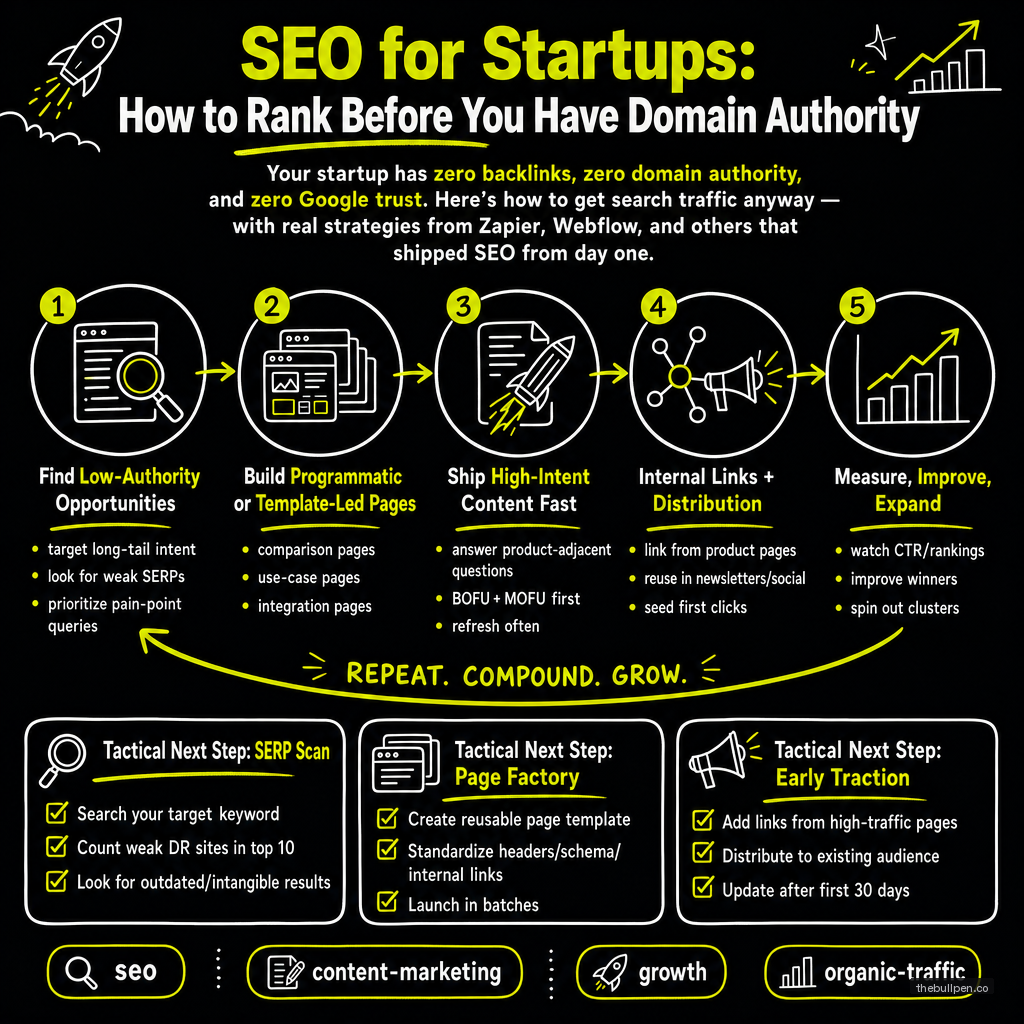
96.55% of pages on the internet get zero search traffic from Google. Most of them deserve it — thin content, poor keyword targeting, no strategic reason to exist. But a significant number are well-written articles on zero-authority domains that Google simply hasn't decided to trust yet.
This is the core problem of early-stage SEO. You know content marketing compounds. You know organic traffic is the most efficient growth channel at scale. But you need traffic today to prove the channel works, and starting from zero means months of nothing before anything happens.
The data is brutally honest. Ahrefs surveyed 3,680 SEO practitioners: the typical timeline to see any results is 3 to 6 months. Google's John Mueller has said new sites can take up to a year before the algorithm figures out where to place them. Most startup founders quit SEO before it has time to work — not because the strategy was wrong, but because they expected results too fast from the wrong keywords.
The trick is knowing which keywords to target at each stage, which technical foundations matter most, and how to build authority before you have any.
Related: Content Marketing for Early-Stage Startups
The Low-Competition Keyword Strategy
The most common SEO mistake startups make is targeting keywords that are too competitive. A new domain has zero chance of ranking for "CRM software" (keyword difficulty 90+) or "project management tool" (85+). These head terms are dominated by companies with thousands of backlinks and years of domain authority.
The correct strategy is to target keywords with a difficulty score below 20. These are long-tail queries with clear user intent and minimal competition. For example, instead of "CRM software," you target "CRM for real estate agents with fewer than 10 employees" (difficulty 12). The search volume is lower — maybe 50 searches per month instead of 50,000 — but the conversion rate is dramatically higher because the searcher knows exactly what they want.
| Keyword Type | Example | Difficulty | Volume | Best For |
|---|---|---|---|---|
| Head term | "CRM software" | 93 | 50K/mo | Established brands |
| Mid-tail | "best CRM for realtors" | 38 | 1,200/mo | Growing domains |
| Long-tail | "CRM for real estate agents <10 employees" | 12 | 50/mo | New domains |
| Question-based | "how does CRM help real estate agents" | 8 | 30/mo | New domains |
| "Vs" keyword | "HubSpot vs Pipedrive for real estate" | 22 | 200/mo | Any domain |
The question-based keywords are particularly valuable for new domains. Google's AI Overviews trigger on question queries 57.9% of the time — meaning a well-structured answer has a shot at appearing in the featured snippet regardless of your domain authority. "Why" questions trigger AI overviews 59.8% of the time.
The "vs" keyword strategy is another underused play for startups. Comparison pages capture users who are actively evaluating solutions. If you're willing to compare yourself honestly against a market leader, those pages are relatively easy to rank for because they require specific, opinionated content that thin affiliate sites can't produce.
The Technical Foundation
Before you write a single article, there are five technical SEO basics that must be right. Skipping them means every page you publish is fighting uphill.
Site structure should be flat. Any page on your site should be reachable within three clicks of the homepage. Organize content into logical groups — /blog/, /product/, /resources/ — and submit your XML sitemap to Google Search Console the day your site goes live.
No accidental blocks. Check your robots.txt. A surprising number of new sites accidentally block Googlebot with a blanket Disallow: /. Also check that you haven't added noindex tags to pages you want indexed.
Core Web Vitals matter for new sites more than old ones. An established domain gets some leeway on page speed. A new domain does not. Aim for LCP under 2.5 seconds, FID under 100ms, and CLS under 0.1. Compress images, use a CDN (Cloudflare free tier), and minimize JavaScript.
Mobile-first indexing is table stakes. Google indexes mobile versions of pages first. If your mobile site is slow or broken, your rankings will suffer regardless of content quality.
Use Ahrefs Webmaster Tools (free) or Google Search Console to monitor these. Both tools send alerts when something breaks, and catching technical issues early prevents weeks of lost indexing progress.
The Content That Works
The startups that won at SEO from day one followed a specific playbook. They didn't write generic blog posts. They built keyword-targeted content machines.
Zapier created an "app directory" — thousands of landing pages for every software integration, each targeting a specific low-competition query like "Connect Gmail + Slack." By 2014, integration pages drove roughly 1 million monthly organic visits. They turned a product feature into an SEO moat.
Airtable created a template directory. Every template — project management, content calendar, inventory tracker — was a standalone landing page targeting "[use case] template" keywords. Users could use templates for free, creating natural backlinks and social shares. The template pages became Airtable's primary organic growth channel.
Webflow built a resource library of design tutorials and "Webflow vs WordPress" comparison pages. The comparison pages captured high-intent commercial traffic. The tutorials built topical authority.
The pattern is clear: the best SEO content for new domains is content that could only exist because of your product. Integration pages, template directories, comparison pages with data from your platform, or industry analysis that uses your product's data are all more effective than generic blog posts.
Related: How to Find and Close Your First 100 Customers
The Authority Problem
Content quality and keyword targeting get you indexed. Backlinks get you ranked.
For a new domain, building backlinks is the hardest part because no one knows you exist. The most effective strategies for zero-authority startups are counterintuitive.
Resource page link building. Find pages that list "best [software category] tools" or "resources for [industry]." If you're not listed, suggest your tool be added. The conversion rate is higher than cold outreach because you're helping the page owner make their resource more complete.
HARO and its alternatives. Sign up for Help a Reporter Out. Journalists post queries; founders are natural expert sources. If your quote gets used, you get a backlink from a major publication. The key is speed — respond within an hour of a relevant query hitting your inbox.
Original data. Run a survey of 100 founders. Publish the results as a report. Pitch it to journalists covering your space. Data-backed stories get linked because they're referenceable. The Semrush State of Content Marketing report earned roughly 4,000 backlinks from 900 domains because the data was original.
Unlinked brand mentions. Search for your brand name in quotes. Find pages that mention you without linking. A simple email — "Thanks for mentioning us! Could you add a link?" — converts surprisingly often.
YouTube mentions. This is the most underrated link-building channel for new startups. Ahrefs' analysis of 75,000 brands found that YouTube mentions correlate with AI visibility at 0.737 — the strongest single factor measured. Sponsor niche YouTube channels relevant to your industry. Appear on podcasts. Publish your own tutorial videos. Google weighs video content heavily, and a YouTube link from a relevant creator drives real traffic even before your domain authority improves.
What Not to Do
The common mistakes are consistent and avoidable.
| Mistake | Why It's Fatal at Early Stage |
|---|---|
| Targeting high-competition keywords | Wastes months of effort on queries you can't rank for |
| Thin content (<300 words, no insight) | Google's Helpful Content Update penalizes this directly |
| Ignoring search intent | Writing a tutorial when searchers want a product comparison |
| Keyword cannibalization | Multiple pages competing for the same query — neither ranks |
| No internal linking | Pages exist in isolation with no authority flow between them |
| Writing without keyword research | Creating content nobody searches for |
| Neglecting Core Web Vitals | New domains get zero leeway on page speed |
The timeline is real: expect zero organic traffic for the first 3 months, a trickle at months 4-6, and compounding returns starting at month 7. Most startups quit in months 2-3. The ones who don't are the ones who targeted the right keywords, fixed the technical foundations, and kept publishing through the silence.
If you commit to the long game from day one, you get the compounding curve. If you start late because you wanted to "wait until we have more content," you've already lost the most valuable asset SEO gives you: time.
Published on the Bullpen Blog. New articles every day at 9 AM UTC.
Get weekly pitch tips
One email a week. Actionable advice for founders.
Get a GTM pitch evaluation in 2 minutes. Try now →