How to Find and Close Your First 100 Customers
A tactical playbook for early customer acquisition — how many outreaches it takes, which channels actually work, what pricing mistakes to avoid, and what the first 100 customers have in common across successful startups.
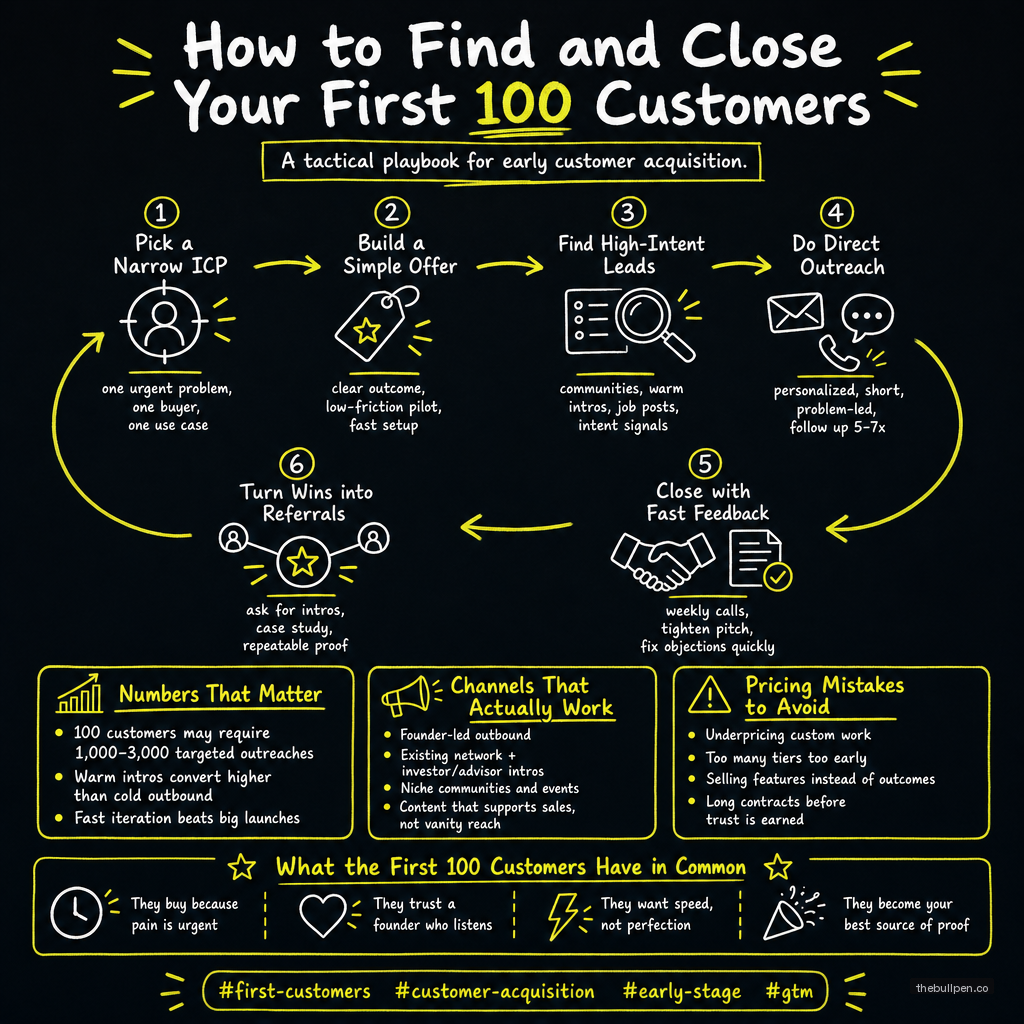
The first 100 customers are the hardest customers you will ever acquire. Not because the product isn't ready — it's usually good enough. Not because nobody wants what you're building — some people definitely do. But because acquiring the first 100 requires a mode of selling that is fundamentally different from everything that comes after.
After customer 100, you can build systems. You can hire a sales team. You can invest in paid acquisition, build a content engine, and run automated campaigns. Before customer 100, none of that works. The only repeatable sales channel at this stage is you, the founder, doing things that don't scale.
I've watched founders burn through $50K on Facebook ads trying to get their first 100 customers. They would have been better off spending that $50K on a plane ticket to visit 50 prospects in person.
Related: Startup GTM Strategy: How to Launch and Get Your First 100 Customers
The Math of First Customers
The numbers are sobering if you haven't done this before. According to data from SaaStr and Close.com, expect to send 200 to 500 cold touches — emails and LinkedIn messages — before you land your very first customer, assuming you have no existing network in your target industry. If you have warm intros, it's more like 10 to 50.
Landing your first 10 customers typically takes 3 to 6 months. Getting to 100 takes 12 to 18 months for the median B2B SaaS company, according to First Round Capital's research. The conversion math is brutal: from cold outreach to meeting, expect 1 to 3 percent. From meeting to closed customer at this stage, maybe 20 to 30 percent. Overall, you're looking at roughly 1 closed deal per 200 to 400 outreaches.
The numbers are not a reason to give up. They're a reason to stop over-optimizing each individual outreach and start sending more volume. Most founders fail at first 100 customers because they send 30 perfect emails, get no replies, and conclude the product is the problem. The product might be fine. They just haven't sent enough emails yet.
Related: Cold Email for Startups: A Playbook That Actually Works
The Only Channel That Works
When you survey successful founders about how they got their first 100 customers, the answer is nearly unanimous. According to First Round Capital's data, 78% of founders say personal outreach by the CEO was the primary channel. YC Startup School data puts founder-led sales at 90% of revenue for companies under $1M ARR.
That outreach is a mix of cold email, LinkedIn DMs, and warm introductions. Paid ads rarely work at this stage — you don't have enough data to optimize, and your CAC will be astronomical relative to deal size. Content marketing takes 6 to 9 months to generate leads, which is too slow when you need revenue now. Events and conferences are expensive and better suited to later stages.
The playbook that works: define a narrow ICP as a specific person at a specific company type, find 200 of them, and send each one a personalized outreach. Not a template with a merge field. A real email that shows you researched their company, understand their problem, and have a specific reason for reaching out.
The difference between a 1% reply rate and a 5% reply rate at this stage is not the quality of your product. It's the quality of your targeting and personalization. One hour of research per prospect pays for itself if it doubles your conversion rate.
The Six Pricing Mistakes
Every founder I've talked to who got their first 100 customers made at least three of these pricing mistakes. Avoiding them will save you months of lost revenue.
Under-pricing is the most common and most expensive mistake. Founders are afraid to charge enough. They think lower prices convert better. In reality, First Round Capital research shows most founders price 40 to 50 percent below market because they don't value their own solution. The SaaStr rule of thumb: charge 2 to 3 times what you think is fair. If you lose 30% of prospects on price, you're probably underpriced. If you lose 60%, you're overpriced.
Over-discounting for early customers is the second most common mistake. Giving a "founder's discount" or a lifetime deal to get the logo trains customers that your product is a commodity. YC warns explicitly against this: if your first 100 customers are all on discount, you have the wrong customers.
Not testing price early costs deals. Founders who avoid mentioning price until late in the sales cycle close fewer deals. Harvard Business Review research shows that early price discussion increases close rates by 15%. Your prospects are adults. They can handle a number.
Having a single pricing tier limits your upside. You need at least two options — monthly and annual, or basic and pro. A simple choice increases conversion because it gives prospects a frame of reference for what's reasonable.
Not raising prices with new customers is a missed opportunity. Your pricing for customer 90 should be higher than your pricing for customer 10. You learn more about your value with every deal. Charge accordingly.
Treating all first 100 customers the same price ignores the reality that some segments can pay more. A startup paying $100 a month and an enterprise paying $5,000 a month both count as "one customer" on the counter. Segment your pricing early.
What the First 100 Customers Have in Common
Research from First Round Capital, YC, and SaaStr converges on a profile of the ideal first customer. They have a clear, urgent pain — they were already trying to solve the problem with duct-tape solutions and spending money on workarounds. They are early adopters by nature, willing to try unfinished products and give detailed feedback. They come from the founder's network or a second-degree connection — roughly 70% of first 100 customers in successful startups are warm connections.
And they all look almost identical. Successful startups don't sell to everyone for the first 100 customers. They focus on a single persona in a single industry. The first 100 customers of an eventual $100M company look like the same company bought 100 times.
First Round Capital's study of companies that reached $10M+ ARR found that the first 100 customers had a net promoter score of 67%, versus 40% for customers 101 through 500. The first 100 were not just customers — they were evangelists. Each one directly referred 2 to 5 more customers on average.
If your first 100 customers are not referring others, you either have the wrong customers or the wrong product. Both are fixable, but you need to know which one.
Related: Complete Guide to Customer Acquisition Cost
The Founder-Led Sales Sprint
For your first 100 customers, optimize for learning, not efficiency. Every objection is product feedback. Every lost deal is positioning data. Every closed customer is a case study waiting to be written.
The founders who succeed at this stage don't try to build a machine. They accept that the first 100 customers require manual, personal, non-scalable effort. They send 500 personalized emails. They do 50 demos a week. They fly to meet prospects in person. They write custom proposals for every deal.
Then, around customer 80 or 90, they start documenting what worked. They write down the sales script, the pricing page, the onboarding sequence. By customer 100, they have something approximating a repeatable process — but it took 100 individual, non-repeatable efforts to get there.
There is no shortcut. The only way to get to customer 100 is through customer 1, one at a time.
Data sources: SaaStr (Jason Lemkin), First Round Capital "State of Startups" surveys, YC Startup School, Close.com sales data (cold email conversion benchmarks), HubSpot pipeline data (early-stage channel distribution), Harvard Business Review (pricing discussion timing).
Ready to see how investors would evaluate your GTM strategy? Upload your pitch to Bullpen for a free AI-powered assessment across 7 investor categories.
Get weekly pitch tips
One email a week. Actionable advice for founders.
Get a GTM pitch evaluation in 2 minutes. Try now →