Cold Email for Startups: A Playbook That Works
Cold email still works — but only if you know the math. Here's exactly how to structure outreach that gets replies, with real data on what converts.
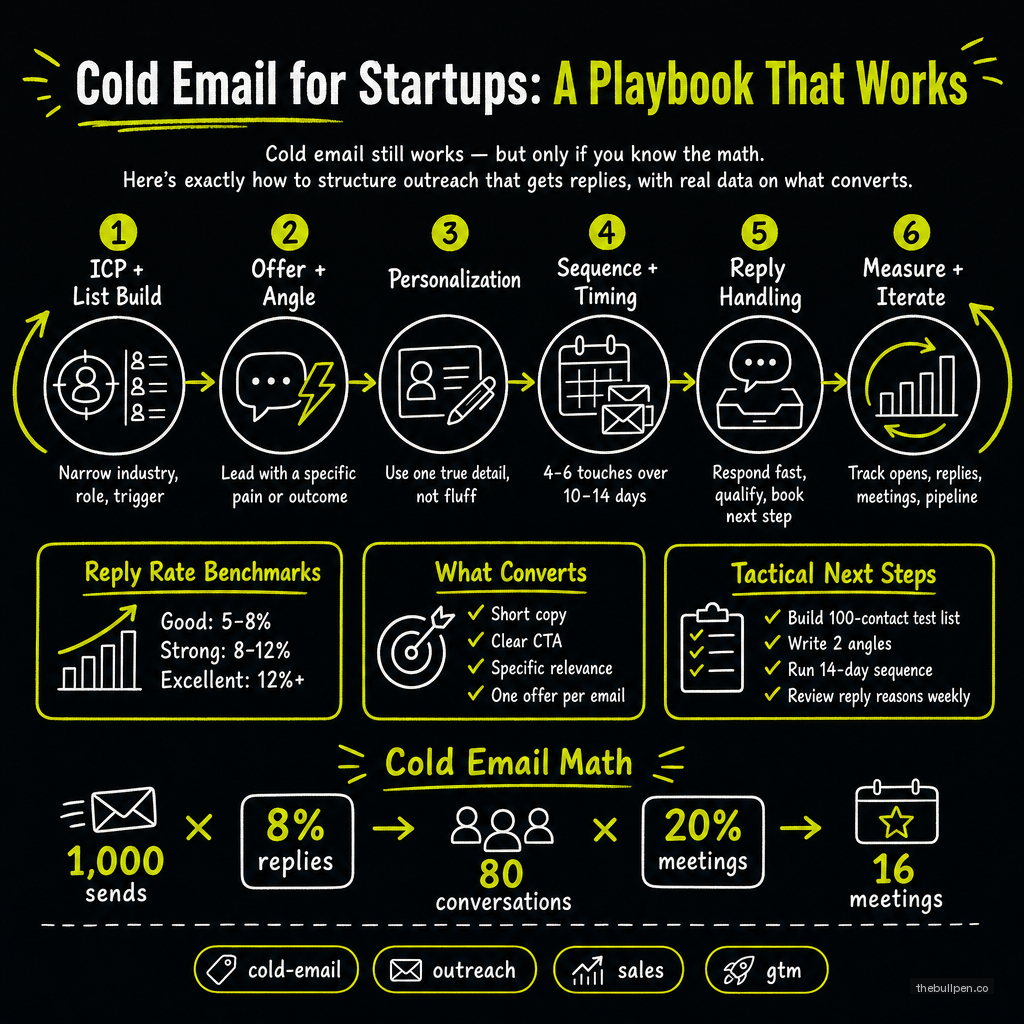
Everyone says cold email is dead. Then you talk to the founders who are actually closing deals, and they tell you it's their highest-converting channel.
Cold email isn't dead. Mass-blasted, templated, spray-and-pray cold email is dead. But personalized, research-backed, value-first cold outreach is very much alive — and it's the most reliable way for an early-stage startup to generate pipeline without spending money on ads.
The math is straightforward. At a 1 to 3 percent reply rate and a 20 to 30 percent close rate from meetings, you need roughly 200 to 500 cold touches to land your first customer. That sounds like a lot until you realize that 500 personalized emails can be sent in a week by one founder. The cost is time. The return is a direct line to your first paying customers.
Related: How to Find and Close Your First 100 Customers
The Structure That Works
After reading thousands of cold emails and tracking what actually converts, the pattern is consistent across industries and deal sizes.
The subject line (3 words). Short subject lines outperform long ones. Personalization in the subject line improves open rates by 20 to 30 percent. The best format is a reference to something specific about the prospect: "{Company} + {topic}." Avoid words like "introduction," "opportunity," or "partnership" — they trigger spam filters and signal generic outreach.
The first sentence (1 line). State who you are and why you're emailing. Not "I'm the CEO of X, a Y platform that helps Z." That's about you. Instead: "I've been following your work on {specific project} and wanted to reach out." That's about them. The first sentence is the only one that determines whether they read the second.
The value proposition (2-3 lines). Explain what you do in terms of the problem you solve for them specifically. Reference their industry, their role, or their company. "We helped {similar company} reduce onboarding time by 40 percent" is more compelling than "We're a SaaS platform for streamlining operations."
The social proof (1 line). If you have relevant customers, logos, or traction, mention it. A single recognizable name is worth a paragraph of description.
The call to action (1 line). Ask for something specific and low-friction. "Would you be open to a 15-minute call on Thursday?" beats "Let me know if you're interested." A specific time and day doubles reply rates.
The signature (1 line). Name, title, company. That's it. No phone numbers, no links to calendly, no tagline. The email should take 10 seconds to read and 10 seconds to reply to.
| Component | Length | Goal |
|---|---|---|
| Subject line | 3–6 words | Get opened |
| First sentence | 1 line | Prove relevance |
| Value prop | 2–3 lines | Spark interest |
| Social proof | 1 line | Build credibility |
| Call to action | 1 line | Get a response |
| Signature | 1 line | Be findable |
The Mistakes That Kill Reply Rates
Sending without research. A generic email sent to a list of 500 prospects gets a 0.5 percent reply rate. A personalized email sent to 50 well-researched prospects gets 5 to 10 percent. The research takes 5 minutes per prospect. That's 4 hours of work for 50 high-quality emails. It's worth it.
Writing too much. Cold emails should be 5 sentences max. If your email requires scrolling, you've already lost. The goal is to start a conversation, not to close a deal in one message.
Asking for too much. "Can you hop on a call?" is easier to say yes to than "Can you review our product and give feedback?" and much easier than "Would you be interested in a pilot?" Match the ask to the relationship. A first email gets a first meeting, not a commitment.
Following up too soon or not at all. Most sales happen between the second and fifth touch. Send a follow-up 3 to 5 days after the first email. A third touch a week later. A fourth two weeks after that. The sequence ends when they reply or after 5 touches. Most people who respond do so on the third or fourth attempt.
Related: Sales Playbooks for Early-Stage Startups
The Follow-Up Sequence
The first email gets opened maybe 40 to 50 percent of the time. The second gets opened by a different group — people who saw the first one but weren't ready to reply. The third catches people who were traveling or busy.
Each follow-up should add value, not just say "following up." Share a relevant article. Mention a new feature. Reference something they posted on LinkedIn. The follow-up should feel like a new reason to reply, not a reminder that they ignored you.
After five touches with no response, move on. The people who haven't replied to five emails are not going to reply to six. Your time is better spent on fresh prospects.
Tools and Systems
Don't automate until you've manually proven that the outreach works. Send the first 50 emails by hand. Track reply rates, meeting rates, and close rates. Once you know the numbers, you can scale with tools that automate personalization and sequencing.
Most early-stage founders over-invest in tools and under-invest in personalization. A spreadsheet and a Gmail account will outperform a $200/month sales engagement platform if you're writing emails that sound like they came from a real person.
Data references: Close.com cold email benchmarks (1-3% reply rate, 200-500 touches per first deal), SaaStr / Jason Lemkin (outreach patterns, follow-up sequences), HubSpot email engagement data (subject line length impact, open rates by personalization).
Ready to test your pitch before you send the cold email? Upload your deck to Bullpen for a free AI-powered evaluation across 7 investor categories.
Get weekly pitch tips
One email a week. Actionable advice for founders.
Get a GTM pitch evaluation in 2 minutes. Try now →