Content Marketing for Early-Stage Startups
Content marketing is the slowest growth channel. That's exactly why it's the best bet for founders with no budget and no audience. Here's how to build a content engine from zero, with real numbers and real examples.
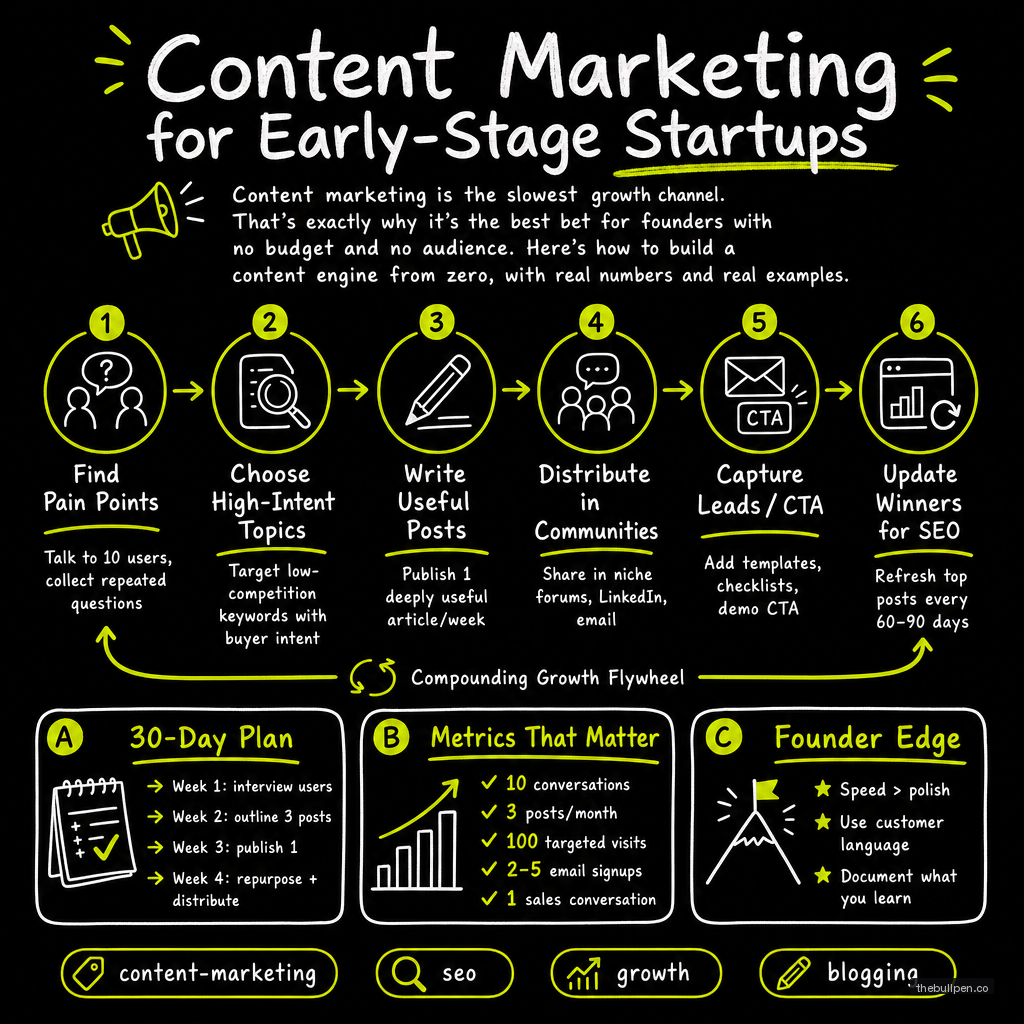
Content marketing has a timing problem. Every guide tells you to start a blog, write consistently, and wait. Six months of posting into silence before the first organic search visitor arrives. Most startup blogs generate more noise than leads, and the ones which succeeded did so because of specific structural advantages most founders don't have.
Content marketing is the only channel that compounds. Paid ads stop working the moment you stop paying. Outbound stops working the moment your list goes cold. A well-written article keeps producing traffic two years after you wrote it, and every article you add increases the value of every article before it. If you're pre-seed with no budget and no audience, content marketing isn't optional — it's the only channel that can eventually deliver meaningful results without capital.
Related: Startup GTM Strategy: A Complete Guide
What Actually Worked: The Zero-Budget Content Playbook
The startup content success stories you've heard — Buffer, GrooveHQ, Intercom, Webflow — all followed the same pattern. They started with zero budget, zero audience, and a single founder writing one post per week for 12 to 18 months before anything happened.
| Startup | Strategy | Traffic Milestone | How Long It Took |
|---|---|---|---|
| Buffer | Transparency blog (salaries, revenue, metrics) | 100K+ monthly readers | 12 months |
| GrooveHQ | Weekly "transparent journey" posts | 500K+ monthly visitors | 18 months |
| Backlinko | In-depth SEO guides | 100K+ monthly visitors | 12 months |
| Webflow | Free educational courses (Webflow University) | 2M+ monthly visits | 3 years |
Buffer's story is the cleanest example. In 2010, Joel Gascoigne started writing about what his company was doing — salaries, revenue numbers, growth experiments — long before anyone cared. The transparency was the hook. People shared the posts because they'd never seen a startup openly publish its numbers. By the end of year one, Buffer's blog was driving 100,000 unique visitors per month. Not one paid dollar was spent.
The throughline across all four: they wrote about things only they could write. Buffer wrote transparent metrics because they were the only ones living those metrics. Webflow taught design because they had the domain authority to teach it. Backlinko reverse-engineered Google rankings because Brian Dean had spent years doing exactly that. None of them tried to write generic startup advice. Generic advice has an infinite supply. Your specific experience does not.
Related: Product-Led Growth vs Sales-Led: Which Is Right for Your Startup?
The Five Content Types That Work at Zero Budget
Not all content is created equal for a startup with no audience. The data from successful zero-budget content engines points to five types that outperform everything else.
Founder narratives. The most effective content an early-stage startup can produce is the honest story of building the company. People follow people, not products. A post titled "How I Went from Zero to $10K MRR in 8 Months" gets shared because it's a story, not a sales pitch. It also requires zero budget, zero research, and zero design — just honesty and a willingness to be vulnerable.
Transparent metrics. Buffer's salary transparency post got them on the front page of every major news site. GrooveHQ publishing their monthly revenue numbers turned a small customer support tool into a business case study. The mechanism is simple: people love seeing numbers they're normally not supposed to see. If you're willing to publish your revenue, churn, or conversion rates, you get attention that a generic "5 Tips for Better Customer Support" post never will.
Contrarian hot takes. A post arguing against conventional wisdom gets more backlinks, more comments, and more social shares than a post agreeing with everyone. "Why You Should NOT Build a Minimum Viable Product" or "The SaaS Metrics Everyone Tracks Are Wrong" spark debates. Debates drive distribution. The threshold for this approach is low: pick a piece of common advice you disagree with, explain why, and back it with your experience.
How-to guides. These are the only content type on this list built for organic search. A detailed guide on "How to Validate a Startup Idea in 7 Days" will produce traffic for years after you write it. The downsides: it takes 6-12 months for SEO to deliver, and the first 10 posts you write won't rank for anything. The upside: on month 14, one of them will be in position three for a keyword that sends 500 visitors per month forever.
Original data. If you have access to data others don't — customer feedback, cohort metrics, A/B test results — publish it. Original data gets cited, and citations produce backlinks, and backlinks produce domain authority, and domain authority makes everything else you write rank higher. This is the slowest play and the highest long-term value.
Related: SEO for Startups: How to Rank Before You Have Domain Authority
Distribution Is the Real Work
If you spend 10 hours writing a post and then just publish it on your blog, you've wasted 10 hours.
The distribution-to-creation ratio for successful content marketers is roughly 80/20 — 80% of your effort goes into getting the piece in front of people, 20% into writing it. For every hour you spend writing, you should spend four hours on distribution.
| Distribution Channel | Typical Reach per Post | Best For |
|---|---|---|
| Hacker News | 5K-50K if hits front page | Technical audiences, developer tools |
| Reddit (r/startups, r/SaaS) | 1K-10K targeted visitors | Startup founders, early adopters |
| LinkedIn (personal profile) | 500-5K views per post | B2B, professional audiences |
| Cross-post to Medium | 10-30% of original traffic | Discovery outside your domain |
| Email newsletter | 10-30% open rate, 2-5% CTR | Your most engaged readers |
| Guest blogging | 200-2K visitors per post | Niche industry backlinks |
| Community posting (Indie Hackers, Slack groups) | 100-500 per share | Engaged, relevant audience |
The practical workflow for a zero-budget founder looks like this: write the post on Monday. Tuesday, post it to Hacker News and the relevant subreddit. Wednesday, cross-post a slightly edited version to Medium and LinkedIn. Thursday, send it to your email list (even if that list is 50 people). Friday, answer a Quora question and drop a link. The weekend, respond to every comment everywhere.
GrooveHQ published 15+ distribution channels per article. Buffer tracked which channels produced signups and doubled down on those. Neither assumed people would find the content on their own.
The Real Numbers: What to Expect
| Timeframe | Monthly Visitors | What's Happening |
|---|---|---|
| Month 1-3 | 0-500 | No search traffic yet. Every visit is from distribution |
| Month 4-6 | 500-2,000 | First organic search visitors. Distribution still driving most traffic |
| Month 6-12 | 2,000-10,000 | Compound growth. Older posts accumulate search traffic |
| Month 12-18 | 10K-100K | SEO becomes primary channel. Email list compounds |
| Month 18+ | 100K+ | Content engine fully running. Paid channels optional |
The average conversion rate from a blog reader to a free trial is 0.5-2%. At 1% conversion, 2,000 monthly visitors produce 20 trials per month. If your product converts 10% of trials to paying customers, that's two new customers per month from content. Not life-changing. But at 100,000 visitors per month, that's 200 trials and 20 customers per month — from zero budget.
Most founders quit in months 1-3 because the numbers are demoralizing. The ones who don't quit are the ones who get the compounding curve.
Related: Building an Email List from Zero: Startup Email Marketing
When Content Beats Paid
There's a simple test for whether content marketing is your best channel. If you answer yes to any of these, content should be your primary acquisition strategy:
- You have zero budget for paid ads (most pre-seed startups)
- Your product has a long sales cycle (B2B SaaS, enterprise tools)
- Your audience is niche (paid targeting is expensive and imprecise)
- You need to build trust before people will buy (financial tools, security products)
- There are low-competition keywords with high purchase intent in your space
This describes most early-stage B2B startups. It describes Bullpen. It describes most companies that win with content.
The alternative — paid acquisition at early stage — usually means spending $2,000 per month on Google Ads to acquire 5 customers at a $400 CAC, when you only have $50,000 in the bank and need the product to work first. It's not that paid doesn't work. It's that early-stage content doesn't require spend, and the results compound in a way paid never will.
The Minimum Viable Content Engine
If you can commit to one thing: write one substantive post per week for 12 months. Not 500-word fluff — 2,000 words of something only you can write. Distribute it to 10 channels. Build an email list from day one. Track which posts produce actual signups, not just vanity traffic.
Twelve months of that produces a library of 50 articles, a growing monthly traffic base, an email list of people who chose to hear from you, and a compound engine that gets stronger every week. Twelve months of doing nothing but building features produces a better product and nobody who knows it exists.
If you have zero budget and zero audience, content marketing is not your second choice. It's your first.
Published on the Bullpen Blog. New articles every day at 9 AM UTC.
Get weekly pitch tips
One email a week. Actionable advice for founders.
Get a GTM pitch evaluation in 2 minutes. Try now →