Product-Led Growth vs Sales-Led: Which Is Right for You?
A framework for choosing your GTM model — when PLG works, when it doesn't, and how to avoid the expensive mistake of picking the wrong one.
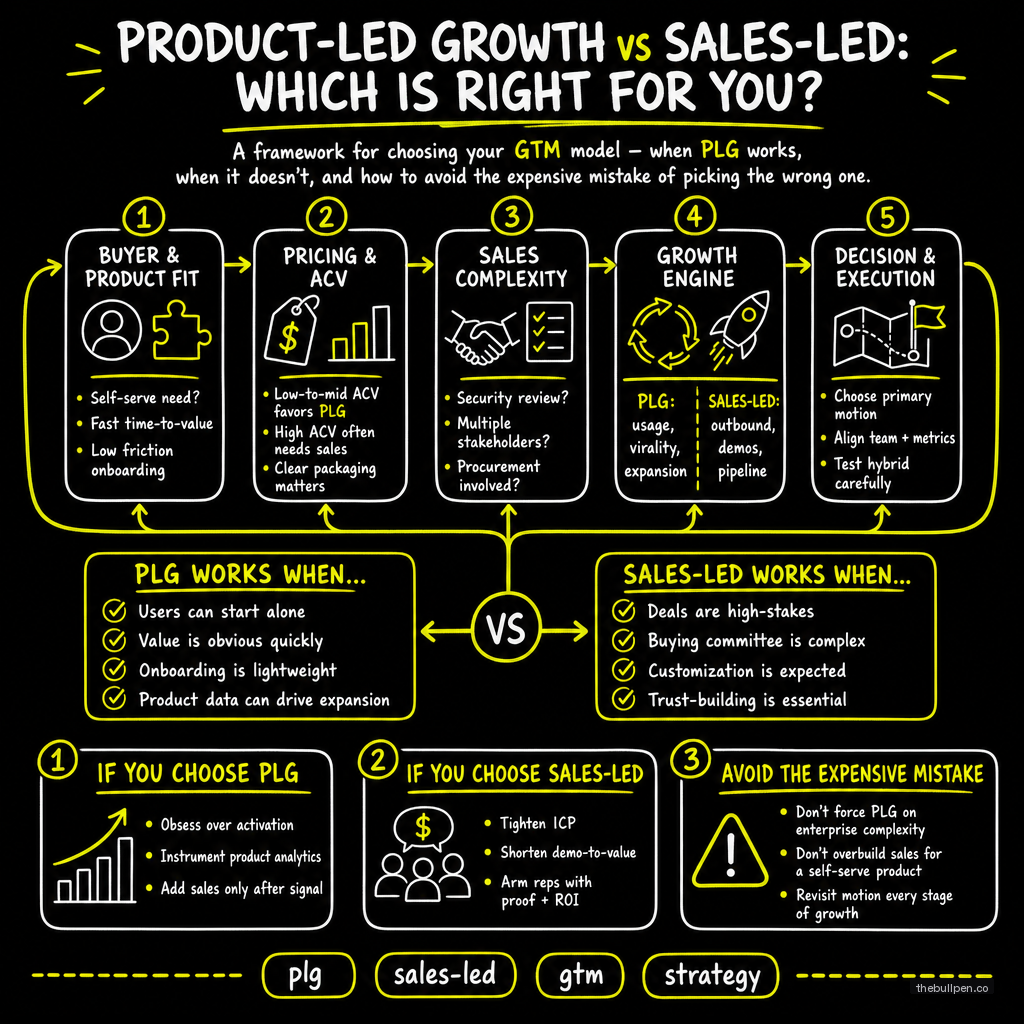
The most expensive mistake early-stage founders make isn't building the wrong product. It's choosing the wrong GTM model for the product they built.
I have watched founders burn eighteen months and two million dollars trying to make PLG work for a product that requires a sales demo to understand. I have also watched founders hire a six-person sales team before they had a product that could be sold without a founder in the room, then run out of money before any of those reps hit quota. Both mistakes kill startups. Both are preventable with a single honest answer to one question: does your product sell itself, or does someone have to sell it?
Related: Startup GTM Strategy: Getting Your First 100 Customers, SaaS Free Trial Strategy (Coming soon — October 20, 2026)
The Three Variables That Determine Your Model
Every product has three characteristics that determine which GTM model fits. Ignore any of them and you will pick wrong.
Time to value. How long between a user first touching your product and getting meaningful value from it? Slack delivered value in under three minutes the first time a user sent a message. Dropbox delivered value in under sixty seconds from install. Notion took longer but hooked users through the sheer pleasure of using it. These are PLG products because the product itself is the sales pitch. Contrast that with a data infrastructure platform where the first meaningful query takes a week of setup. No one is going to self-serve their way through that. That product needs a sales conversation before the first line of code is written.
Decision complexity. How many people need to agree before someone pays you? PLG works when one person can make the buying decision with a credit card. Slack spread through teams because one person started using it and invited their colleagues. Zoom dominated because one person could host a free meeting and the experience was better than anything else available. When the buying decision requires a procurement process, legal review, or a committee of seven stakeholders, the product cannot sell itself. Someone needs to navigate that process for the customer.
Unit economics at scale. Can you acquire customers for less than they pay you, and does that math hold at volume? PLG companies like Calendly and Canva operate with CAC ratios below 0.3x because product virality and organic search do most of the work. Sales-led companies like Salesforce and Workday operate with CAC ratios above 1.0x because every deal requires expensive human effort. Neither is right or wrong. The risk is choosing PLG for a product whose actual CAC math requires a sales team, or choosing sales-led for a product whose best acquisition channel is viral.
Related: SaaS Pricing Strategy, Startup Metrics That Matter
When PLG Wins
The products that succeed with PLG share a pattern that is surprisingly consistent across every successful example of the last decade.
The product is simple enough that a new user can understand it without instruction. The onboarding flow takes under five minutes. The value of the product increases with the number of users in the same organization. And the pricing model aligns with usage rather than requiring a contract negotiation.
Slack grew from zero to one billion dollars in ARR in roughly six years without a traditional sales force for most of that period. Their growth was driven by user invitations. Every message sent inside Slack was a sales conversation happening without a salesperson. Dropbox grew to one hundred million users before hiring their first enterprise sales rep. Zoom went public with a majority of revenue coming from self-serve and free-to-paid conversion. Calendly has operated with barely any outbound sales team for its entire history, growing on the back of a product so simple that scheduling a meeting is the entire onboarding flow.
These companies succeeded not because they had better products than their competitors but because their products had the right characteristics for PLG. The product could be evaluated without a demo. The value was immediately visible. And the virality loop was built into the core experience, not bolted on as an afterthought.
The PLG decision works when the answer to this question is yes: will a user who discovers your product through a friend, a search result, or an app store listing, sign up, get value, and invite someone else, all without talking to anyone from your company? If the answer to any part of that chain is no, PLG will fail.
Related: Product-Led Growth Playbook for SaaS
When Sales-Led Wins
Sales-led growth gets a bad reputation in the startup community because it sounds less elegant than growth through product virality. But for the right product, it is the only viable path.
Enterprise software with high ACV, long implementation timelines, and multiple stakeholders cannot be sold through a free trial. No one at a Fortune 500 company is going to self-serve their way onto a new data pipeline platform. No hospital system is going to evaluate a new electronic health records system through a freemium tier. These products require a sales process because the buying process requires it.
Salesforce reached thirty billion dollars in ARR through a sales-led motion that involved thousands of reps, elaborate demo environments, and a partner ecosystem. Workday sells HR software with an average deal size above five hundred thousand dollars per year. There is no world in which either of these companies could have grown through self-serve alone.
The sales-led decision works when the product requires implementation support, when the average deal size is above twenty thousand dollars annually, when the purchasing decision involves multiple stakeholders with different priorities, and when the sales cycle includes procurement and legal review. In those conditions, the cost of a sales team is not overhead. It is the cost of doing business.
Related: Sales Playbooks for Early-Stage Startups
The Hybrid Trap
Most companies end up with a hybrid model. They start PLG, add sales later for larger deals. Or they start sales-led, add self-serve for smaller customers.
OpenView's PLG research has tracked this pattern extensively. Their data shows that PLG companies that add a sales motion see an average of thirty percent higher revenue growth than pure PLG companies. But the timing of that transition is critical. Add sales too early and you burden the company with fixed costs before the product is ready to convert. Add sales too late and you leave enterprise revenue on the table while competitors with better enterprise motions eat your lunch.
The hybrid model is the destination for most successful SaaS companies. The question is not whether you will end up there, but when and how you make the transition. The signal that it is time to add a sales team is not hitting a revenue number. It is when you have product-qualified leads requesting sales conversations that you cannot handle through self-serve. When users are asking to buy before you have someone to sell to them, that is the signal. Before that signal arrives, a sales team is a cost center, not a growth engine.
The Founder's Decision
Here is the framework that matters more than any GTM model diagram.
Write down the answers to three questions. Does a new user get value from your product in under five minutes without help? Can one person in an organization make the decision to pay for it? Is the marginal cost of serving one more user near zero?
If the answer to all three is yes, you should start with PLG. If the answer to any of them is no, you should start with sales-led. If you are uncertain about any of them, you should start with PLG but build the product in a way that preserves the option to add a sales motion later. That means instrumenting for product-qualified leads, keeping pricing simple enough that a sales team can negotiate within bounds, and never building a feature that requires a demo to understand.
The wrong GTM model will kill you slower than building the wrong product, but it will kill you just as surely. The difference is that changing your GTM model is harder than changing your product. You can rewrite code. You cannot unhire a sales team or rebuild a decade of brand perception as a self-serve product.
Data sources: OpenView's Product-Led Growth research reports, SaaStr annual surveys on sales-led metrics, public investor letters from Slack and Zoom, and revenue data from Salesforce, Dropbox, and Calendly public filings.
Ready to see how investors evaluate your GTM strategy? Upload your pitch deck to Bullpen for a free evaluation across 7 categories including GTM execution.
Get weekly pitch tips
One email a week. Actionable advice for founders.
Get a GTM pitch evaluation in 2 minutes. Try now →