Growth Loops for SaaS: A Complete Taxonomy
A growth loop is a self-reinforcing engine where output feeds back into input. Unlike funnels, loops compound over time. Here's a taxonomy of every major SaaS growth loop and how to build one.
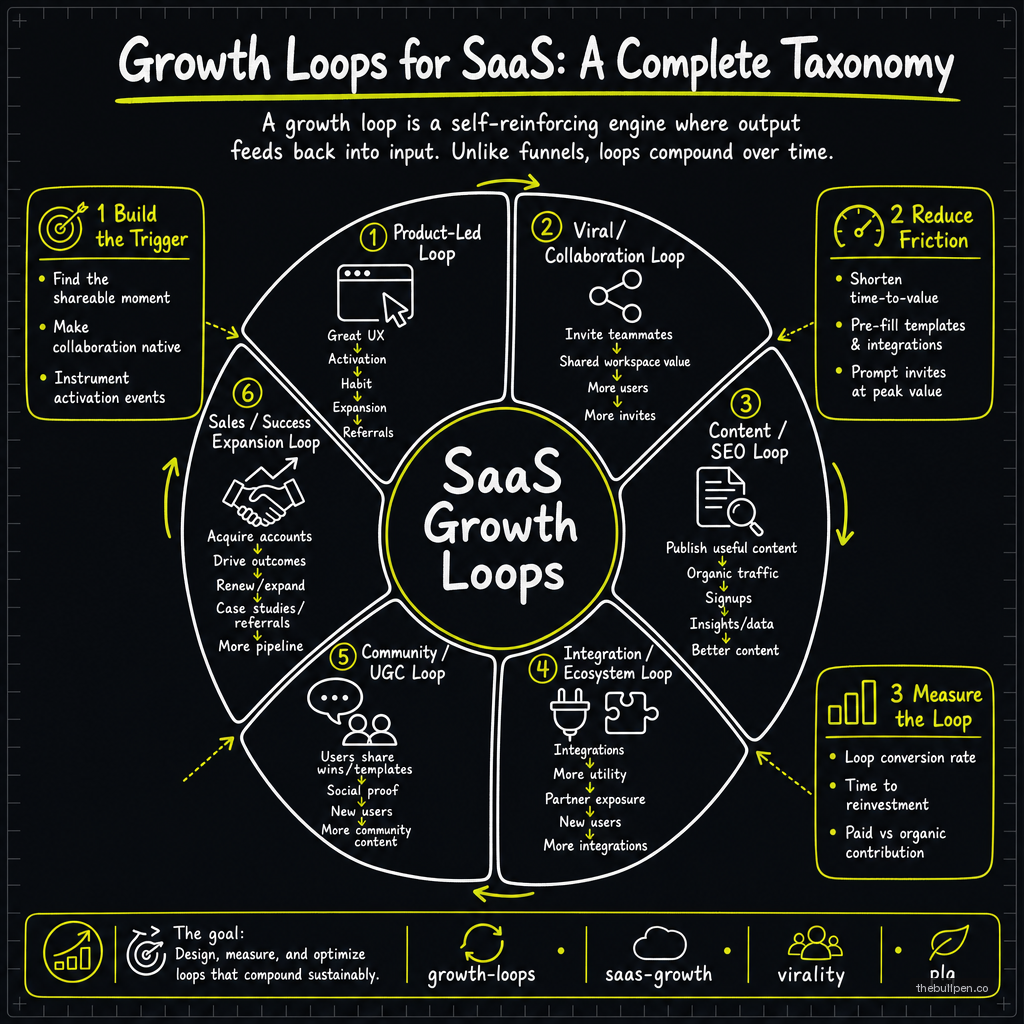
A growth funnel has a beginning and an end. Users enter at the top, flow through conversion stages, and either become customers or drop off. When the funnel runs dry, you need more users at the top.
A growth loop is different. The output of one cycle becomes the input for the next. Every user who goes through the loop has the potential to bring in more users. This is why loops compound — each cycle creates more energy than it consumes.
The difference between a company with a growth funnel and a company with a growth loop is the difference between pouring water into a bucket and building a well. Buckets run dry. Wells keep producing.
Related: Product-Led Growth vs Sales-Led: Which Is Right for Your Startup?
The Five Loop Types
Every SaaS growth loop falls into one of five categories. Understanding which one fits your product determines your entire growth strategy.
Viral loops. Users invite other users as a natural part of using the product. Slack spreads because teams invite colleagues to channels. Zoom spreads because a host sends a link to participants. The invite is not a marketing campaign — it's a feature of the product. Viral loops work best for products with inherent network effects and multi-user value.
Content loops. Users create content that attracts more users, who then create more content. Webflow's community shares templates that bring in new designers who create more templates. Notion's template gallery works the same way. The content created by one user becomes the acquisition channel for the next.
Sales loops. One closed deal generates referrals, case studies, or social proof that closes the next deal. HubSpot's customer case studies became their primary acquisition asset. Each new customer adds to a library of proof that makes the next sale easier.
SEO loops. Content you publish today attracts backlinks and domain authority, which makes future content rank higher, which attracts more backlinks. Zapier's app directory pages accumulated links over years, creating a moat that no competitor could quickly replicate.
Community loops. A user joins, gets value from the community, contributes, and the community's value grows for the next user. Stack Overflow's model: each answered question makes the site more valuable for the next person searching for the same answer.
| Loop Type | Example | Input | Output | Compounds? |
|---|---|---|---|---|
| Viral | Slack, Zoom | Invite sent | New users who send invites | Yes — fast |
| Content | Webflow, Notion | Template created | Users who create templates | Yes — medium |
| Sales | HubSpot | Closed deal | Case study → more deals | Yes — slow |
| SEO | Zapier | Published page | Search traffic → backlinks | Yes — very slow |
| Community | Stack Overflow | Answered question | Better site → more answers | Yes — medium |
How to Build One
The most common mistake founders make is trying to build a viral loop before they have product-market fit. Viral loops amplify engagement — they don't create it. If users don't love your product enough to invite others, no amount of "share with friends" prompts will fix that.
The right approach is to identify a behavior that some users already do naturally and make it easier. If you notice users sharing screenshots of your product on Twitter, build a share feature. If they copy their workspace link to share with colleagues, add a one-click invite.
Once you have a loop running, the optimization is relentless. Improve the conversion rate at every step. Reduce friction in the invite flow. Test different incentives. Track the loop cycle time — how long it takes for one full turn of the loop.
Related: Community-Led Growth: Building a Movement
Measuring Loops
Measure loop velocity: how fast can new users be acquired through the loop, and how many new users does each existing user generate? If a loop generates 1.1 new users per existing user, it compounds. If it generates 0.9, it decays.
Track the loop's contribution to total acquisition. A viral loop driving 5% of signups is nice. A viral loop driving 50% is a growth engine. Most companies operate multiple loops simultaneously — the best ones know which loop drives the most growth and optimize it before touching the others.
When Loops Don't Work
Not every product can support a growth loop. Enterprise products with long sales cycles and high ACVs rarely have natural shareability. B2B backend infrastructure tools have no visible output for users to share. If your product is used alone, in secret, or only by specialists, a growth loop may not be the right strategy.
But even products without organic loops can create them. Build a template library. Publish original data that journalists will cite. Create a comparison page that generates SEO traffic. Make your API public so developers build integrations that draw users. If there's no natural loop, build an artificial one.
Published on the Bullpen Blog. New articles every day at 9 AM UTC.
Get weekly pitch tips
One email a week. Actionable advice for founders.
Get a GTM pitch evaluation in 2 minutes. Try now →