Community-Led Growth: Building a Movement
Community-led growth is the most durable GTM motion for B2B startups — but only if you build it for the right reasons. Here's how community-driven companies like Notion, Webflow, and Figma turned users into evangelists.
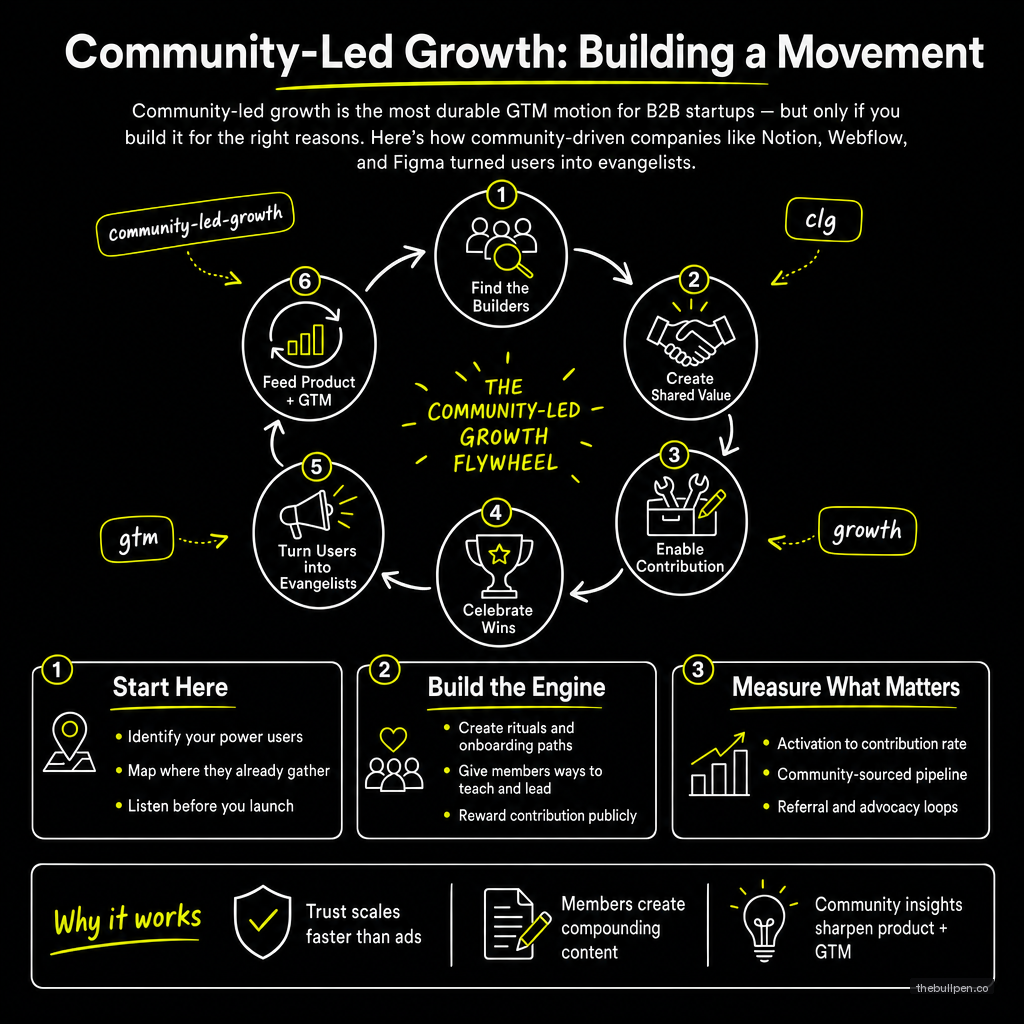
Community-led growth is the most overused and misunderstood GTM term of the last five years. Every startup says they're building a community. Most are running a Slack group with 200 members who never talk to each other.
Real community-led growth is something different. It's a growth model where your users become your distribution channel — not because you asked them to share, but because the product and the community around it make sharing a natural byproduct of use.
Notion didn't become a $10B company through paid acquisition. Their users built template galleries, shared workspaces, and evangelized the product to their teams because using Notion made them feel like part of something bigger than a tool. Webflow's community of designers and developers shares work, teaches each other, and advocates for the platform because the community adds value that the product alone can't.
Related: Product-Led Growth vs Sales-Led: Which Is Right for Your Startup?
The Three Pillars of CLG
Community-led growth works when three conditions are met.
The product has inherent shareability. Notion workspaces are shareable by nature — every page has a URL, every template can be duplicated. Figma files are designed for collaboration. Webflow sites can be published and remixed. The product's architecture makes community participation feel effortless, not like a marketing campaign.
Users derive status from participation. The most successful communities don't rely on altruism. They rely on status. On Product Hunt, launching a product and earning upvotes is a status game. On GitHub, contributing to a popular repository signals expertise. On Figma, publishing a well-designed component that gets thousands of copies builds a designer's reputation. Status is the engine that keeps the community running without constant intervention.
The community creates value that scales independently. A good community generates content, support, and network effects that compound over time. Stack Overflow's content is entirely user-generated. Notion's template gallery is built by users. Webflow's educational content comes partly from its community. When the community creates more value than the company does, CLG is working.
How to Build It
The most common mistake founders make is trying to manufacture a community before they have product-market fit. A community without a core product that people love is an empty room. The community amplifies the product — it doesn't replace the need for one.
The right sequence is: build a product that a small number of people love deeply. Those people will organically gather — on Twitter, in Slack, on Reddit. When you see them gathering, join the conversation. Listen to what they're asking for. Then build the infrastructure to support them.
Phase 1: Organic congregation. Don't start a Slack group. Find where your users are already talking about your product — Twitter threads, subreddits, existing Slack communities. Participate genuinely. Answer questions. Share insights. Build relationships one at a time.
Phase 2: Structured container. When the organic conversation reaches a critical mass (50-100 active participants), create a dedicated space. A Discord server, a Circle community, or even a well-tagged Twitter list. The key is that the community should feel like it existed before the container — the container formalizes what's already happening, not starts something new.
Phase 3: User-generated value. Encourage members to create and share. Templates, tutorials, case studies, integrations. Feature the best examples prominently. Make contributors visible. The moment a user creates something that another user finds valuable, the community starts compounding.
| Phase | Timeline | Metric | Signal to Move |
|---|---|---|---|
| Organic congregation | 1-3 months | Mentions in the wild | 50+ active conversations about your product |
| Structured container | 3-6 months | Community size | 100+ engaged members contributing regularly |
| User-generated value | 6-18 months | Content created by users | Templates, tutorials, or integrations created by others |
Examples That Worked
Figma. Figma's community grew from a simple insight: design files are collaborative by default. Every Figma file has a shareable link. Designers started sharing their work, then their components, then their full design systems. Figma built the Community tab — a marketplace for user-created plugins, templates, and design systems — which became a distribution engine. Designers discovered new tools through the community and brought them back to their teams.
Webflow. Webflow's community started with a forum where users helped each other with HTML, CSS, and the platform's nuances. The company invested in educational content — Webflow University — partly created by community members. Meetups organized by users spread the platform organically. By the time Webflow raised its Series A, the community was generating more leads than the sales team.
Notion. Notion's community grew through templates. Users built workspaces for project management, personal knowledge management, and team wikis, then shared them publicly. Each shared template was both a showcase of what Notion could do and a recruitment tool — someone discovering Notion through a template was already evaluating the product through a use case relevant to them.
Related: Startup GTM Strategy: A Complete Guide
Measuring What Matters
Community-led growth dies when you optimize for the wrong metrics. Member count and message volume are vanity metrics. The metrics that matter:
- Active contributors. How many members created something of value this month (a post, a template, a reply that helped someone)?
- Community-sourced leads. How many signups came through a referral from a community member or a shared community asset?
- Support deflection. How many support tickets are answered by the community before the company needs to intervene?
- User retention by community participation. Do community members retain at higher rates than non-members? (Almost always yes, if the community is healthy.)
The best community metric is the most obvious one: are people talking about your product to people who don't work for you? If the answer is yes at scale, you've built something real.
When Not to Do CLG
Community-led growth isn't right for every startup. It works best when the product is complex enough that users need help from each other, visible enough that sharing demonstrates skill, and sticky enough that the community compounds over years.
It doesn't work for simple products where there's nothing to teach or share, products with no inherent shareability (most enterprise backend tools), or startups that need rapid revenue and can't wait 12-18 months for a community to mature.
If your product doesn't naturally create a reason for users to gather, community-led growth is the wrong playbook. Pick up content marketing or outbound sales instead.
Published on the Bullpen Blog. New articles every day at 9 AM UTC.
Get weekly pitch tips
One email a week. Actionable advice for founders.
Get a GTM pitch evaluation in 2 minutes. Try now →