Startup Pricing Strategy: A Framework for Founders
Pricing is the most leveraged decision a founder makes. Here's how to set your first prices, when to raise them, and why most startups leave 40-50% of revenue on the table.
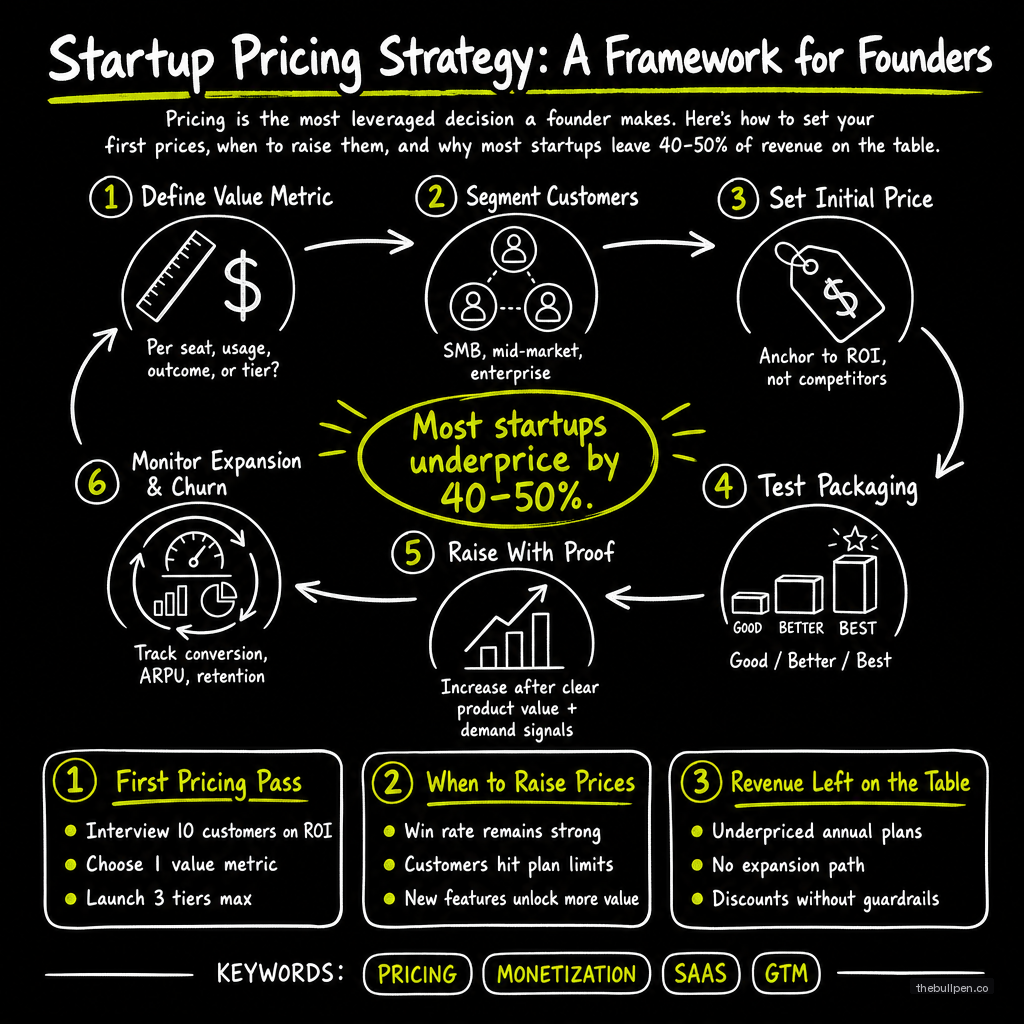
Pricing is the most leveraged decision you will make as a founder. It requires no engineering, no design, no marketing spend, and no sales effort. All it takes is changing a number, and the impact on your revenue is immediate and permanent.
A 20% price increase flows directly to your bottom line. If you have 100 customers paying $100 a month, raising your price to $120 adds $2,000 a month to your revenue — $24,000 a year — without acquiring a single new customer. Most founders will spend months building a feature that adds less value than a 20% price increase would deliver in an afternoon.
Yet pricing is the decision that founders spend the least time on. They set a number based on a competitor's pricing page, or what feels reasonable, or what they'd be willing to pay themselves. Then they never revisit it.
The research from First Round Capital and SaaStr is consistent: most founders under-price by 40 to 50 percent. They leave money on the table because they're afraid that raising prices will kill demand. In reality, demand is much less price-sensitive than founders assume, and the customers who leave over price are usually the ones you want to lose anyway.
Related: Startup GTM Strategy: How to Launch and Get Your First 100 Customers
The Three Pricing Models
Every SaaS pricing model falls into one of three categories, and the right one depends on your product and your customers.
Flat-rate pricing — one product, one price. This is the simplest model and the best for early-stage startups because it removes complexity from the buying decision. The downside is that you capture the same amount from heavy users and light users, leaving money on the table from your power users. Flat-rate works best when your product has a clear one-size-fits-all value proposition.
Tiered pricing — multiple plans at different price points (Basic, Pro, Enterprise). This is the most common model for SaaS because it captures more value from different customer segments. The key is to make the tier boundaries align with real differences in customer needs, not arbitrary feature counts. The best tiered models have a free or cheap entry point that captures the long tail, a mid-tier that captures most SMB customers, and an enterprise tier with custom pricing for large accounts.
Usage-based pricing — customers pay based on consumption (per seat, per API call, per storage). This aligns cost with value and can drive adoption, but it adds unpredictability for customers and complexity for you. The best approach is usually a hybrid: a base subscription plus usage overages. This gives customers predictability while capturing upside from heavy usage.
| Model | Best For | Risks |
|---|---|---|
| Flat-rate | Simple products, early-stage, one ICP | Leaves money on the table from power users |
| Tiered | Most B2B SaaS, multiple customer segments | Too many tiers confuse buyers |
| Usage-based | APIs, infrastructure, products with variable consumption | Unpredictable revenue, customer budgeting friction |
If you don't know which model to use, start with tiered. It's the most forgiving and the easiest to adjust as you learn.
The Pricing Process
Don't try to get pricing right on the first try. The goal is to get it close enough to start selling, then iterate based on feedback.
Step one: set a baseline. Pick a price that's higher than you're comfortable with. A good heuristic: whatever number you're thinking, add 50 percent. If you thought $100, start at $150. You can always lower it later (though you shouldn't need to). Raising prices later is much harder than lowering them, so start high.
Step two: run price tests. Try different price points with different customer segments. A/B test your pricing page. Run a promotion at a lower price to a small group and compare conversion rates. The data will tell you where the sweet spot is.
Step three: raise prices over time. Your pricing for customer 100 should be higher than your pricing for customer 10. As you add features, build brand awareness, and improve your product, your value increases. Your price should increase with it. Annual price increases of 10 to 20 percent are standard in SaaS and expected by customers.
Step four: grandfather existing customers. When you raise prices, don't increase the price for your existing customers. Grandfather them at their current rate. This keeps them happy while still capturing more value from new customers. You can eventually migrate them to the new pricing by offering value-add upgrades.
The Mistakes That Cost You Revenue
The most expensive pricing mistake is setting it and forgetting it. Founders who never revisit their pricing leave money on the table permanently.
The second most expensive mistake is pricing based on cost instead of value. Your costs don't determine what your product is worth to a customer. The value you deliver does. A product that saves a company $100,000 a year is worth $50,000 a year, regardless of what it costs you to build and run it. Price on value delivered, not on cost plus margin.
The third mistake is making pricing too complex. More than three tiers, add-ons that multiply into dozens of combinations, enterprise pricing that requires a call for every prospect — all of these kill conversion. The best pricing is simple. One to three tiers, clear differentiation between them, and a way to start using the product immediately without talking to a salesperson.
The fourth mistake is not charging enough for the first conversation. Many founders avoid discussing price until late in the sales cycle because they're afraid it will scare prospects away. The research says the opposite: early price discussion increases close rates by 15 percent because it signals confidence and lets the prospect self-qualify.
Related: How to Find and Close Your First 100 Customers
When to Raise Prices
There are three natural moments to raise prices. When you add significant new functionality, when you achieve product-market fit and have a backlog of demand, and when you're turning away customers because you can't serve them fast enough.
If none of those moments have arrived, you can still raise prices annually. A 10 to 15 percent annual increase for new customers is standard in SaaS. Your existing customers are grandfathered, so the only people affected are new prospects who don't know what your pricing was last year. The friction is minimal and the revenue impact compounds.
The best time to raise prices was yesterday. The second best time is today.
Data references: First Round Capital (under-pricing by 40-50%), SaaStr / Jason Lemkin (pricing frameworks, annual increases), Harvard Business Review (early price discussion increases close rates), ProfitWell (pricing optimization benchmarks).
Ready to see how your pricing strategy looks to investors? Upload your deck to Bullpen for a free AI-powered assessment across 7 investor categories.
Get weekly pitch tips
One email a week. Actionable advice for founders.
Get a GTM pitch evaluation in 2 minutes. Try now →