PR for Startups: Get Press Without a PR Agency
A tactical guide to DIY PR for bootstrapped founders — how to build relationships with journalists, write pitches that get opened, and earn coverage without spending a dime.
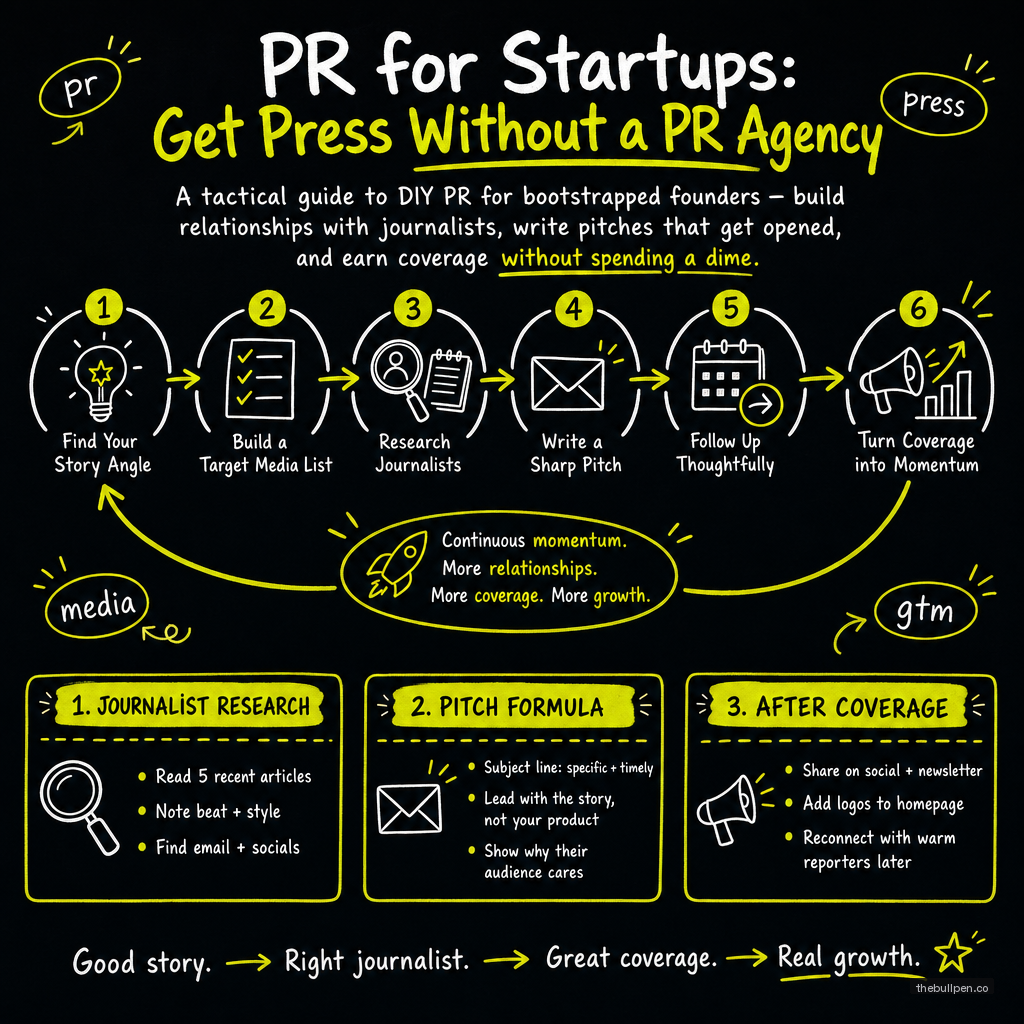
PR for Startups: Get Press Without a PR Agency
Retaining a PR agency costs $5,000–$15,000 per month — and most agencies will not even take a startup that has not raised a Series A. For bootstrapped founders, agency PR is not an option. It is a luxury good priced out of reach.
That is fine. Some of the best startup press ever written originated from a founder sitting alone at a kitchen table, sending a single well-crafted email. You do not need a PR agency. You need a system.
Finding the Right Journalists
Sending your press release to tips@techcrunch.com is not a strategy. That inbox contains thousands of unread submissions. Your email will be one of them, and it will stay unread.
You need a specific journalist who covers your beat. Here is how to find them.
Muck Rack is the best starting point. Search for keywords related to your space — "fintech," "developer tools," "remote work" — and Muck Rack returns a ranked list of journalists who have recently written about those topics. Their free tier shows the journalist's recent articles, social handles, and contact information.
Twitter (X) lists remain the most underrated PR tool. Create a private list of reporters who cover your space. Monitor what they tweet about, what stories they are working on, and which sources they cite. When you eventually pitch, your email will reference something they actually care about — because you have been watching.
Newsletter bylines are also revealing. Many tech journalists write their own newsletters on Substack or Beehiiv. Subscribe to a handful. You will learn their specific interests, writing style, and pet topics faster than any media bio can tell you.
| Finding Journalists | What to Look For |
|---|---|
| Muck Rack search | Beat keywords, recent article topics |
| Twitter/X lists | Current stories, source types, personality |
| Newsletter bylines | Long-form interests, editorial voice |
| Google News alerts | Who is covering competitors |
| LinkedIn browsing | Mutual connections for warm intros |
Related: The Cold Email Playbook for Startups
Writing a Pitch That Gets Opened
Journalists receive 100–200 pitches per day. The average email open time is about two seconds. If your subject line and first sentence do not deliver a clear value proposition, your email is deleted.
Subjects that work: specific, newsworthy, and personal. "New data on X shows Y trend affecting Z industry" beats "Introducing our new funding round." "Quick question about your recent piece on remote onboarding" beats "PR pitch inside."
Structure your email as follows:
- Subject line: 6–10 words. State the hook. Avoid ALL CAPS, exclamation points, and words like "revolutionary" or "disruptive."
- First sentence: Demonstrate that you read their work. "Saw your piece on supply chain AI for SMBs , relevant to something we just found."
- Second paragraph: The story, not the feature. What is happening in the world that makes your startup newsworthy? A trend, a data point, a shift in consumer behavior. Your startup is the example, not the story.
- Third paragraph: Social proof. Who uses your product? What results have you seen? How many customers? Journalists want evidence, not enthusiasm.
- Close: Call to action. "Want to chat this week? I can share the full data." Keep it low-pressure.
Do not attach files. Do not include your entire press kit. Do not follow up more than once.
Related: Content Marketing for Early-Stage Startups
Timing Is Half the Battle
When you send matters as much as what you send.
Tuesday, Wednesday, and Thursday mornings are the highest-open windows for journalist pitches. Monday is for planning. Friday is for deadline chaos and early departure.
Newsjacking is one of the most effective zero-cost PR tactics. A regulation change, a competitor's product launch, a viral industry controversy , any major event in your space creates a window of journalist attention. If you can offer commentary, data, or a contrary take within 24 hours of the news breaking, your odds of coverage multiply.
Embargoes are useful but overused by early-stage startups. If you have real data , a survey, a market report, product launch metrics , offering a 48-hour embargo to a small group of targeted journalists gives them time to write a thoughtful piece. If your news is "we raised a seed round," skip the embargo. Nobody is racing to break that story.
Building relationships before you need them is the ultimate timing advantage. Comment on a journalist's articles. Share their work on social media. Send them a useful data point from your analytics , even if it does not directly relate to your startup. When you eventually pitch your own story, you are no longer a stranger. You are a known, helpful source.
The HARO Approach
Help a Reporter Out (HARO) is a free service where journalists post queries seeking sources for upcoming stories. Founders can respond with relevant expertise or data. There is no cost, and the upside is significant: HARO-sourced quotes appear in major outlets like the Wall Street Journal, Forbes, and Inc. regularly.
The key is speed and relevance. HARO queries go out three times a day, and the first 5–10 responses get read. Respond within an hour of the query arriving. Keep your response to three sentences. Offer a specific data point or insight, not a general pitch about your company.
A single HARO-sourced mention is worth more than a month of cold pitching to the same outlet. Journalists come to you, they are already interested in your topic, and they need what you have.
Metrics That Actually Matter
Do not obsess over vanity metrics. A feature in a top-tier publication that does not mention your product or link to your site has near-zero business value. Measure what matters.
- Referral traffic from media coverage to your site. Did anyone click through?
- Signups or trials originating from the coverage. Use UTM parameters on every link.
- Backlinks for SEO. A mention from a high-DA outlet improves your search rankings. Screenshot the link, not the logo.
- Follow-up inbound interest. Did investors, partners, or talent reach out after the article ran?
- Share of voice. Of all the coverage in your category over a given period, what percentage mentions your startup?
One targeted mention in a niche publication your ideal customers actually read is worth ten generic mentions in TechCrunch.
Startups That Did PR Without Agencies
Calm (the meditation app) built massive press coverage before hiring any PR help by tying their product to cultural moments , post-election anxiety, New Year's resolution season, World Mental Health Day. They pitched journalists with data about user behavior spikes tied to current events.
Notion grew through organic creator-driven coverage. Rather than pitching their product directly, they seeded access to influential bloggers and YouTubers, who then wrote comparatives and tutorials. The press followed the community.
Gumroad bootstrapped its way to press by being transparent about revenue. Founder Sahil Lavingia published detailed financial breakdowns publicly. Journalists wrote about the numbers, and the press coverage wrote itself.
The common thread: these startups gave journalists a story , data, a trend, a controversy, a bold opinion , not a product pitch. They made the journalist's job easier. That is the only PR strategy that scales without a retainer.
Published on the Bullpen Blog. New articles every day at 9 AM UTC.
Get weekly pitch tips
One email a week. Actionable advice for founders.
Get a GTM pitch evaluation in 2 minutes. Try now →