Go-to-Market Slide: Why Social Media and Content Marketing Isn't a Plan
The GTM slide is where decks fall apart. Most founders list channels they hope will work instead of showing a plan that makes sense for their specific business. Here's how to build a GTM slide investors trust.
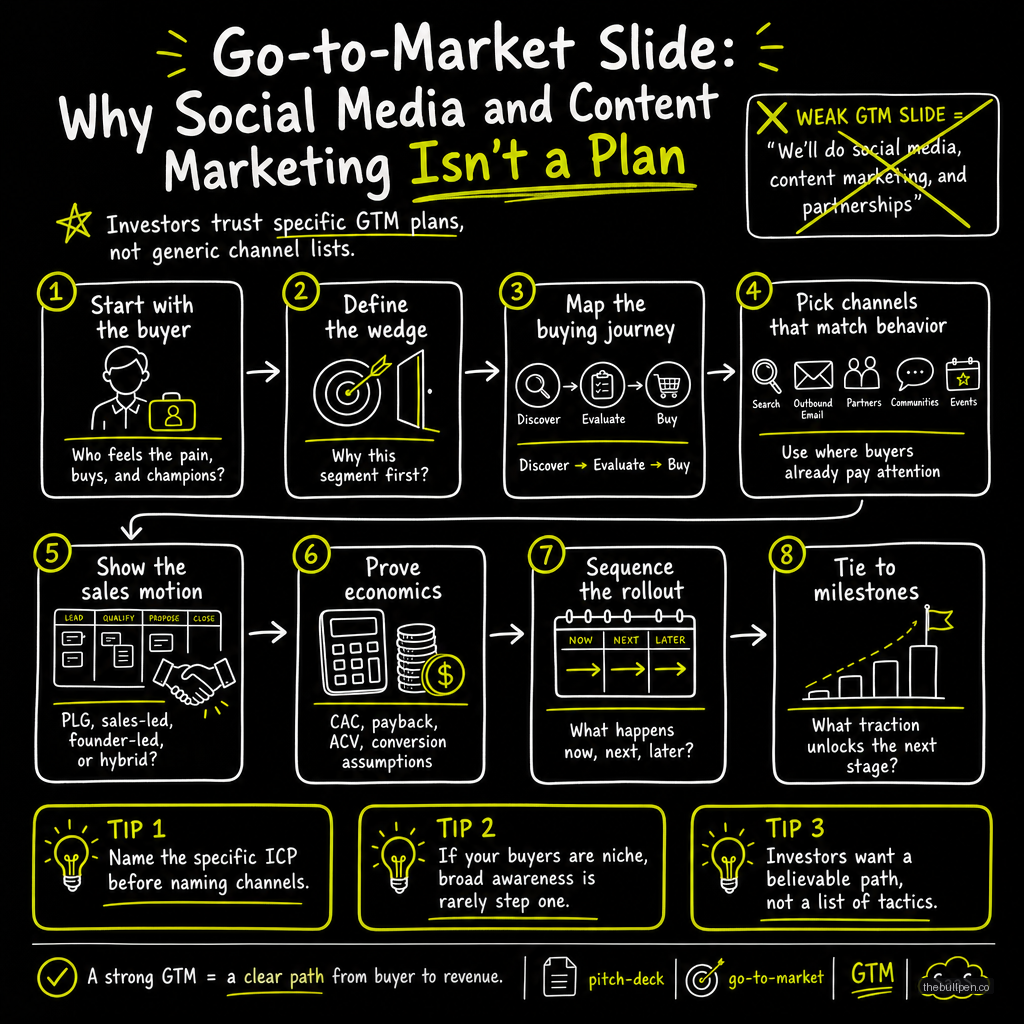
The GTM slide is where most pitch decks fall apart. Founders who nailed the problem slide, wrote a compelling solution, and built a convincing traction chart suddenly list four generic distribution channels — content marketing, social media, paid ads, and partnerships — as if checking boxes makes a go-to-market plan.
Investors see through this immediately. A GTM slide that says "we'll use content marketing and paid ads" without specifying the budget, timeline, or expected unit economics tells the investor that the founder hasn't thought seriously about distribution.
This is a fatal gap. The best product in a crowded market with no distribution plan loses to a mediocre product with a great distribution plan every time. Peter Thiel made this argument in Zero to One, and a decade of startup outcomes has proven him right.
Related: The Complete Guide to Building a Pitch Deck
What Investors Actually Want to See
The GTM slide answers one question: given our product, our customers, and our constraints, what is the most efficient path to revenue?
Investors evaluate your answer across a few dimensions: channel identification (do you know which channels work for your specific product?), unit economics (do you know what your CAC is or will be?), timeline (do you know which channels work fast and which take time?), and defensibility (does your distribution strategy create a competitive advantage over time?).
| Channel | Typical CAC | Time to Scale | Best For |
|---|---|---|---|
| Outbound sales | $5K-$50K (enterprise) | 3-6 months | High-ACV B2B (>$20K) |
| Product-led growth | $0-$500 | 6-12 months | Low-ACV, self-serve |
| Content marketing | $0-$500 (founder time) | 6-12 months | Any, requires patience |
| Paid acquisition | $50-$500 | Immediate | Validate demand quickly |
| Partnerships | $0-$5K | 3-9 months | Platform plays, API products |
| Community | $0-$200 | 12-18 months | Developer tools, creator products |
The most convincing GTM slides focus on one primary channel and explain why it's the right one for this specific business. A deck that says "we'll start with outbound sales because our average deal is $50K and enterprise buyers need a human conversation" shows more strategic clarity than one listing six channels with no prioritization.
Related: How to Nail the Problem Slide
Pre-Revenue vs. Post-Revenue GTM
The GTM slide looks different depending on whether you have revenue data.
Pre-revenue. If you haven't sold anything yet, your GTM slide should show research: how similar companies in your space have acquired customers, what channels are available, and what your hypotheses are for channels you plan to test first. Investors won't penalize you for not having data if you show thoughtful reasoning about why your chosen channel makes sense.
The best pre-revenue GTM slides include a testing plan: "We'll test three channels in the first 90 days with $X budget each, measure CAC and conversion rate, and double down on the winner." This shows investors you understand that distribution is an experimental science, not a checklist.
Post-revenue. If you have customers, your GTM slide should show real data: CAC by channel, channel payback period, and the ratio of paid vs organic acquisition. The best post-revenue GTM slides show a clear primary channel with improving unit economics over time.
| Pre-Revenue GTM | Post-Revenue GTM |
|---|---|
| Research-backed channel hypothesis | Real CAC by channel |
| Testing plan with budget and timeline | Improving unit economics over time |
| What similar companies have done | What's actually working for you |
| Channel prioritization rationale | Channel concentration signal |
The Three Most Common Mistakes
Listing too many channels. A slide with six logos and "partnerships" as a catch-all tells investors you haven't prioritized. The best startups win through one primary distribution channel and build others as the company scales. Airbnb won through listing supply. Slack won through product-led growth. Zoom won through freemium. Each had one dominant channel that they optimized relentlessly before expanding.
Confusing activities with strategy. "We'll do content marketing, social media, and attend conferences" is a list of activities, not a strategy. A strategy answers: which channel will be our primary growth engine, and why? How much will it cost to acquire a customer through this channel? How long will it take before the channel produces meaningful pipeline?
Ignoring the unit economics. Every channel conversation should include CAC. If you're raising $2M and your CAC through outbound sales is $15K, you need ~133 customers to break even on customer acquisition. Is that realistic in your market? If you're going the PLG route, what's your self-serve conversion rate and how does that affect your CAC payback period?
The GTM Slide Template
If you need a starting point, this structure works:
Go-to-Market

Primary channel: [one channel, with rationale]
CAC: [$X] · Payback period: [X months]

Testing plan (if pre-revenue) / Results to date (if post-revenue):
- Channel 1: [result or hypothesis]
- Channel 2: [result or hypothesis]
- Channel 3: [result or hypothesis]

Why this works for us: [one sentence about your specific advantage]
The best GTM slides in funded decks share one quality: they show that the founder has spent more time thinking about distribution than about any other part of the business. That's the signal investors are looking for.
Published on the Bullpen Blog. New articles every day at 9 AM UTC.
Get weekly pitch tips
One email a week. Actionable advice for founders.
Upload your deck. Get scored in 2 minutes. Free. Try now →