The Problem Slide: Why Most Founders Rush It (And Why You Shouldn't)
The problem slide is the most important slide in your deck — and the one founders rush through fastest. Here's how to make investors feel the pain instead of just acknowledging it.
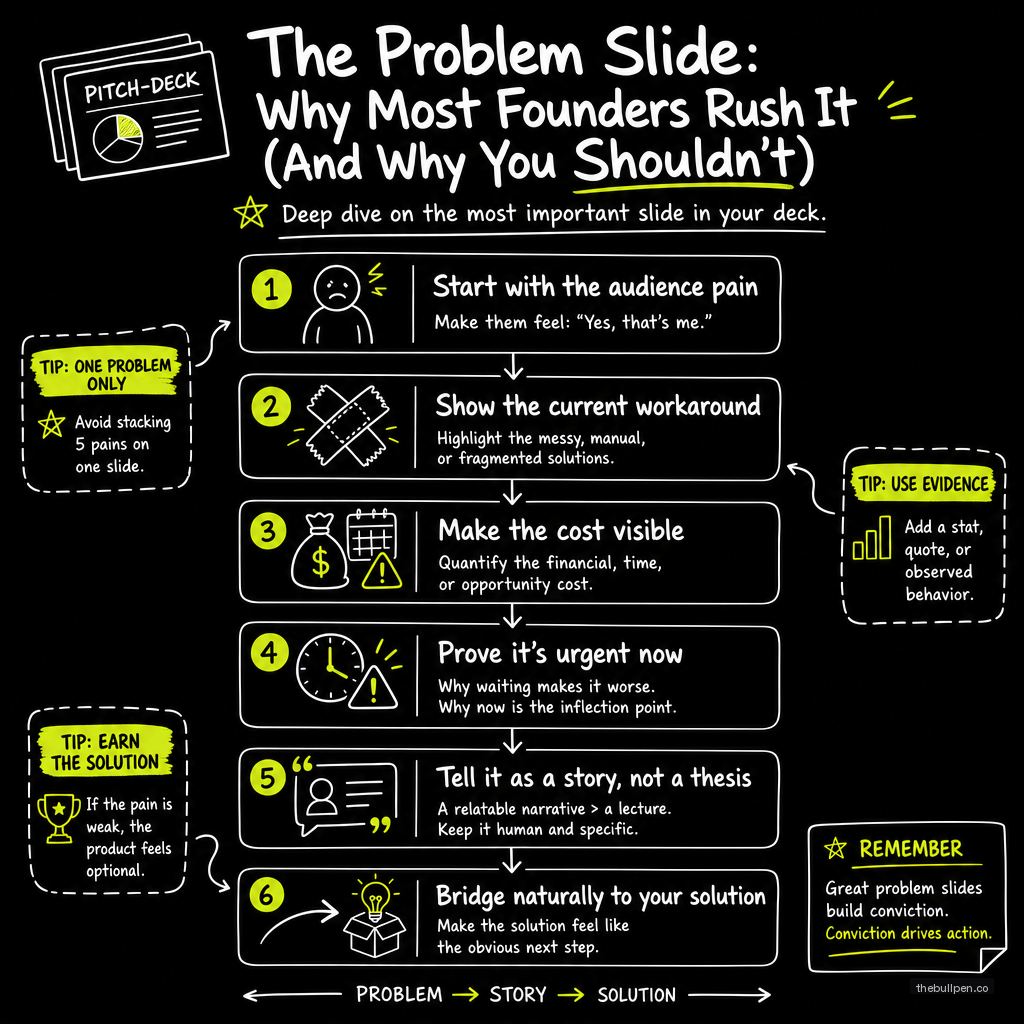
Every founder spends weeks on their solution slide. They agonize over product screenshots, debate feature lists, and iterate on the UI mockups until they're pixel-perfect. Then they slap together the problem slide in 15 minutes because "everyone knows the problem exists."
This is backwards. Investors don't fund solutions. They fund solutions to problems they believe are real, urgent, and painful enough that someone will pay to fix them. If your problem slide is weak, nothing else matters. The investor never gets to your solution because they don't believe the starting premise.
DocSend's 2018 data on pitch deck engagement showed that investors spend the most time on the problem and solution slides — an average of 2.4 minutes combined, out of roughly 3.5 minutes total on a deck they like. That means over two-thirds of the investor's attention goes to whether your problem exists and whether your solution fits it. The rest of your deck is supporting evidence.
If you're spending more time on your team slide than your problem slide, you're optimizing for the wrong thing.
Related: The Complete Guide to Building a Pitch Deck That Raises Capital
The Problem-Solution Mirror
The single most effective structure for a problem slide comes from Airbnb's 2009 seed deck — the most-referenced pitch deck in startup history. A Business Insider employee at YC Demo Day photographed the slides, and what they captured is a masterclass in problem slide structure.
Airbnb's problem slide had three statements:
- Hotels are expensive and impersonal
- Travelers want local experiences
- People have unused spaces
Their solution slide answered each one directly — like a mirror:
- Rent out your extra space to travelers
- Stay with locals
- Cheaper than a hotel
The analyst who broke down this deck on Slidebean called it the "problem-solution combination" and noted it's one of the hardest parts to nail. The key insight: each problem statement maps to exactly one solution statement. Nothing is orphaned. Nothing is abstract.
If your problem slide has five bullet points but your solution only addresses three, an investor notices. They might not say it out loud, but they feel it. The mirror structure forces you to be honest about what problem you're actually solving.
What Makes a Problem Slide Work
A great problem slide makes the investor nod and say "that's real." A bad one makes them shrug and say "I guess that could be a thing."
The difference comes down to three things.
Specificity. "Email is broken" is not a problem statement. It's an opinion. "The average enterprise employee spends 4 hours per day managing email — more time than they spend on their actual job" is a problem statement backed by a statistic that creates a visceral reaction. Specificity gives your problem weight.
Urgency. The best problems are getting worse over time. A problem that's stable is interesting. A problem that's compounding is investable. Show that the problem is growing, that more people are feeling it, that the cost of not solving it is increasing. The trend line is your argument for why now.
Proximity. The problem needs to affect people the investor knows. If you're pitching B2B software and your problem slide talks about how hard it is to onboard employees at large enterprises, name a company the investor has heard of. Make them feel like they've seen this problem themselves. The closer the problem feels, the more real it becomes.
The Three Mistakes That Kill Problem Slides
Mistake one: assuming the problem is obvious. This is the "everyone knows" trap. You assume that because the problem is clear to you, it's clear to everyone. It's not. Investors see 50 to 100 decks a week. Most of them blur together. Your job is to make the problem feel fresh and specific, even if it's a problem the investor has heard before. The framing is what matters.
Mistake two: making the problem too big. "Global warming is destroying the planet" is a true statement and a terrible problem slide for a startup. It's too large for one company to solve. Investors want problems that your specific solution can meaningfully address. The best problem slides define a precise, bounded problem that exists for a specific group of people and that your team is uniquely positioned to solve.
Mistake three: skipping the problem entirely. Some founders skip the problem slide because they think it's obvious or because they don't want to dwell on negativity. This is fatal. If you don't establish the problem, the investor has no framework for evaluating your solution. They don't know what "good" looks like, so they can't assess whether your product is the answer. Every pitch needs a villain, and the problem is it.
Related: Solution Slide Best Practices: Show, Don't Tell
The Problem Slide Template
The best problem slides follow a structure that can be adapted to almost any startup.
Header: a single sentence that crystallizes the problem in human terms. Not a headline like "The Problem" — that's wasted space. Use the header to make the argument: "Why Teams Waste $8,000 Per Employee Per Year on Unnecessary Meetings."
First visual or statistic: something that makes the problem quantifiable. A number, a chart, a comparison. The goal is to create a reaction. "The cost of unnecessary meetings to US businesses exceeds $37 billion annually."
Second layer: who feels this pain. Describe the person or company that experiences this problem most acutely. Make it specific enough that the investor can picture them.
Third layer: why it's getting worse. An accelerating trend, a technological shift, a regulatory change — something that makes the problem more urgent today than it was five years ago.
The close: a single line that transitions to the solution. "There has to be a better way" or "That's why we built [product]."
The Airbnb deck did this in three slides. You can do it in one or two. The key is density — every sentence should advance the argument that this problem is real, urgent, and worth solving.
How to Know If Your Problem Slide Works
Test it on someone who knows nothing about your space. Read them your problem statements and ask if they've experienced this. If they say yes unprompted, the problem is real. If they need you to explain why it matters, the problem isn't specific enough.
Then test it on someone who invests in your space. Read them the problem slide and ask: "does this make you want to see the solution?" That's the only test that matters. If they're curious about what you built, the problem slide did its job. If they're skeptical about the premise, you have more work to do.
Data references: DocSend 2018 Pitch Deck Study (time spent per slide analysis), Slidebean analysis of Airbnb's YC W09 seed deck (Business Insider photos), Airbnb seed deck (YC Demo Day, 2009).
Ready to see how investors would evaluate your pitch deck? Upload it to Bullpen for a free AI-powered assessment across 7 investor categories — including problem clarity, solution fit, and market positioning.
Get weekly pitch tips
One email a week. Actionable advice for founders.
Upload your deck. Get scored in 2 minutes. Free. Try now →