The Ultimate Guide to Startup Accelerators: How to Get In and Make the Most of It
Everything you need to know about startup accelerators — from Y Combinator to Techstars, how to apply, what programs look for, and how to maximize your time in one.
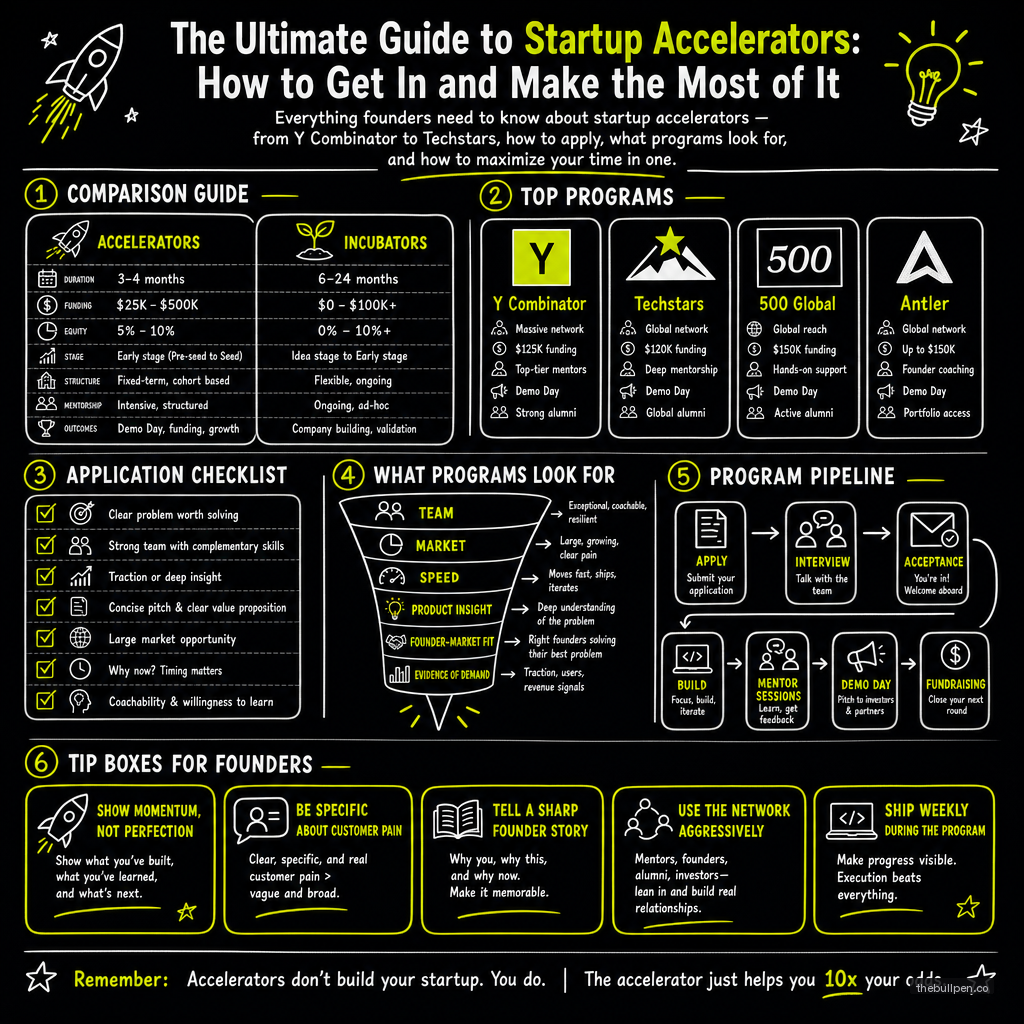
Startup accelerators are the most efficient path from zero to funded — if you pick the right one and work the system correctly. But they're not magic. Getting in is the easy part relative to what comes after.
Every season, thousands of founders apply to Y Combinator, Techstars, 500 Global, and Seedcamp. Most get rejected. Some get in and waste the opportunity. A few leverage the program into a career-defining outcome.
This guide covers the full accelerator lifecycle: deciding if one is right for you, applying, getting in, surviving the program, crushing demo day, and navigating what comes after.
Do You Actually Need an Accelerator?
Accelerators aren't for everyone. They work best for specific types of founders at specific stages.
When Accelerators Make Sense
You should apply to an accelerator if: you're a first-time founder who needs structural guidance, you're building in a space where the accelerator's network is genuinely valuable, you need the credential to attract later investors, or you need the structured timeline to force decision-making.
YC's alumni network is arguably more valuable than the program itself. Techstars' mentor network is unmatched. 500 Global's international reach is a differentiator. Each program has a distinct superpower.
When They Don't
If you already have strong revenue ($100K+ ARR), a clear path to Series A, and a strong network, an accelerator's marginal value is low. The equity you give up (typically 5-10% for $100K-$150K) is expensive relative to what you get.
Founders who raise from angels or friends-and-family at a comparable valuation often retain more optionality.
Related: Hidden Costs of Accelerators, Accelerator Equity Guide
Accelerators vs. Incubators
Incubators are open-ended and early stage. They don't take equity (usually). They provide space, resources, and community. Accelerators are fixed-term, cohort-based, and equity-funded. They're designed to compress years of learning into 3-4 months.
You can do both — incubator first to explore, accelerator later to scale.
How to Get In
The application process is competitive. YC accepts less than 2% of applicants. Techstars accepts about 1-2%. Understanding what they're looking for changes your odds.
What Accelerators Look For
Contrary to popular belief, accelerators don't look for polished products. They look for pattern-breakers: founders who are relentless, coachable, and building something that could be massive.
The evaluation framework is usually: team (50%), market (30%), product (20%). Your team quality — domain expertise, founder-market fit, and demonstrated resilience — outweighs everything else.
Related: Accelerator Interview Preparation
The Application
The application is your first filter. Most are short (YC's is famously compact). Every word counts. Be specific. Show traction, not intentions. "We have 200 users and 15% week-over-week growth" beats "we're solving a massive problem."
For video applications: be authentic. Don't script. Don't pitch. Talk like a human. Founders who sound rehearsed get passed over for founders who sound real.
Related: Accelerator Video Application Tips, Accelerator Pitch Deck Tips
Common Application Mistakes
Applying too early (no users, no product, no signal). Applying to every program without tailoring your application. Not doing your homework on the specific program's focus. Ignoring the essay questions — they're as important as the metrics.
Related: Accelerator Application Mistakes to Avoid
Should You Apply to Multiple?
Yes. Apply to 5-10 programs. Don't put all your eggs in one basket. But tailor each application to the specific program's thesis and portfolio. A generic application that went to 20 programs is obvious and wasted effort.
Related: Multiple Accelerator Application Strategy
Choosing Between Programs
If you're lucky enough to have multiple offers, don't just pick the brand name. Pick the right fit.
Y Combinator
The gold standard. Best alumni network in the world. Best fundraising outcomes. But also the most intense, the least hand-holding, and the most competitive to get into. YC is right for founders who learn by doing and need a powerful credential.
Related: Y Combinator Application Guide, Y Combinator vs. Techstars: Which Is Right for You?
Techstars
Best mentor network. More structured curriculum. Strong in specific verticals (healthtech, fintech, climate). Often a better fit for hardware, deep tech, and regulated industries where mentor expertise matters more than general startup advice.
500 Global
Best for international founders and emerging markets. Strong focus on growth and distribution. More pragmatic and less prestige-driven than YC. Good for founders who want hands-on growth support rather than a credential.
Related: 500 Global Accelerator Guide
Seedcamp
Europe's answer to YC. Strong network across European and UK ecosystems. Good for European founders who want to stay local but access world-class resources.
Related: Seedcamp Europe Accelerator Guide
Corporate Accelerators
Microsoft, Google, AWS, and industry-specific corporate accelerators offer non-dilutive funding, distribution, and technical credits. But they often come with strings — preferred access to your data, right of first refusal, and less flexible terms.
Related: Corporate Accelerators: Are They Worth It?
International Considerations
If you're a non-US founder, consider programs that specialize in international founders. Some accelerators have specific tracks for founders from certain regions. The best program for you might not be in the US.
Related: Accelerators for International Founders (Coming soon — October 31, 2026), International Accelerators Compared
Making the Most of Your Accelerator
Getting in is step one. What you do during the program determines the outcome.
Before the Program
Pre-work matters. Line up customer conversations. Prepare your baseline metrics. Know what you want to get out of the program — specific milestones, not vague "growth." Set a clear goal for demo day.
If you're employed, decide whether to quit before or during the program. Most programs expect full-time commitment. Some are flexible.
Related: Should You Quit Your Job for an Accelerator?
During the Program
The accelerator is a compression chamber. You'll make more decisions in 3 months than in the previous 3 years. Protect your focus. Say no to distractions. The activities that move your metrics are the only priority.
Office hours with partners are the most valuable resource. Come prepared with specific asks, not status updates. "I need help with pricing for enterprise customers" beats "we're doing great!"
Related: Accelerator Office Hours: How to Use Them (Coming soon — October 1, 2026), Accelerator Mentorship Guide
The Cohort Effect
Your cohort is your peer group for life. These are founders at a similar stage, going through the same pressure. The relationships you build with cohort members are as valuable as the program itself. Be generous — share learnings, make introductions, support each other.
Related: The Accelerator Cohort Effect (Coming soon — September 25, 2026)
Demo Day
Demo day is not a fundraiser. It's a distribution event for your fundraising. The goal is to get 30+ meetings in the following 2 weeks, not to get a check on stage.
Your demo day pitch should be tighter, faster, and more memorable than a standard pitch. Investors see 30+ pitches in a single demo day. You need to stand out in the first 60 seconds.
Related: Demo Day Preparation Guide
After the Accelerator
The program ends, but the value continues.
Post-Accelerator Fundraising
The 2-4 weeks after demo day are the highest-density fundraising window you'll ever have. Strike while the iron is hot. Schedule meetings aggressively. Your demo day deck and pitch should be polished and ready for follow-up.
The fundraising post-accelerator is different from normal fundraising. You have more leverage, more urgency from investors, and a clearer narrative. Use it.
Related: Post-Accelerator Strategy
The Alumni Network
The alumni network is the longest-lasting accelerator benefit. YC has 10,000+ alumni. Techstars has 15,000+. These are people who've been through what you went through, speak the same language, and are generally willing to help.
Be intentional about alumni engagement. Attend events. Offer help before asking for it. The network compounds over years, not days.
Related: Accelerator Alumni Network: How to Leverage It (Coming soon — October 7, 2026)
What If You Don't Raise After Demo Day?
Most companies don't raise immediately after demo day. That's normal. The distribution you got from demo day is still valuable — those relationships remain. Keep building, keep updating investors, and raise when you have more traction.
Related: No Raise After Demo Day? Here's What to Do (Coming soon — November 12, 2026)
What If You Get Rejected?
The best founders use rejection as data. YC rejected Airbnb, DoorDash, and many other billion-dollar companies. If you get rejected, apply again. Improve your traction, refine your story, and demonstrate progress.
Related: How to Reapply After Accelerator Rejection (Coming soon — November 24, 2026)
FAQ
How much equity do accelerators take?
Typically 5-10% for $100K-$150K investment. YC takes 7% for $500K (as of 2026). Techstars takes 6-10% for $100K-$120K. Evaluate the equity cost against the network, credential, and program value.
Should I quit my job before or during an accelerator?
Most programs require full-time commitment. Quit before starting, not during. The accelerator is too intense to run in parallel with a job.
Do I need a co-founder to get into an accelerator?
It helps. Most accelerators prefer multi-founder teams. Solos can get in, but they need a stronger story and a clear support system. Some programs (like Entrepreneur First) help you find a co-founder.
Related: Solo Founder in an Accelerator, Entrepreneur First Guide
What's the real value of an accelerator?
The network, the credential, and the compressed timeline. In that order. The curriculum is available online. The capital is replaceable. But the network and the mental model of "we have 12 weeks to transform this company" are uniquely valuable.
Which accelerator is best for hardware and deep tech?
Techstars has strong hardware and deep tech tracks. 500 Global has programs in emerging markets. For biotech, look at IndieBio or MassChallenge. Generalist programs like YC also accept hardware companies, but your odds improve at niche programs.
Related: Biotech and Deep Tech Accelerators, Accelerator for Hardware Startups (Coming soon — November 6, 2026)
Ready to get into a top accelerator? Upload your pitch deck to Bullpen for a free AI-powered evaluation. We analyze your application readiness across 7 categories and give you actionable feedback before you hit submit.
Get weekly pitch tips
One email a week. Actionable advice for founders.
Your Demo Day pitch, evaluated in 2 minutes. Try now →