How to Prepare for Accelerator Interviews
A tactical guide to acing the accelerator interview round — including specific questions, timing breakdowns, and what programs actually look for.
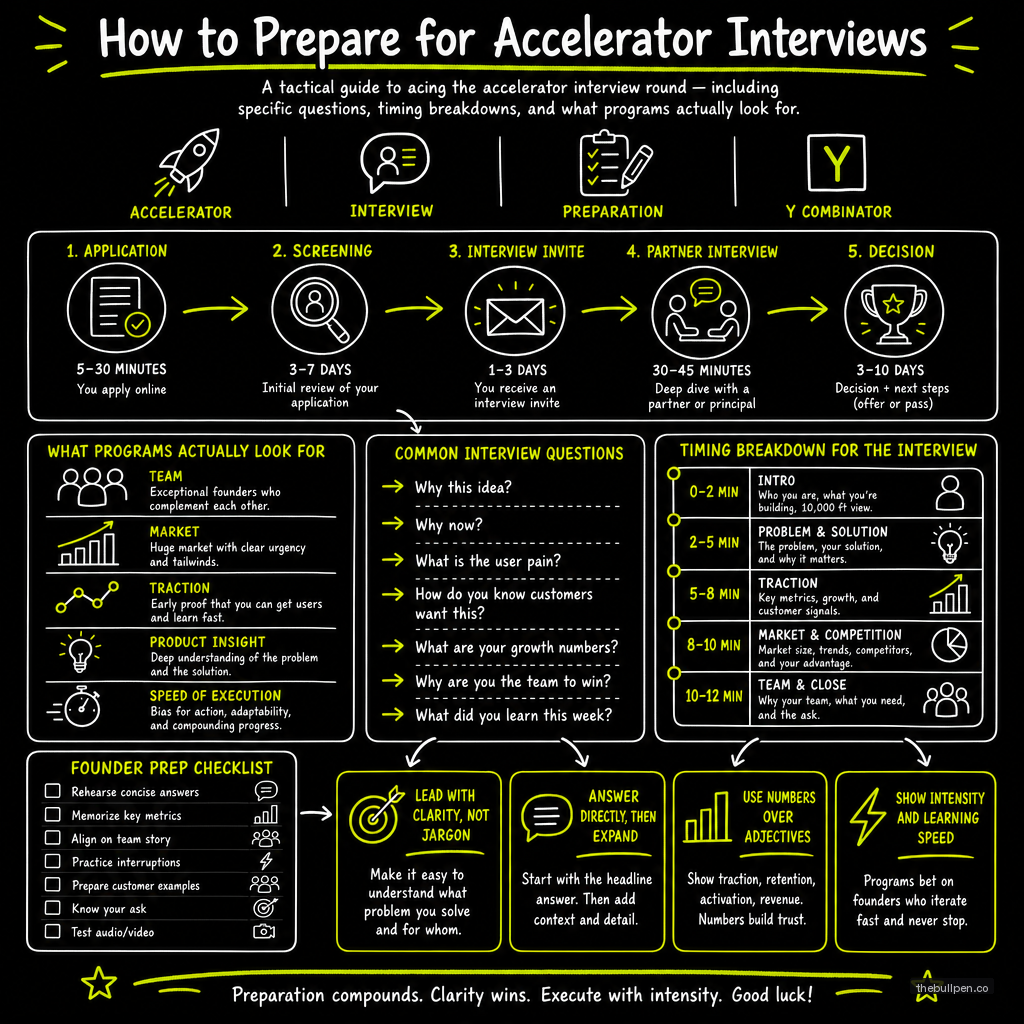
You made it past the written application. That puts you in an elite group — but the real gate is ahead. Every year, Y Combinator receives roughly 45,000 applications for about 275–300 spots. The acceptance rate hovers around 1.5–2%. For Techstars, which runs dozens of programs globally, the numbers vary but the competition is similarly intense. The interview is where most founders stumble, even when their applications were stellar.
The interview round tests something the application can't: how you think on your feet, how well you know your business, and whether you're the kind of founder a program wants to work with for three intensive months. Here's how to prepare for it.
The Y Combinator Interview: 10 Minutes That Define Your Company
YC's interview is famously short — exactly 10 minutes. A handful of partners sit around a table, and they've already read your application. They don't want a rehearsed pitch. They want answers.
The conversation follows a pattern. Three questions come up nearly every time:
- What do you do? This is your opening. You have roughly 30 seconds to explain your company clearly enough that a partner could repeat it back to a peer. If you need jargon, acronyms, or a five-minute setup, you're in trouble.
- Why now? Why couldn't this business have been built five years ago? Why won't it be obsolete in two? This question tests whether you have a genuine market insight or just a feature idea.
- How will you make money? Even pre-revenue founders need a credible answer. YC invests in companies, not charities. You need to show you understand unit economics, pricing, and your path to revenue — even if you haven't started charging yet.
Michael Seibel, former YC CEO and current Group Partner, has said it plainly: "Don't pitch — have a conversation." The partners are trying to evaluate whether you're coachable, honest, and quick on your feet. A memorized script works against all three.
Related: Accelerator Application Mistakes
Techstars: A Different Format, Same Pressure
Techstars interviews are longer , typically 30 to 60 minutes , and involve managing directors from the local program alongside program staff and sometimes alumni. The format is less compressed but more layered. You'll get questions about team dynamics, how you handle conflict, and your willingness to pivot.
Techstars managing directors place heavy weight on founder-market fit and coachability. They're selecting companies for a program that involves intense mentorship, so they need to know you can take feedback without getting defensive, and push back without being difficult.
| Feature | Y Combinator | Techstars |
|---|---|---|
| Duration | 10 minutes | 30–60 minutes |
| Interviewers | 3–5 partners | Managing directors, program staff, alumni |
| Format | Rapid-fire Q&A | Extended conversation + scenario questions |
| Key trait tested | Clarity under pressure | Coachability and team dynamics |
| Decision timeline | Same day or next day | Within 1–2 weeks |
| Focus | Product, market, traction | Team, mentorship fit, local ecosystem |
Other accelerators fall somewhere in between. 500 Global and the Alchemist Accelerator run 20–30 minute interviews. The common thread across all of them: the interview is about fit as much as it is about your business.
Related: Accelerator Equity Guide
Common Interview Questions (With Actual Examples)
Preparation means knowing the questions and having sharp answers ready. Below are questions that appear across multiple programs, with the type of answer that works versus what sinks you.
"Tell us about your team. Why are you the right people to build this?"
A weak answer lists credentials. A strong answer tells a story of why your specific combination of skills, experience, and obsession with this problem gives you an unfair advantage. "I've been a physician for 10 years and saw this workflow failure every single day" is more compelling than "We have two engineers from Google."
"What's the biggest risk you're facing right now?"
Founders who say "no risks, everything is going great" lose credibility. The right answer names a real risk and shows you have a plan to address it. "Adoption in enterprise is slow because of compliance review cycles. We're starting with teams under 50 people where no compliance review is needed, then using those case studies to shorten the cycle for larger deals."
"What have you learned from customers in the last week?"
This is a trap question for any founder who isn't actively talking to users. If you can't name a specific insight from recent conversations, the interviewer knows you're not doing the work. "We learned that our pricing page confuses users , they don't understand the difference between our pro and enterprise tiers, so we're testing a simplified version next week" shows you're in the arena.
"If we don't accept you, what will you do?"
The right answer conveys that you're building this company regardless. "We'll keep going. We have enough runway for 12 months and a clear set of milestones to hit. Acceptance would accelerate us, but it doesn't define us."
"Who is your competitor, and why will you beat them?"
Don't say you have no competitors. It signals either naivety or dishonesty. Acknowledge the competitive landscape and explain your specific wedge. "We compete with Zapier for automation workflows, but we're winning with customers who need database-native integrations that Zapier can't handle."
Related: Bullpen Accelerators Hub
Common Mistakes Founders Make in Accelerator Interviews
The interview is where otherwise strong founders self-destruct. Here are the patterns that kill applications.
Reading from a mental script. When a founder visibly tries to steer every answer back to a rehearsed talking point, the interviewers notice. It reads as evasive and untrustworthy. If a partner asks a question you didn't expect, answer that question , not the one you wish they'd asked.
Defensiveness under pressure. Partners will challenge your assumptions by design. If you get defensive, you've shown them you're hard to work with. The correct response: "That's a fair concern. Here's what we've seen, and here's what we're doing to address it."
Failing to listen. Founders sometimes answer a question the interviewer didn't ask because they stopped listening early. Pause. Process. Then speak.
Overexplaining the obvious. Assume the interviewers are smart. Get to the unique part of your business immediately.
Bringing too many people. For YC, bring no more than two founders. Extra team members create awkward dynamics in a 10-minute slot.
Not knowing the numbers. You should know MRR, growth rate, CAC, LTV, churn, and active users cold. Saying "I'd have to check" is fatal.
What the Interview Tests That the Application Can't
The written application is curated. You have time to think, edit, and polish. The interview removes that buffer. Here's what gets tested in the room that no amount of application polish can simulate:
Communication clarity. Can you explain a complex business in simple terms? Founders who can't articulate their value proposition in 30 seconds haven't thought about it deeply enough. The interview reveals that immediately.
Authentic founder-market fit. The application lets you claim "I'm passionate about this problem." The interview reveals whether that passion is real. Interviewers can tell the difference between a founder who's been in the industry for years and one who did a weekend of research.
Decision-making under uncertainty. Founders make dozens of decisions every day with incomplete information. The interview gives interviewers a sample of how you think through ambiguity. Your answer to "What would you do if this customer segment doesn't materialize?" tells them more about your ability to adapt than any traction metric.
Team dynamics. If multiple founders attend, the interviewers watch how you interact. Who defers to whom? Do you build on each other's answers or interrupt? Do you seem like a functional team or a collection of individuals? For programs like Techstars where you'll spend 12 weeks shoulder-to-shoulder, team dynamics are critical.
Honesty about gaps. Every early-stage startup has holes in its strategy. Founders who fake perfection seem naive. Founders who name their gaps and show they're fixing them seem honest and capable. The interview tests which one you are.
How to Actually Prepare
Block off a few hours and follow this drill:
-
Write out answers to the questions above, plus any from past batches. Don't memorize them , internalize the shape so you can adapt in the moment.
-
Do mock interviews with people who will be harsh. Founders who have been through accelerators are ideal. Record the sessions and watch yourself for filler words, rambling, and nervous habits.
-
Prepare your co-founder. Agree on who answers which types of questions. Practice smooth transitions: "I'll take this one, and then [co-founder] can speak to the technical implementation."
-
Know your demo. If the program allows a live demo (Techstars sometimes does), have it ready on a dedicated device with airplane mode on.
-
Arrive early and breathe. YC interviews happen in Mountain View, California. Techstars interviews are local to each program's city. Get there with time to spare. Sit in the waiting room, drink water, and remind yourself: this is a conversation.
The interview is the last filter. It's also the most human one. The partners want to say yes. They're looking for reasons to believe. Give them those reasons.
Published on the Bullpen Blog. New articles every day at 9 AM UTC.
Get weekly pitch tips
One email a week. Actionable advice for founders.
Your Demo Day pitch, evaluated in 2 minutes. Try now →