Techstars vs Y Combinator: Which Accelerator Is Right for You?
The honest comparison between the two most famous accelerators in the world — equity, network, outcomes, and which one actually fits your startup.
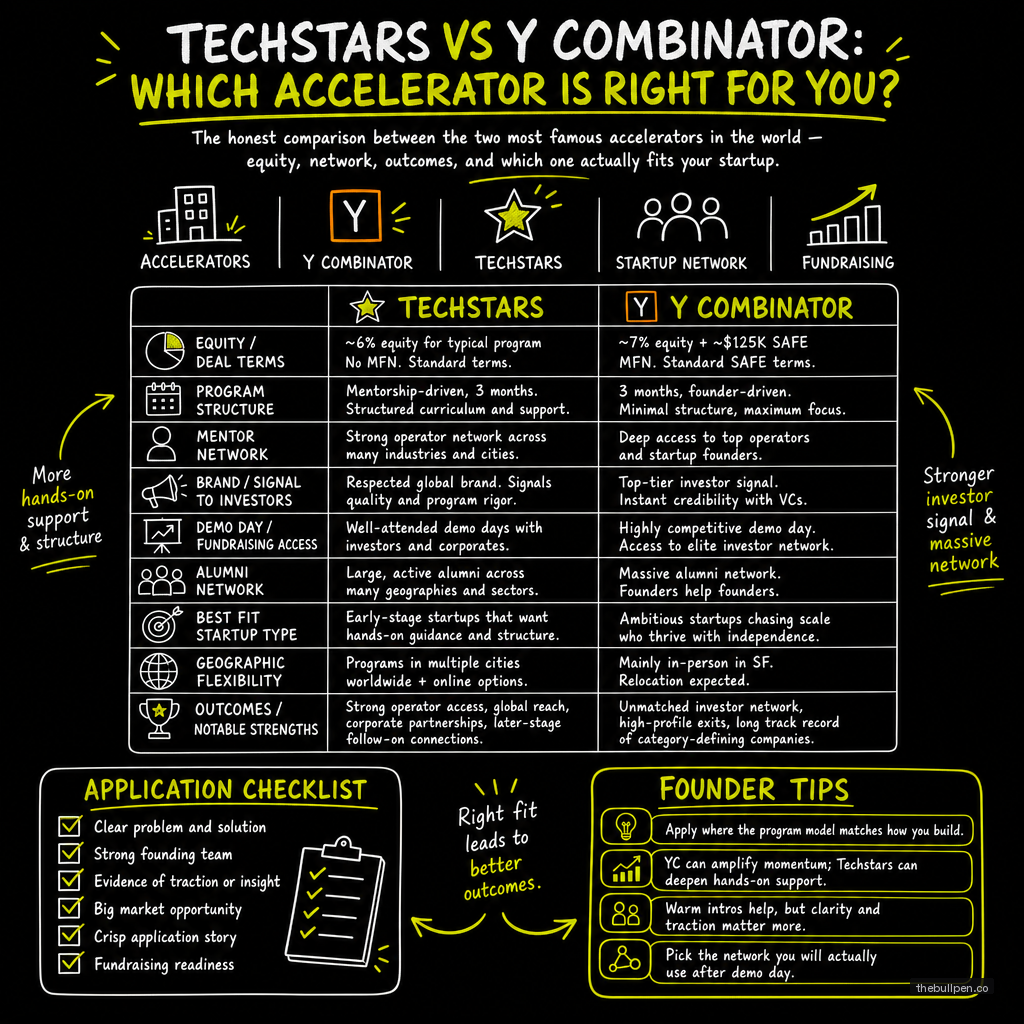
If you're a first-time founder with a reasonably interesting startup, you're going to apply to Y Combinator and Techstars. Probably in that order, because YC is the name everyone knows and Techstars is the backup.
This ordering is backwards for a lot of startups. Not because YC isn't better — in many ways it is — but because the programs are so different that the question isn't "which one is better" but "which one is better for what I'm building right now."
I've seen founders who crushed YC and floundered after. I've seen founders who got rejected by YC, did Techstars instead, and built massive companies because the mentor network gave them exactly what YC couldn't: industry-specific connections and structured support. The program matters less than the fit.
Related: The Complete Y Combinator Application Guide
The Head-to-Head
| Dimension | Y Combinator | Techstars |
|---|---|---|
| Standard investment | $500K ($125K standard + $375K rolling fund) | $120K |
| Equity taken | 7% | 6–10% (varies by program) |
| Program length | 3 months | 3 months |
| Batches per year | 2 (winter + summer) | 50+ programs worldwide, rolling |
| Companies per batch | ~250–300 | ~10–15 per program |
| Acceptance rate | ~1–2% | ~1–2% |
| Location | San Francisco (remote option) | 50+ cities worldwide |
| Application length | Very short (~10 questions) | Longer (~20+ questions) |
| Selection process | Application → Interview (10 min) | Application → Interview |
| Program model | Office hours, group sessions, dinner speakers | Mentor-driven, structured curriculum |
| Notable alumni | Airbnb, Stripe, Dropbox, DoorDash, Coinbase | SendGrid, DigitalOcean, ClassPass, Sphero |
| Best for | Software startups with strong founders, anyone who can benefit from the brand | Hardware, deep tech, regulated industries, founders who want mentor support |
The most surprising number on this table is the acceptance rate. They're about the same — both accept roughly 1–2% of applicants. But the volume is dramatically different. YC accepts 250 to 300 companies twice a year. Techstars runs over 50 programs globally, each accepting 10 to 15 companies. In total, Techstars funds more companies per year, but each individual program is much smaller.
This matters more than you think. A YC batch of 300 companies means you're surrounded by peers but competing for attention. A Techstars cohort of 12 means you're going to know everyone's name and every mentor will know yours.
The Y Combinator Advantage
YC's superpower is the brand and the network. There's no other accelerator where saying the name instantly communicates something to investors, acquirers, and employees. The YC alumni network is the strongest in the world, and it compounds — every batch adds hundreds more founders who will take your call, intro you to investors, and buy your product.
The standard deal has shifted. YC now offers $500K: $125K on the standard 7% SAFE plus $375K as an uncapped SAFE available to all batch companies. That's more money than Techstars offers, and the terms are clean.
YC also wins on simplicity. The application is famously short. The interview is famously brief — 10 minutes, no slides, just your founders and a panel of partners asking rapid-fire questions. The program itself is famously unstructured: office hours with partners, weekly group dinners with speakers, and otherwise hands-off. YC assumes you know how to build and they want to get out of your way.
The funding outcomes are real. YC companies have raised follow-on funding at higher rates and higher valuations than any other accelerator. The data is clear: if your goal is to maximize your chance of raising a Series A, YC is the best bet.
The Techstars Advantage
Techstars' superpower is mentorship. Every company gets matched with a lead mentor — an experienced operator in their space — and has access to a network of hundreds of mentors per program. If you're building in a regulated industry, a hardware company, a biotech, or anything that requires domain-specific knowledge, this matters more than the YC brand.
The geographic distribution is Techstars' other massive advantage. They run programs in over 50 cities worldwide — London, Berlin, Austin, Boulder, Seattle, Toronto, and dozens more. If you don't want to move to San Francisco, or if your business is location-specific, Techstars has a program that fits.
The equity terms vary by program but typically range from 6% to 10% for the $120K investment. That's less capital for more equity than YC, which is one reason founders sometimes choose Techstars only after a YC rejection. But that math misses the point: Techstars programs are smaller, more focused, and better for certain types of companies. The cost of equity isn't just the percentage; it's the value the program provides against it.
Techstars also has stronger vertical programs. There are Techstars programs specifically for AI, for blockchain, for healthcare, for climate, for defense. If your startup fits one of these verticals, you get a program designed for your space rather than a generalist program where you're competing for attention with 299 other companies.
Related: 500 Global: Inside the World's Most Global Accelerator
How to Choose
YC if you're building a pure software company, you're confident in your ability to execute without much hand-holding, and you want the strongest possible signal for future fundraising. YC if you can move to San Francisco for three months and you thrive in a sink-or-swim environment. YC if the brand alone will open doors that your current stage cannot.
Techstars if you're building something that benefits from domain expertise — hardware, regulated industry, deep tech — and the mentorship will genuinely accelerate you. Techstars if you can't move to San Francisco and want a program that comes to you. Techstars if you want a smaller cohort where you're not fighting for attention.
The worst reason to choose one over the other is "YC is more prestigious so I'll apply there first." The prestige is real but it's only valuable if the program structure fits what you need. A founder who needs mentor support and ends up in YC's unstructured program will struggle more than a founder who gets exactly that support at Techstars.
Apply to both. See who accepts you. Then decide based on fit, not ego.
Data sources: Y Combinator standard deal terms (apply.ycombinator.com), Techstars program terms (techstars.com), PitchBook accelerator benchmark reports, Crunchbase portfolio data. Acceptance rates are approximate based on published data and founder reports — actual rates vary by batch and program.
Want to know how investors would evaluate your startup? Upload your deck to Bullpen for a free AI-powered assessment across 7 investor categories.
Get weekly pitch tips
One email a week. Actionable advice for founders.
Your Demo Day pitch, evaluated in 2 minutes. Try now →