Accelerator Application Video: How to Record One That Gets You In
The video application is your best chance to stand out in an accelerator application pool. Here's what YC, Techstars, and others actually look for — and the mistakes that guarantee rejection.
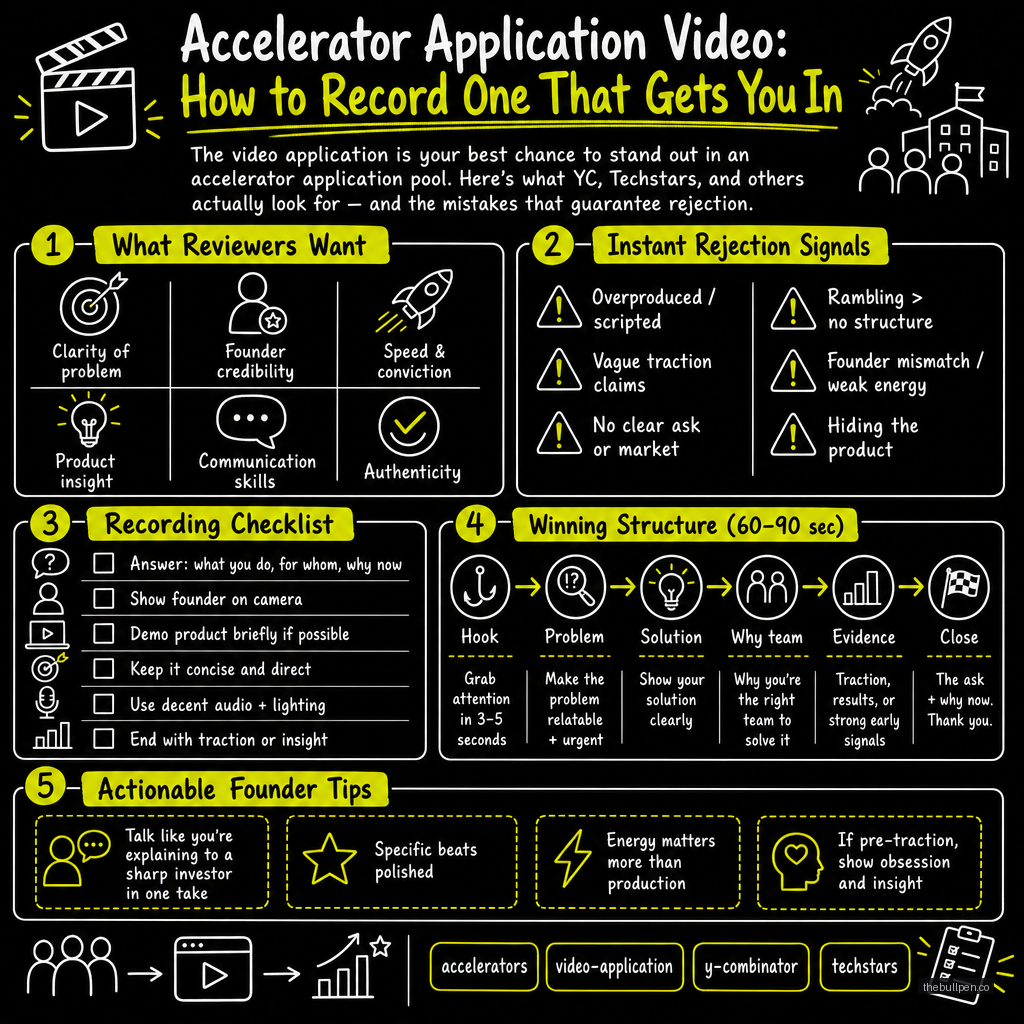
When Y Combinator reviews applications, one element carries disproportionate weight: the one-minute video. The partners have said it publicly — the video gives them something the written application can't: a sense of who you are as a person. Are you articulate? Are you passionate? Do you understand your own business well enough to explain it in sixty seconds without notes?
Techstars has a similar philosophy. 500 Global does too. Every major accelerator uses the video as a gut check on the founder. The written application tells them what you're building. The video tells them whether they want to work with you.
And most founders get the video wrong. They script it. They overproduce it. They try to cram their entire business plan into sixty seconds of rushed talking. The video that gets you into YC is not the video that looks like a TV commercial. It's the video that sounds like a conversation.
Related: The Complete Y Combinator Application Guide
What Accelerators Actually Look For
The video is not a pitch. It's a character assessment. Accelerators are looking for three things, in order of importance.
Can you communicate clearly under pressure? A one-minute video is a constrained format. If you can't explain your business clearly in that window, you probably can't pitch it clearly to investors either. The pressure of the timer creates a simulation of the high-stakes environments you'll face in the program.
Do you genuinely understand your business? The best videos don't repeat the written application. They add texture — specific insights about customers, a clear articulation of why now, a moment of honesty about a challenge you're facing. Generic answers feel generic. Specific ones feel real.
Are you someone the partners want to work with? Accelerators spend three months in close contact with their cohort. They're selecting for coachability, energy, and self-awareness as much as they're selecting for traction. A video that shows you're humble, curious, and driven is more compelling than one that tries to sound like you've already figured everything out.
| What YC Looks For | What Doesn't Matter |
|---|---|
| Clear, simple explanation of what you do | Fancy editing or graphics |
| Why this problem matters now | Rehearsed, polished delivery |
| Personal passion and energy | Expensive camera or lighting |
| Honesty about challenges | A long list of credentials |
| Short and specific answers | Covering everything in one minute |
The Format That Works
The most effective accelerator video format has been validated across thousands of successful applications. It's simple and repeatable.
Sixty seconds. One continuous shot. No cuts, no b-roll, no music. The founders sit together (or the solo founder sits alone) and speak directly to the camera like they're talking to a smart friend who asked what they're working on.
The first 15 seconds: what you do. One sentence that explains your product and who it's for. "We're building a platform that lets small businesses send invoices and get paid in under 24 hours." That's it. If you can't explain it in one sentence, you're not ready to apply.
The next 30 seconds: why now and why you. Two connected ideas. Why is this the right moment for your company? And why are you the right person to build it? The best answers connect market timing to personal experience. "I spent five years running a small construction company and watching late payments strangle my cash flow. Now that Stripe and Plaid have made payment infrastructure accessible, we can finally fix this."
The final 15 seconds: something memorable. A specific number. An insight from a customer conversation. A moment of honesty about what you're still figuring out. Something that makes the partner remember you when they review applications the next day.
Common Mistakes
Reading from a script. Partners can tell immediately. The slight eye movement, the unnatural pauses, the perfectly constructed sentences that no one speaks naturally. Memorize bullet points, not a script. Then talk like a human.
Trying to cover everything. Your written application covers the details. The video is for the big picture. Founders who try to explain their market size, competitive landscape, revenue model, and team background in sixty seconds end up explaining nothing well.
Bad audio. A video with good audio and mediocre video quality is fine. A video with bad audio is unwatchable. Use an external microphone if you have one. Record in a quiet room without echo. Test your audio before recording the real take.
No energy. The most common feedback from YC partners is that videos feel flat. Founders are nervous and it shows. The fix is counterintuitive: amp up your energy by about 30% above what feels natural. On camera, natural energy reads as low energy. Slightly animated reads as engaged.
Recording alone when you have a co-founder. If you have a co-founder, record together. The interaction between founders tells partners more about your working relationship than any written answer about your equity split. Do you finish each other's sentences? Do you disagree productively? Or do you sit in awkward silence while one person does all the talking?
Related: Accelerator Application Mistakes That Guarantee Rejection
Production Quality: The Minimum Viable Bar
You don't need expensive equipment. You need three things that cost nothing:
- Good lighting. Face a window. Natural light from the front is better than any studio setup. Avoid overhead lights that cast shadows on your face.
- Clean audio. Record in a room with soft surfaces — carpet, curtains, furniture with upholstery. This absorbs echo. Test by recording ten seconds and playing it back before your real take.
- A stable camera. Prop your phone on a stack of books at eye level. Looking slightly up at the camera is unflattering. Looking slightly down is fine. Looking straight ahead is ideal.
The best production quality is invisible. If a partner watches your video and thinks "great lighting" instead of "great idea," you've spent effort in the wrong place.
What to Do the Day Before
Record a practice take and watch it. Most founders discover things they want to change — they talk too fast, they use jargon, they forgot to mention something important. Iterate on the practice take. Record the real version when you're happy with the practice.
Then, before you submit, have someone who doesn't work on your startup watch it. If they can't tell you what you do after sixty seconds, your video needs another pass.
The video won't make or break your application on its own. But if the partners finish watching yours and think "I want to meet that founder," you've done your job.
Published on the Bullpen Blog. New articles every day at 9 AM UTC.
Get weekly pitch tips
One email a week. Actionable advice for founders.
Your Demo Day pitch, evaluated in 2 minutes. Try now →