The Complete Y Combinator Application Guide
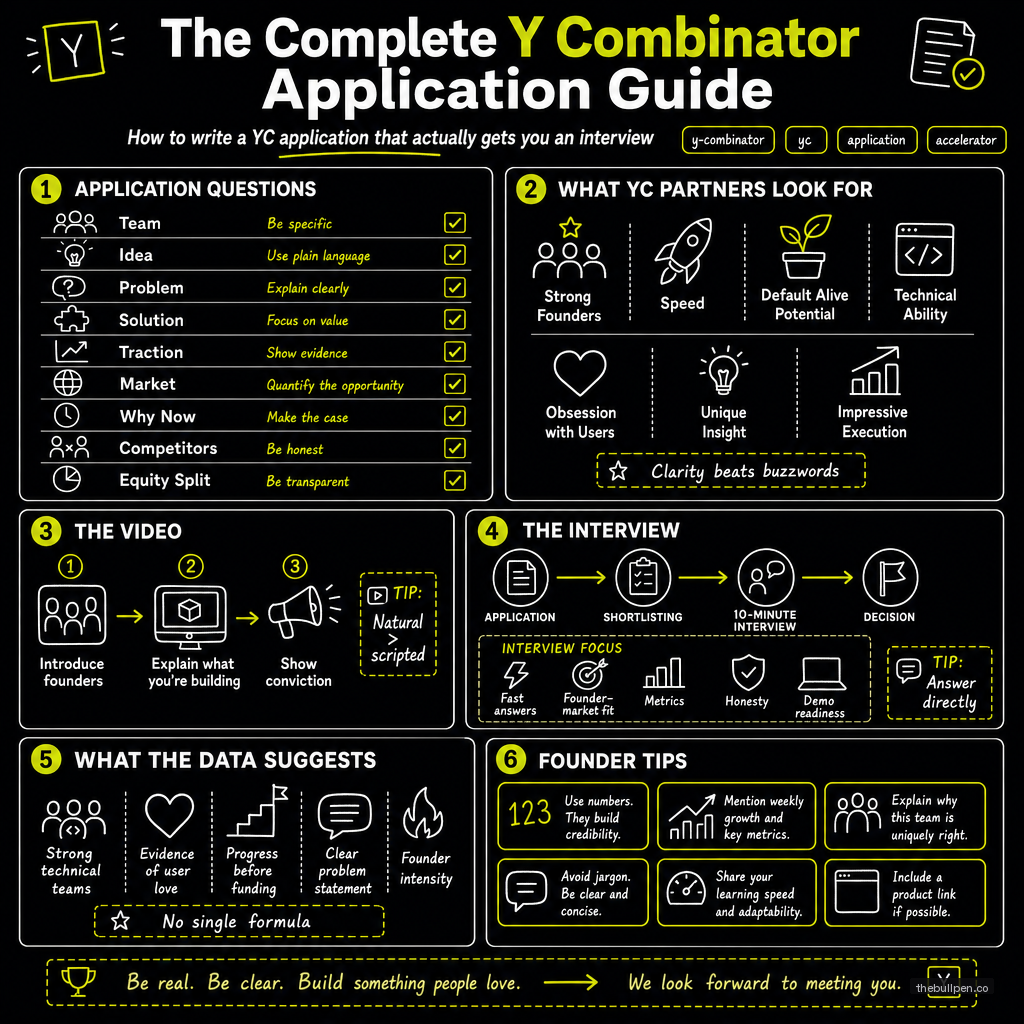
How to write a YC application that actually gets you an interview — the exact questions, what partners look for, the video, the interview, and what the data says about who gets in.
Twenty-five thousand applications. Two hundred fifty acceptances. Every batch, the math stays roughly the same: a 1.5 to 2.5 percent acceptance rate that makes Harvard look inclusive.
The difference between an application that gets a 10-minute interview and one that gets a form rejection comes down to a handful of specific signals YC partners look for every batch. Once you know those signals, the application becomes a targeting problem, not a writing problem.
Related: The Ultimate Guide to Startup Accelerators, YC vs Techstars: Which Is Right for You?
The Application is 40 Questions You Should Already Know the Answers To
YC's application asks about forty questions, but they cluster into four groups: what you've built, the numbers that prove it matters, why your team can execute, and the one-minute video. Each cluster tests a different thesis about your company, and you don't get partial credit across clusters.
The company information section is straightforward but most founders get it wrong in the same way. The tagline question — "In one sentence, what does your company do?" — is the single most important field on the entire form. Michael Seibel has said repeatedly that if he can't understand what you do from the tagline, the rest of the application gets read with that ambiguity baked in. Stripe's original application tagline was "We make it easy to accept payments online." Airbnb's was "Book rooms with locals, rather than hotels." Neither is clever. Both are immediately clear.
The "impressive progress" question is where traction matters, and this is where most founders misunderstand what YC considers impressive. YC does not need you to have $100K in revenue. They need you to have any signal that people want what you're building. Airbnb had three users and $200 a month in revenue when they applied. DoorDash had twenty orders a week delivering food from four Palo Alto restaurants. Reddit had two hundred users and zero revenue. What each of them had was a clear growth trajectory — doubling month over month from a tiny base — and a product that a small number of people actively used without being paid to.
If you've been working on your startup for six months and have zero users, zero revenue, and no one actively using your product, the application is going to be an uphill battle regardless of how good your idea sounds in writing. The exception is deep tech and hardware, where timelines are longer and YC judges by different standards. For everything else, the threshold is lower than most founders think but higher than they hope: one hundred weekly active users or three paying customers, with a growth curve that isn't flat.
Related: Common Application Mistakes to Avoid, What Accelerators Look For in Applications
The Numbers That Matter
YC partners do not use a scoring rubric, but they consistently reference the same metrics across interviews and office hours. Garry Tan puts it directly: "The key metric we care about is growth. If you can show 5 to 10 percent week-over-week growth in a meaningful metric, whether revenue, users, or engagement, we'll pay attention."
The growth rate matters more than the absolute number. A company doing $100 MRR growing at 10 percent weekly is on a trajectory to hit $10K MRR in twelve months. A company doing $10K MRR and flat is a company that has stalled. YC has seen enough flatline companies to know the pattern.
Cohort retention is the second signal. Dalton Caldwell has said that if you can show users coming back to your product without you prompting them, that is worth more in the application than a polished product demo. A cohort table showing D7 retention above 30 percent for a consumer product or D30 retention above 80 percent for B2B is the kind of evidence that makes a partner lean forward.
Revenue is optional but helpful. YC's own Startup School data showed that companies with at least $1K MRR were roughly three times more likely to be accepted than those with zero. This is not a hard cutoff. Stripe had zero revenue when accepted, but it correlates with everything else YC values: the ability to build a product people will pay for.
Related: Startup Metrics That Actually Matter
The Team Section is a Pattern-Match
YC admits companies, not ideas. Garry Tan has said this explicitly, and the application data backs it up. The team section — founder backgrounds, how you met your co-founder, your biggest failure — is where YC evaluates whether you look like the kind of founders who will figure it out regardless of whether the current idea works.
The most common mistake in this section is treating it like a resume. This is a test of founder-market fit: do you have domain expertise, a relevant network, and evidence that you can build things people want?
The co-founder question is more important than most applicants realize. YC prefers multi-founder teams, and they pay close attention to how you met and how long you have worked together. Two founders who met on a co-founder matching site last week and have never built anything together is a yellow flag. Two founders who worked together at a previous startup and decided to start something new is a green flag. YC is pattern-matching against the thousands of applications where co-founder conflict killed the company before the product found market fit.
The biggest failure question tests how you process failure, not whether you have failed. The worst answer blames external circumstances or dodges the question. The best answers are specific, honest, and show that you learned something concrete. Michael Seibel has said he looks for founders who are "relentlessly resourceful" — and how you talk about failure is one of the fastest ways to demonstrate that trait or its absence.
Related: Solo Founder in an Accelerator, Founder-Market Fit Guide
The Video is Not Optional
The one-minute video where all founders answer "Tell us about something you've built" is probably the most misunderstood part of the application. Geoff Ralston has said the video is often more important than the written application. Dalton Caldwell has said the same thing in his office hours sessions, which get hundreds of thousands of views on YouTube.
The video is a test of three things: whether you can communicate clearly under pressure, whether you are actually building something, and whether you and your co-founder have the kind of chemistry that survives an accelerator.
Single take, all founders on camera, pointing at a product demo or showing a live walkthrough. Natural lighting. Clear audio. No script. The best videos feel like a founder showing a friend what they built over coffee. The worst feel like a pitch.
Reading from notes, a professionally produced video that plays like a commercial, one founder dominating the conversation while the other sits silently, and talking about the idea without showing anything real are the patterns that get a video ignored. YC has explicitly said they want to see what you built, not hear about what you plan to build.
The technical requirement is straightforward: one minute, any device, one take. The high-bandwidth signal is showing that you and your co-founder can, under time pressure, communicate naturally about something you made. The low-bandwidth signal — and the one most applicants accidentally send — is looking rehearsed, scattered, or disengaged.
Related: How to Nail Your Accelerator Video Application
What Happens If You Get an Interview
If your application passes the first cut, you get invited to a ten-minute interview with two or three YC partners. Ten minutes is not a lot of time, and the format is designed to test weak points, not to let you deliver a pitch.
The partners have read your application. They know the basic facts. The interview is a stress test: they push on the assumptions that sounded reasonable on paper, they ask about the metric that looks suspicious, and they watch how you handle being challenged. Dalton Caldwell has described the ideal interview as "a conversation where we're trying to convince ourselves to say yes, and you're making it easy for us."
The most common outcome is a rejection within an hour of the interview. Around 15 to 20 percent of interviewed companies get accepted. If you get rejected, YC sometimes gives specific feedback, but usually not. The volume of applications makes individualized rejections impractical.
Unless you are applying to an early batch like W26 and have a specific reason to go now, the question is not whether you should apply, it is whether you should apply this batch or wait for the next one. YC accepts companies, not applications. A rejected application with improved traction six months later is a much stronger application than the one you would have submitted in a hurry.
Related: How to Reapply After Accelerator Rejection (Coming soon — November 24, 2026), Startup Pitch Deck Guide
What Has Changed
The fundamentals of the application have been stable for years, but the context around it has shifted.
YC now offers $500,000 for 7 percent equity, up from $125,000 in 2020. The batch structure has compressed to eight weeks with remote participation as the default and an optional in-person component at the end. More than 60 percent of companies in recent batches are AI-related, which means the competition for a slot is even steeper if you are building outside of AI and somewhat less steep if you are building something the current batch is underweight on.
Applications are now processed with a faster feedback loop — some rejections come within 48 hours through a "quick review" feature that YC introduced in 2024. The old system of waiting weeks for a rejection notice is mostly gone.
None of these changes affect how you should approach the application itself. The threshold for what makes a compelling application is remarkably consistent across batches: clarity about what you are building, evidence that someone wants it, a team that looks like it can execute, and a video that proves you are real people building real things. Everything else is noise.
Data sources: YC's official blog, application office hours with Dalton Caldwell (YouTube), interviews with Michael Seibel and Garry Tan, YC Startup School, and YC's own published batch statistics. Acceptance rates are calculated from YC's published application and acceptance numbers across recent batches.
Ready to see how your pitch deck measures up against YC's criteria? Upload your deck to Bullpen for a free AI-powered evaluation across 7 investor categories.
Get weekly pitch tips
One email a week. Actionable advice for founders.
Your Demo Day pitch, evaluated in 2 minutes. Try now →