Rejection: What to Do When Accelerators Say No
Every accelerator says no more often than yes. Here's what the data says about rejection — and what to do next.
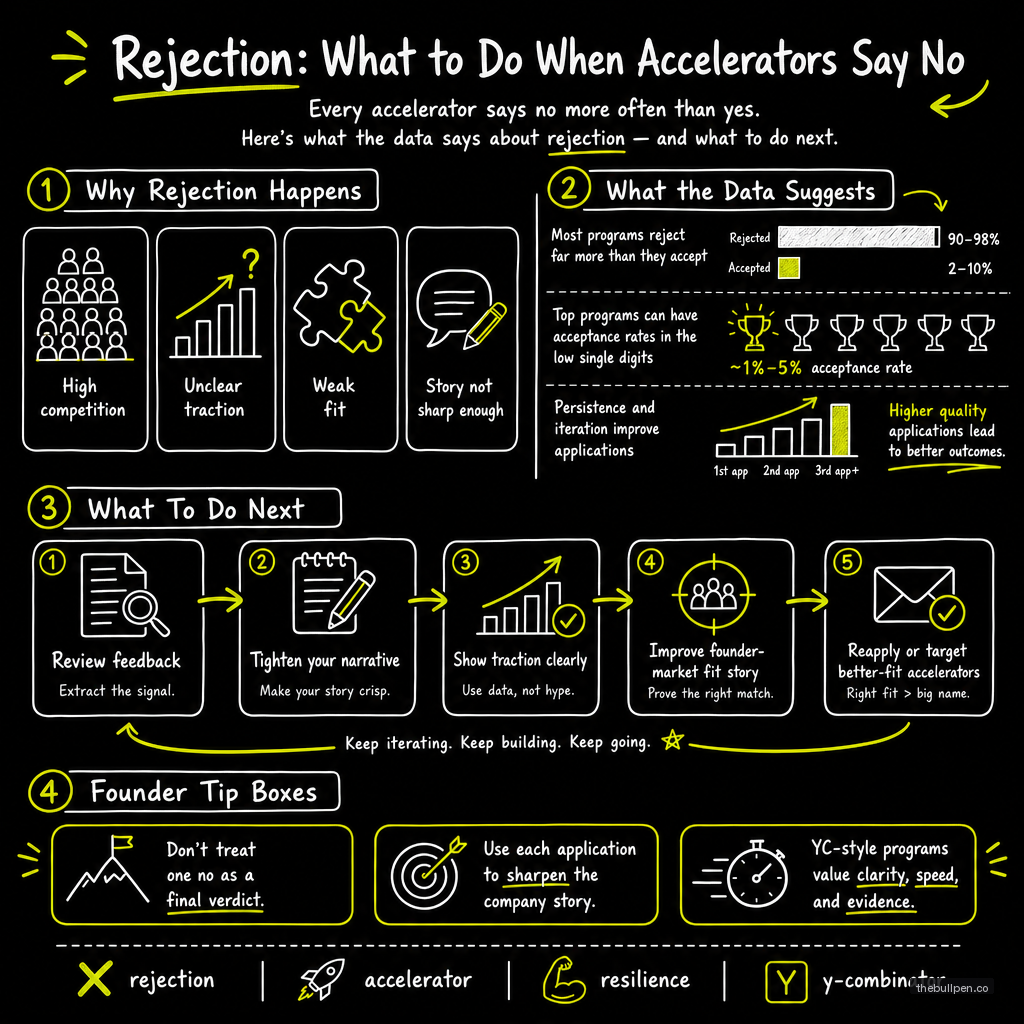
Rejection: What to Do When Accelerators Say No
The odds were never in your favor. Y Combinator accepts roughly 1.5–2% of applicants — meaning 98% of founders hear "no" every single batch. Nobody talks about that second number on demo day.
Rejection from an accelerator is not a signal about your startup's potential. It is a signal about fit, timing, and the brutal math of selection scarcity. The question is not whether you'll get rejected at some point. The question is what you do next.
The Numbers Are Grim — And Irrelevant
Let's put the data on the table. Across the major accelerator programs, acceptance rates hover in the single digits:
| Program | Acceptance Rate | Applicants per Batch |
|---|---|---|
| Y Combinator | ~1.5–2% | 15,000–20,000 |
| Techstars | ~1% | 10,000+ |
| 500 Global | ~2–3% | 5,000+ |
| Seedcamp | ~2% | 3,000+ |
These numbers make it clear: rejection is not an exception. It is the default outcome. Y Combinator alone rejects more than 14,000 companies each cycle. If you were rejected, you are in the company of the vast, vast majority.
More importantly, the companies that did get in were themselves rejected — by someone, somewhere — before they made it.
The Rejection Roll Call
Every startup founder knows these names. Fewer know how many times they were turned away before breaking through.
Airbnb applied to Y Combinator's summer 2008 batch and was rejected. The partners thought the idea was a bad one. They applied again for the winter 2009 batch and were accepted. That batch produced the most valuable startup in YC history. Paul Graham said of the decision: "Airbnb was one of the most impressive companies we've funded. We almost didn't fund them because we thought the idea was a bad one."
Stripe was rejected. So was DoorDash, which applied twice. Reddit also applied twice. Coinbase got a no. Segment submitted three applications before being accepted. Flexport . now a $8B logistics company , was turned away initially.
SendGrid was rejected by Techstars. The founders bootstrapped instead. SendGrid later went public and was acquired for $3 billion.
These are not exceptions to the rule. They are the rule. The difference between the founders who made it and the ones who didn't is rarely about the rejection itself. It is about what they did while sitting in the rejection.
Related: Common Accelerator Application Mistakes
Why Accelerators Say No (It's Not What You Think)
Founders almost always interpret rejection as a verdict on their product. It is usually not.
Accelerator partners evaluate hundreds of applications per day. They look for pattern matches: team quality, market size, traction trajectory, and , critically , how clearly the founder can communicate all three. If your application was unclear, generic, or failed to show rapid learning, that is a fixable communication problem, not a product problem.
Other common reasons for rejection:
- No clear evidence of traction. Not revenue necessarily , any signal that people want what you are building.
- Market too small or unclear. If the partners cannot picture a billion-dollar outcome from your one-pager, they pass.
- Founder-market mismatch. A team with no relevant domain expertise in a complex space raises red flags.
- Wrong timing. Your idea might be right, but five years too early or six months too late for the current thesis.
- Application quality. Typos, vague answers, missing metrics, or a generic "we'll change the world" pitch.
Every one of these is fixable. None of them mean your startup should not exist.
Related: How to Reapply After Accelerator Rejection (Coming soon — November 24, 2026)
What to Do Now: A Four-Part Action Plan
Rejection came. It stings. Now move forward. Here is the playbook.
1. Course-Correct, Then Reapply
The most straightforward path: fix whatever was wrong and apply again. Y Combinator and Techstars explicitly encourage reapplications. Many founders who get in on their second or third attempt say the gap year , or gap batch , was essential. They used the time to build real traction, sharpen their pitch, and accumulate the kind of evidence that cannot be faked in a written application.
Do not reapply with the same application. Changed outcomes require changed inputs.
2. Try Other Programs
Y Combinator is not the only game. Niche accelerators , focused on a specific vertical, geography, or founder background , often have higher acceptance rates and more relevant networks. A health-tech startup may get more value from Rock Health or StartUp Health than from a generalist program. A B2B SaaS company in the Midwest might find a better home at gener8tor or Techstars' Chicago program.
Use the accelerator's specific mentorship and network, not just the brand name. A tier-two program where you are a priority is better than a tier-one program where you are invisible.
3. Bootstrap and Build Proof
No accelerator means no dilution and no schedule pressure. Use the leverage. SendGrid bootstrapped after Techstars said no. They built a real business , one that generated real revenue and real customers , on their own terms. By the time they raised institutional capital, they had negotiating power.
Traction is the best rejection antidote. Every month you spend growing your user base, revenue, or engagement metrics makes future applications , or future fundraising , stronger.
4. Join a Niche or Vertical-Specific Program
If a generalist accelerator said no, consider a program that targets your specific space. Niche programs often have deep domain expertise and a more relevant network. They also evaluate you against a smaller, more focused applicant pool.
The result is not just a higher acceptance rate. It is a cohort of peers who understand your specific challenges and a mentor network that can actually help with them.
The Uncomfortable Truth About Accelerators
Fewer than 10% of unicorns emerged from a traditional accelerator program, according to PitchBook data. The vast majority of billion-dollar startups were built with no accelerator at all. Some used angel funding. Some bootstrapped. Some raised venture capital directly.
Accelerators are a distribution advantage, not a survival requirement. They compress learning, open doors, and provide signal. But they are not the only path , and for many successful companies, they were not the path at all.
Rejection from an accelerator tells you one thing: you did not fit that program's selection criteria on that day. It tells you nothing about your ability to build a company that matters.
The founders who win are the ones who treat every no as a data point and keep moving. That is the only application that never gets rejected.
Published on the Bullpen Blog. New articles every day at 9 AM UTC.
Get weekly pitch tips
One email a week. Actionable advice for founders.
Your Demo Day pitch, evaluated in 2 minutes. Try now →