How to Apply to Multiple Accelerators at Once
Managing deadlines and tailoring applications.
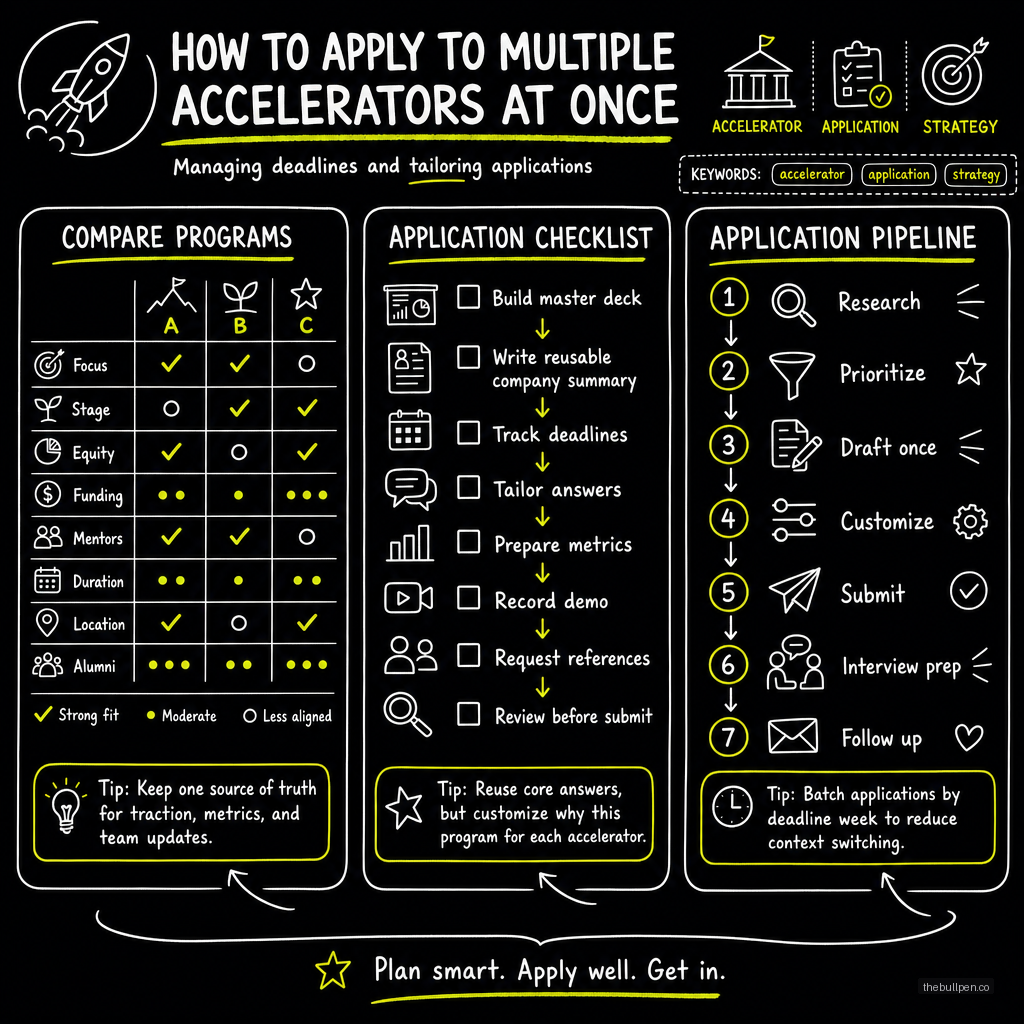
Multi-applying gets labeled as desperation by some founders who prefer a single-target strategy. In practice, it is the rational approach to a numbers game where single-program acceptance rates sit at 1 to 3 percent. Founders who submit to one accelerator per cycle leave their outcome to luck. Those who apply to six or eight build a system around probability, feedback, and optionality.
YC receives roughly 25,000 applications per batch and accepts about 250. That is a 1 to 2 percent acceptance rate. Techstars runs city-specific programs that each see hundreds of applicants for 10 to 15 slots, roughly 1 to 1.5 percent per program. 500 Global processes around 7,000 applications per cycle and accepts 3 to 5 percent. Seedcamp evaluates approximately 3,000 applications for 2 to 3 percent acceptance. These numbers make a single-application strategy a near-certain rejection.
The math shifts with volume. Applying to seven programs at 2 percent acceptance each yields roughly a 13 percent chance of getting into at least one. More importantly, multiple applications in flight create overlapping decision windows. A founder who receives an offer from one program can use it as leverage or context when evaluating another. Getting in somewhere matters. Having a choice across multiple options matters more.
Paul Graham summarized the industry sentiment concisely: "Applying to multiple accelerators is fine." Accelerator managers see multi-applications constantly. The only behavior that raises a red flag is accepting two offers simultaneously and attempting to hold both.
Related: The Ultimate Guide to Startup Accelerators
How Acceptance Rates Stack Up
The table below shows the four major programs a typical founder considers in a single batch cycle. The numbers are approximate but directionally accurate based on published data and founder-reported figures.
| Program | Applications | Slots | Acceptance Rate |
|---|---|---|---|
| Y Combinator | ~25,000 | ~250 | 1-2% |
| Techstars (per city) | ~500-1,000 | ~10-15 | 1-1.5% |
| 500 Global | ~7,000 | ~210-350 | 3-5% |
| Seedcamp | ~3,000 | ~60-90 | 2-3% |
The variation is real. 500 Global's higher acceptance rate reflects its broader geographic mandate and larger batch sizes. Techstars' city-level programs are more selective per application because each program has a specific thesis tied to its local ecosystem.
Some founders misread these numbers as a ranking. A lower acceptance rate does not mean a better program. It often means a program receives more applications from founders who do not fit. A founder building a hardware product may have better odds at a Techstars program with a hardtech focus than at YC, even if YC's aggregate rate is similar. Context matters more than the headline percentage.
Building Your Program List
A practical target is five to eight applications per batch cycle. Any fewer leaves too much to chance. Any more dilutes the quality of each submission.
Organize them by program type while keeping prestige as a secondary consideration. YC and Techstars are batch-driven with fixed deadlines. 500 Global and Seedcamp accept applications on a rolling basis. A founder targeting the summer cycle should align YC's summer deadline (applications open in March), Techstars spring programs (applications due a few months before each program start), and the rolling windows of 500 Global and Seedcamp so that decision waves arrive within a few weeks of each other.
This timing overlap is the hidden advantage of multi-applying. When offers land in the same two-to-three-week window, a founder evaluates them side by side instead of accepting the first one out of fear that no others will come.
Tailoring Each Application
A copied application signals that the founder has not done their homework. Each program evaluates startups through a different lens, and the application should match that lens.
YC focuses on team quality and traction. The application emphasizes the founders' background, the problem they are uniquely positioned to solve, and growth metrics that demonstrate product-market pull. The questions are short and direct. Answers should be specific and data-heavy.
Techstars emphasizes mentorship potential. The application is longer and includes questions about what kind of guidance the founders need. A strong Techstars application names specific gaps the program's mentors can fill. A founder who says "we need help with enterprise sales" signals readiness to engage with the mentor network.
500 Global looks for growth potential and international ambition. The application rewards founders who articulate a clear path to scale across markets. Traction matters, and so does the story of how the startup will reach a global audience.
Seedcamp evaluates European fit and product quality. The application tends to favor founders who understand the European market landscape and have early signals of product adoption within that context.
The video application should be unique per program. Record a core version and customize the opening thirty seconds for each accelerator. A YC video that starts with traction numbers and a Techstars video that starts with a mentorship ask both feel authentic to their audiences.
Related: Y Combinator Application Guide
Real Examples: Segment and Lambda School
Segment was rejected by YC in its early days. The founders applied to 500 Global, got accepted, and used the program to refine their product and go-to-market approach. Later, after building meaningful traction through 500 Global's network, they were accepted into YC. The multi-application approach gave them a path into an accelerator that fit their stage at the time instead of waiting for an aspirational acceptance.
Lambda School's founders applied to YC and Techstars simultaneously. When Techstars extended an offer, they used the program's structure and feedback to improve their business model. The Techstars experience reshaped their thinking about the product, which made their subsequent YC application stronger. The multi-application did not hurt them. It accelerated them through two different program styles.
Both stories share a common thread: the founders did not treat accelerators as a static ranking. They treated them as tools for different stages of building a company. The first program did not have to be the last program.
Managing the Calendar
Batch-driven programs run on fixed schedules. YC has two per year. Techstars runs multiple city programs across the year with quarterly start dates. Rolling programs like 500 Global and Seedcamp accept applications year-round and make decisions on a rolling basis.
A workable calendar for the summer cycle:
| Milestone | Target Date |
|---|---|
| YC summer application due | March |
| Techstars spring interviews | January-April |
| 500 Global rolling application | Submit anytime with strong story |
| Seedcamp rolling application | Submit anytime |
| Decision overlap window | May-June |
The goal is to submit all applications within a six-to-eight-week window so that decisions cluster. A founder who submits to YC in March, a Techstars program in February, and 500 Global in March can expect to hear back from all three between April and June. That overlap is when the real strategy begins.
Handling Multiple Offers
A founder who receives more than one offer has entered a different negotiation. The programs implicitly compete. A founder can share one offer with another program and ask whether terms can be improved. This is standard practice. Accelerators expect it.
The terms worth comparing include equity taken, cash invested, program duration, location requirements, and follow-on funding support. A program that takes 7 percent with a lower cash investment may be better than one that takes 6 percent with more cash, if the network or alumni outcomes are stronger. A program in a city the founders want to live in has a hidden value that does not appear in the term sheet.
Cohort size matters. A YC batch of 250 to 300 companies means the founder competes for partner attention. A Techstars cohort of 10 to 15 means the founder gets direct mentorship from every partner. Smaller is not always better, and the difference should factor into the decision.
The only unacceptable behavior is accepting two offers at the same time and trying to defer one. Accelerators share information. A founder who tries to double-commit will burn relationships permanently.
Related: Choosing Between Accelerator Offers (Coming soon — October 25, 2026)
Keeping Bridges Intact
Rejections happen to most founders. YC rejected Airbnb. 500 Global rejected companies that later became unicorns. A rejection signals fit for that batch at that time more than it judges the startup's overall viability.
If one accelerator accepts and others reject, the founder should decline the rejected programs professionally. A short note thanking the reviewers, acknowledging the decision, and expressing interest in future opportunities keeps the door open. Many founders reapply to the same program in a later cycle with stronger traction and get accepted.
If a founder declines an offer to join a different program, that relationship matters too. Accelerator managers track how founders handle themselves. A respectful decline with specific reasoning leaves a positive impression that can lead to future intros, investments, or partnerships.
The accelerator ecosystem is smaller than it looks. The manager who reads an application today may be a partner at a venture fund tomorrow. The founder who handles rejection directly and acceptance professionally builds a reputation that outlasts any single program decision.
Related: How to Reapply After Accelerator Rejection (Coming soon — November 24, 2026)
The Practical Workflow
Building five to eight tailored applications in one cycle requires a system. Start with a master document containing the core company story, traction metrics, team backgrounds, and market data. Then create a version of that document customized for each program's emphasis.
For YC, lead with the team and growth numbers. For Techstars, lead with the mentorship needs and coachability. For 500 Global, lead with the international growth story. For Seedcamp, lead with European product-market fit.
Track deadlines in a single calendar. Set internal deadlines two weeks before each program's actual deadline to leave room for review and iteration. Use the video application as a forcing function; if the video is ready, the written application is usually close behind.
The founders who get into multiple accelerators combine strong fundamentals with a strategic approach to the application process.
Published on the Bullpen Blog. New articles every day at 9 AM UTC.
Get weekly pitch tips
One email a week. Actionable advice for founders.
Your Demo Day pitch, evaluated in 2 minutes. Try now →