Seedcamp: Europe's Leading Accelerator, Explained
Seedcamp is Europe's answer to Y Combinator — but it operates more like a rolling venture fund than an accelerator program. Here's how it works, what it invests, and whether it's right for your startup.
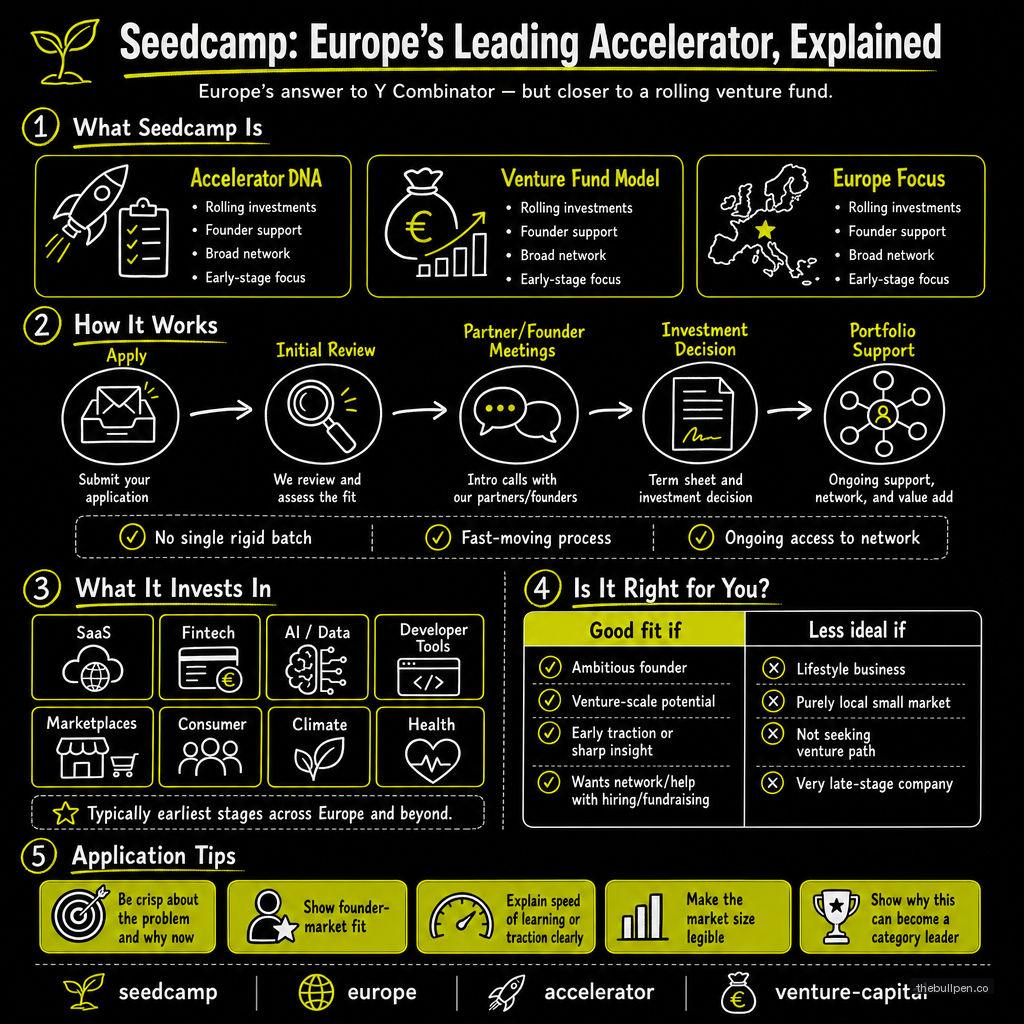
If Y Combinator is the default answer for "which accelerator should I apply to," Seedcamp is the answer most US-centric founders don't know they should be considering. Founded in London in 2007 by Saul Klein and Reshma Sohoni, Seedcamp has quietly built the strongest early-stage portfolio in Europe — 550+ companies, $100 billion-plus in combined enterprise value, and twelve unicorns including Revolut, UiPath, Wise, and Synthesia.
But Seedcamp operates more like a rolling seed-stage venture fund than a traditional accelerator. It writes first checks year-round, processes applications in roughly two weeks, and supports founders through a network of 1,250-plus alumni and a team of operating partners who cover hiring, GTM, marketing, product, finance, and legal.
The distinction matters because it changes who the program is for. If you're looking for the YC experience — the batch, the pressure cooker, the demo day sprint — Seedcamp will feel underwhelming. If you're looking for a capitalized partner who moves fast, writes meaningful checks, and stays involved indefinitely, Seedcamp is one of the best options in Europe.
Related: The Ultimate Guide to Startup Accelerators
The Seedcamp Model
Seedcamp describes itself as a founder's "first backer." The pitch is simple: apply, get a decision within two weeks, and if accepted, receive a first check of $350,000 to $1 million as a lead or co-lead investor.
| Dimension | Seedcamp | Y Combinator | Techstars |
|---|---|---|---|
| Founded | 2007 (London) | 2005 (SF) | 2006 (Boulder) |
| Structure | Rolling VC fund | Fixed batches (2x/year) | Fixed cohorts (3-month) |
| First check | $350K-$1M | $500K ($125K + $375K SAFE) | $220K |
| Equity | Negotiated (lead/co-lead) | 7% standard | 6% standard |
| Portfolio size | 550+ companies | 5,000+ companies | 2,600+ companies |
| Unicorns | 12 ($1B+) | 200+ | ~30 |
| Portfolio value | $100B+ | $600B+ | Not disclosed |
| Decision speed | ~2 weeks | ~2-3 weeks | ~2-3 months |
| Geography | Europe-focused | US-centric | Global (40+ programs) |
The most striking difference is in portfolio concentration. Seedcamp has 12 unicorns out of 550 total companies — roughly 2%. YC has 200-plus unicorns out of 5,000 companies — roughly 4%. The ratios aren't far apart, and Seedcamp's portfolio includes companies that hit valuations their size founders could never have accessed from a US-only accelerator. Revolut alone is worth $75 billion. Synthesia hit a $4 billion valuation after its Series E. UiPath went public on the NYSE.
What Seedcamp Actually Does for Founders
Seedcamp doesn't have a demo day. Instead, it offers a set of services designed to replace the structural support that a cohort-based model provides.
The expert collective is the most valuable piece — a global network of domain specialists who take introductions from Seedcamp portfolio companies. Need a VP of Engineering who's scaled a fintech to 200 people? Seedcamp can find three. Trying to navigate UK financial regulation? They have a partner who's done it twice.
The community piece matters more than most founders expect. Seedcamp Nation — the alumni network of 1,250-plus founders — functions as a private deal flow and support network. There are 30-plus global founder events per year, an annual ski trip (Skeedcamp is real, and it's as ridiculous as it sounds), and a continuous stream of customer introductions and hiring referrals.
The team itself is small and experienced. Reshma Sohoni and Carlos Espinal have been running Seedcamp together for over a decade. They've seen more European startup cycles than almost anyone else in the ecosystem. That depth of pattern recognition is something a new VC fund can't replicate and a program like Y Combinator can't match for the European context.
Related: Techstars vs Y Combinator: Which Accelerator Is Right for You?
The Portfolio: What Success Looks Like
The seedcamp portfolio is weighted toward B2B, fintech, and AI — reflecting both the strengths of the European tech ecosystem and the team's investing preferences.
| Company | Sector | Stage | Valuation / Outcome |
|---|---|---|---|
| Revolut | Fintech | Public company | $75B valuation (2026) |
| UiPath | RPA / AI | Public (NYSE: PATH) | $10B+ at IPO |
| Wise | Fintech | Public (LSE: WISE) | $11B at IPO |
| Synthesia | AI Video | Series E ($200M) | $4B valuation |
| Sorare | NFT/Gaming | Series B | Unicorn |
| Pleo | Spend management | Series C | Unicorn |
| 9fin | Fintech/Data | Series B | $1.3B (2026) |
| wefox | Insurtech | Series C | Unicorn |
The Revolut story is the biggest. Seedcamp invested early, before Revolut was a household name in Europe. When the company hit a $75B valuation in 2026, the seed-stage checks Seedcamp wrote turned into hundreds of millions in paper value. That kind of outcome is rare — it's the top of the distribution. But it shows what can happen when a European fund backs a European company with global ambitions from day one.
Wise is the other standout. Seedcamp sold a partial stake in Wise in 2017 at a significant gain, described at the time as "one of the best European seed exits in recent years that wasn't an acquisition or IPO." The discipline to take partial liquidity while keeping exposure to the upside is something most early-stage investors get wrong.
Who Should Apply
Seedcamp works best for European founders building B2B or fintech products with global potential. The fund is rolling — there's no application deadline, no batch start date. If you're ready, you apply, and the process moves in weeks.
The sweet spot is pre-seed to seed: companies that have some traction (revenue, users, or clear customer demand) but haven't raised institutional capital yet. Seedcamp likes to lead or co-lead rounds, which means they want to set the terms and bring in a syndicate of angels and other funds alongside them.
If you're a US-based founder, Seedcamp is probably not your best option. Y Combinator or Techstars will give you better access to US investors and a stronger brand in the American market. If you're a European founder looking for a first institutional backer who understands your market, Seedcamp should be on your shortlist alongside local options in your ecosystem.
Performance and Track Record
Seedcamp's financial performance is solid by any standard. It returned its first fund at roughly 2x in 2016. Funds I and II were acquired by Draper Esprit in 2017 for $26.3 million, delivering a 4x return to limited partners. Fund VI, closed in 2023 at €166 million, is the largest fund in the firm's history — more than double the size of its previous vehicle.
The portfolio metrics are clean: $100 billion-plus in total enterprise value, 30-plus companies valued above $100 million, 12 above $1 billion. For a firm that's written early checks into over 550 companies, the hit rate at the top end is competitive with any seed-stage fund in the world.
The open question is whether Seedcamp can maintain its hit rate as it scales. Fund VI at €166 million means larger checks and more capital to deploy. Bigger funds create pressure to write larger rounds into more companies, which can dilute the quality of the portfolio. Seedcamp's returns so far have been driven by a small number of outsized wins — Revolut, UiPath, Wise — and the question every limited partner asks is whether the next Revolut is still out there.
Related: The Complete Y Combinator Application Guide
The Bottom Line
Seedcamp is the closest thing Europe has to a Y Combinator, but it's not a YC clone. The rolling application model, the emphasis on first checks and lead rounds, and the deep European network make it a distinct option for founders building on this side of the Atlantic. If you're a European founder with a B2B or fintech product and some early traction, Seedcamp should be one of the first five conversations you have.
If you're looking for a structured program with a demo day and a cohort of peers, look elsewhere. Seedcamp is a venture fund that calls itself an accelerator. The distinction matters more than most founders think.
Published on the Bullpen Blog. New articles every day at 9 AM UTC.
Get weekly pitch tips
One email a week. Actionable advice for founders.
Your Demo Day pitch, evaluated in 2 minutes. Try now →