Entrepreneur First: The Talent-First Accelerator Model
Entrepreneur First doesn't want your startup idea. It wants you. The talent-first accelerator has spawned over 600 companies and produced 3 unicorns — but the path through it is unlike anything in traditional startup building.
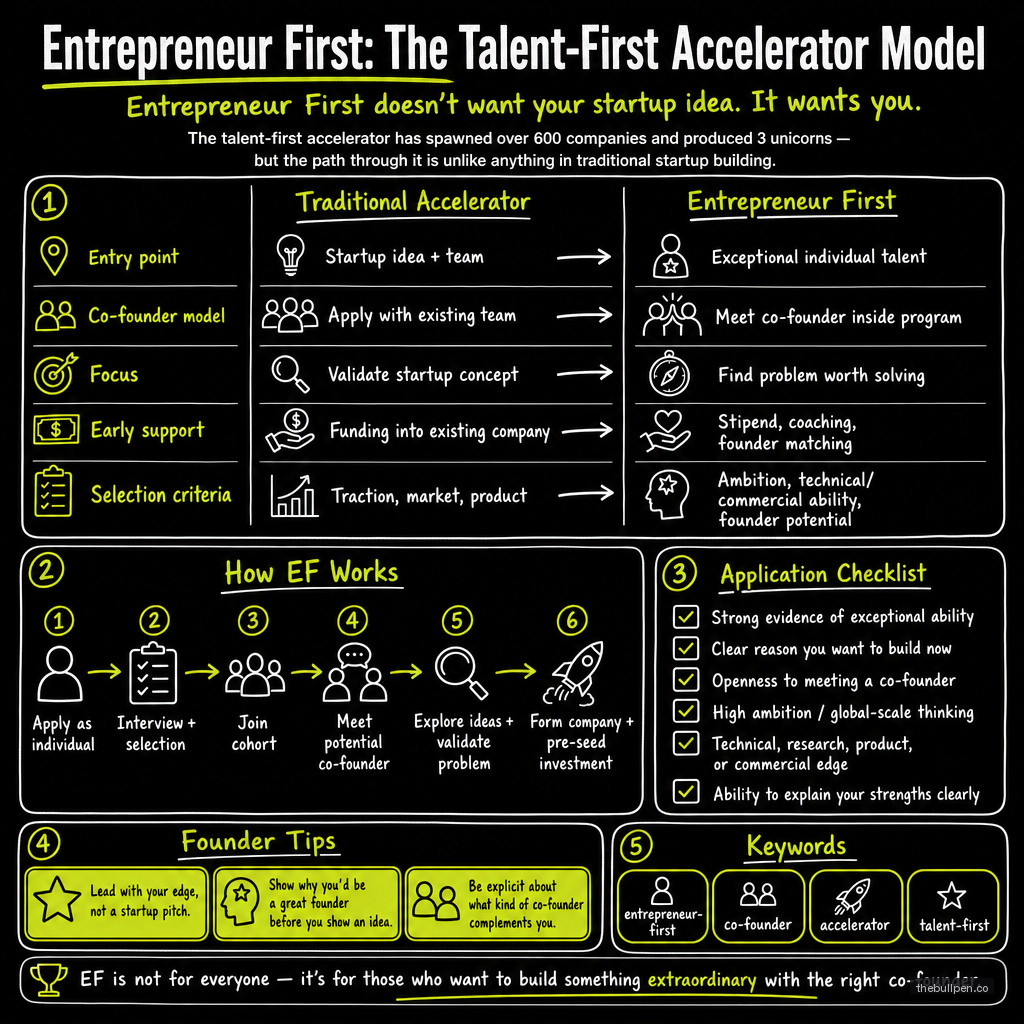
Most accelerators have the same entry requirement: bring a startup. Bring a team, bring an idea, bring traction — ideally all three. Y Combinator wants to see founders who've already built something. Techstars wants to see a problem you've validated. 500 Global wants signals of product-market fit.
Entrepreneur First doesn't want any of that. It wants you — alone, maybe with a vague sense that you want to start something, maybe with nothing more than a technical skill and the willingness to quit your job. Submit an application describing who you are, not what you're building. If you get in, EF will match you with a stranger, give you a stipend, and expect you to form a company from scratch in twelve weeks.
The model sounds insane. It has produced over 600 companies, a combined portfolio valuation above $16 billion, and some of the most interesting startups in Europe. It has also produced a lot of broken co-founder relationships and people who spent three months of their life building something that went nowhere. Both things are true at the same time.
Related: The Ultimate Guide to Startup Accelerators
How EF Actually Works
Entrepreneur First operates in two distinct phases: Form and Launch. You don't get to Launch unless you survive Form, and most people don't.
Phase 1: Form (Weeks 1-12)
You arrive as an individual. No co-founder, no idea, no company. The cohort — typically 50 to 80 people — is a mix of engineers, designers, product thinkers, scientists, and domain experts. EF runs structured exercises designed to surface who you are as a builder: what you care about, what problems you see, what skills you bring.
The matching process is the core of the program. You spend weeks 2 through 8 meeting potential co-founders. EF claims roughly 80% of participants find a co-founder within this window. If you haven't matched by week 8, you leave the program.
The psychology here is different from any other accelerator. In YC, you're a team protecting your idea. In EF, you're a single person trying to convince someone else to bet their career on you. The dynamic flips from "here's what I've built" to "here's who I am and why you should work with me." It's more like speed dating for founders than a startup program.
| Phase | Duration | What Happens | Gate |
|---|---|---|---|
| Apply | 2-4 weeks | Submit personal application (no idea needed) | ~2-3% acceptance |
| Form | 12 weeks | Co-founder matching + idea formation | Must match by week 8 |
| Investment Committee | 1 week | Pitch the idea to EF partners | Must pass IC |
| Launch | 12 weeks | Build + prep for Demo Day | Demo Day pitch |
| Post-Demo Day | Ongoing | Fundraising support | ~$2-7M typical round |
If you match and form a viable idea, you present to EF's Investment Committee. This is the second major filter. The committee doesn't just evaluate your idea — they evaluate whether you and your co-founder can work together under pressure. Roughly 60% of matched pairs pass IC and move to Launch.
Phase 2: Launch (Weeks 13-24)
The Launch phase is where EF looks more like a traditional accelerator. You get $50K to $250K in pre-seed funding (typically $80K for ~8% equity), cloud credits from AWS, Azure, and Google Cloud, and access to EF's network of investors and operators. Since October 2023, all Launch participants must relocate to San Francisco for this phase.
Demo Day at EF is structured differently from YC or Techstars. Instead of pitching to a room of 300 investors in one shot, EF runs a series of smaller, curated investor meetings over several weeks. The approach is more surgical — EF matches your specific company to the specific VCs most likely to write a check.
Companies that come out of EF's Launch phase typically raise $2-7 million within a few months of Demo Day. Some raise more. Tractable raised a $25 million Series B. Cleo raised a $44 million Series C. But those are the top end, and they're not the norm.
Related: Techstars vs Y Combinator: Which Accelerator Is Right for You?
What the Portfolio Actually Looks Like
EF has produced some genuinely impressive outcomes. The portfolio spans AI, fintech, crypto, biotech, climate, and hard tech — the same diversity you'd expect from individually recruiting scientists, engineers, and domain experts rather than selecting for a specific market thesis.
| Company | Sector | Notable Milestone | EF Cohort |
|---|---|---|---|
| Tractable | AI/Insurance | $1B+ unicorn, SoftBank backed | 2014 |
| Cleo | Fintech | $44M Series C, 4M+ users | 2016 |
| Magic Pony Technology | AI/Video | Acquired by Twitter for ~$150M, 18 months after founders met at EF | 2015 |
| Sonantic | AI/Voice | Acquired by Spotify (2022) | 2021 |
| Permutive | AdTech | SoftBank backed, Series C | 2015 |
| Aztec | Blockchain/Privacy | a16z backed, Ethereum privacy | 2018 |
| Omnea | Procurement | First Round Capital backed | 2022 |
| Magdrive | Space Propulsion | Founders Fund backed | 2020 |
Magic Pony Technology is the story EF tells most often, and it's the best argument for the model. Two people who didn't know each other met at EF in 2015, started working on AI video compression in London, and sold the company to Twitter for $150 million eighteen months later. That kind of outcome is rare — but it's the kind of thing that can happen when you assemble very smart people in a room and force them to start companies.
The portfolio valuation of $16 billion across 600+ companies works out to roughly $26 million per company on average. That's not bad for a portfolio where most companies are less than five years old. But averages hide the reality: a handful of companies drive the vast majority of the value.
The Catch: Where EF Breaks Down
The talent-first model has real structural weaknesses, and anyone considering EF should understand them upfront.
The conversion problem. Only 20-30% of EF participants raise VC funding after the program. Most others take jobs, start something independently, or go back to their previous careers. The 600+ companies EF claims includes everyone who passed IC and incorporated — not everyone who raised institutional money. If you go through EF and don't find a co-founder, or find one but can't raise, you've spent three to six months with no salary and a potentially expensive lesson.
The equity question. EF takes roughly 8-10% of your company for the $50-250K pre-seed investment. For context, YC takes 7% for $500K. EF's deal is more expensive both in absolute equity percentage and in valuation terms, because your company at the EF stage has zero revenue, zero users, and often zero code. You're giving up a significant piece of something that doesn't exist yet.
| Accelerator | Equity Taken | Investment | Stage Required |
|---|---|---|---|
| Entrepreneur First | ~8-10% | $50-250K | Pre-idea (individual) |
| Y Combinator | 7% | $500K | Prototype + team |
| Techstars | 6-10% | $120K | MVP + team |
Co-founder divorce. The 8-week matching process is designed to be fast, and it works — most people find someone. But a relationship formed in two months under artificial pressure is not the same as one forged through shared hardship over years. Some pairs survive. Many don't. When co-founders split post-EF, it's usually messy because EF requires a 50/50 equity split at incorporation. Undoing that later is painful and sometimes impossible.
The SF relocation requirement. Since late 2023, EF requires all Launch-stage participants to relocate to San Francisco. For European founders — EF's original core demographic — this is a significant ask. It increases costs, complicates visas, and fundamentally changes who the program is for. The move made strategic sense (US investors write bigger checks), but it narrowed EF's pipeline.
Related: The Dark Side of Accelerators: What Nobody Tells You (Coming soon — October 13, 2026)
Who Should Apply
EF works best for a specific type of person: technically strong, early enough in their career that they can afford 6 months of risk, and lacking a specific idea or co-founder. If you're a senior engineer at a FAANG company with a startups-in-general itch but no specific startup in mind, EF is designed for you. If you're a PhD who wants to commercialize research but has never talked to a customer, EF will force you to try.
EF does not work well for: experienced founders who already know what they want to build, operators with deep domain expertise who should raise on their own terms, anyone who can't afford to be without income for 3-6 months, or people who need structured mentorship (EF is lighter on mentorship than Techstars or 500 Global).
The best proxy for whether EF is right: can you name three people who would work with you before you've started? If yes, you probably don't need EF. If no, EF might be the fastest way to find them.
The Bottom Line
Entrepreneur First is the most innovative accelerator model to emerge in the last fifteen years. It solved a real problem — the shortage of high-quality technical co-founders — by inverting the application process. Instead of asking "what are you building," it asks "who are you." That shift unlocked a pipeline of talent that traditional accelerators couldn't reach.
The model's limits are structural. 8-10% equity for pre-idea funding is expensive. The 20-30% conversion rate means most participants don't get the outcome they hoped for. The forced 50/50 split is a time bomb for many co-founder pairs. And the SF relocation requirement has changed what EF is.
But if you're a strong individual contributor who wants to start something and doesn't know where to begin, there's no faster way to find a co-founder, get a check, and force yourself into motion. Whether EF makes sense depends entirely on whether you're the kind of person the talent-first model is built for — and the answer takes a lot of honesty.
Published on the Bullpen Blog. New articles every day at 9 AM UTC.
Get weekly pitch tips
One email a week. Actionable advice for founders.
Your Demo Day pitch, evaluated in 2 minutes. Try now →