500 Global: Inside the World's Most Global Accelerator
500 Global is the most geographically diverse accelerator in the world — operating across 80+ countries with a focus on emerging markets. Here's how it works, what it costs, and who it's for.
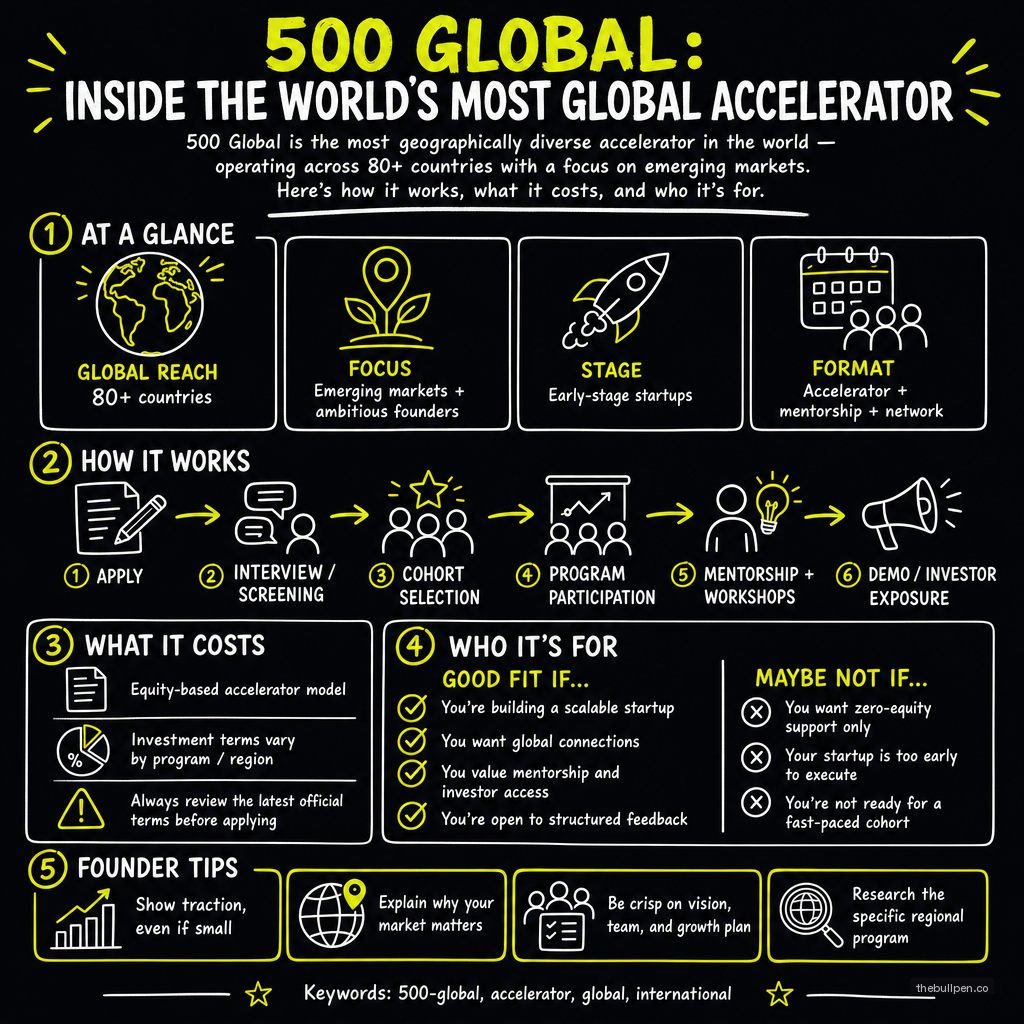
When founders think about accelerators, they think about Y Combinator and Techstars. Those are the two biggest names, the ones with the best-known alumni, the ones every blog post compares. But there's a third accelerator that has quietly become the most geographically diverse in the world, with a portfolio that spans more than 80 countries.
500 Global — formerly 500 Startups — has funded over 2,800 companies across 80-plus countries. They operate seed-stage programs in San Francisco, Mexico City, Bangkok, Dubai, and dozens of other locations. Their thesis is simple: great founders exist everywhere, and most venture capital is concentrated in a handful of cities.
In many parts of the world, 500 Global is the only major accelerator that will even consider a local founder. That alone makes it worth understanding.
Related: The Ultimate Guide to Startup Accelerators
How 500 Global Is Different
The most obvious difference is geographic. YC operates in San Francisco. Techstars operates in 50 cities but is concentrated in North America and Europe. 500 Global operates across Latin America, Southeast Asia, the Middle East, Africa, and Europe — plus their flagship Silicon Valley program.
The program model is also different. 500 Global runs shorter, more flexible programs than either YC or Techstars. Their seed program is four weeks of structured curriculum followed by ongoing support, rather than a fixed three-month residency. This makes it accessible to founders who can't relocate for an extended period.
The investment is structured as a standard SAFE with broadly similar terms to other top-tier accelerators, though the exact amount varies by program. The equity stake is comparable to Techstars — typically in the range of 5 to 8 percent — but the deal structure is designed to be founder-friendly and standardized across programs.
The portfolio approach is different too. 500 Global invests in more companies per fund than almost any other accelerator, which means less individual attention but a broader network. For founders who value portfolio diversity and international connections over hands-on mentoring, this tradeoff works well.
The 500 Global Advantage
The network is the asset. With 2,800-plus companies across 80 countries, the 500 Global alumni network is arguably the most international of any accelerator. If your business involves cross-border operations, emerging markets, or international expansion, the connections are unmatched.
The growth focus is another differentiator. 500 Global is known for being more growth- and distribution-oriented than other accelerators. Their curriculum emphasizes go-to-market strategy, growth hacking, and fundraising mechanics over product development. For founders who have a working product and need help scaling, this is a better fit than programs that focus on product-market fit.
The geographic flexibility matters more than most US-based founders realize. If you're building a startup in Mexico City, Bangkok, or Nairobi, your accelerator options are limited. 500 Global runs programs designed specifically for your ecosystem, with local mentors who understand your market. You don't need to move to San Francisco to get accelerator-quality support.
Who Should Apply
500 Global is the right choice if you're building a company outside the traditional startup hubs and want accelerator support without relocating. It's also a strong option if your business is inherently international — cross-border payments, global marketplaces, or anything that benefits from a geographically diverse network.
It's a weaker choice if you need intensive, hands-on support for early product development. The program is shorter and less structured than YC or Techstars, which means you need more self-direction. It's also less effective if your primary goal is the credential — 500 Global's brand recognition in the US is lower than YC's, though it's growing rapidly in international markets.
The application process is straightforward: a standard online application followed by interviews. Acceptance rates vary by program but are broadly competitive — expect single-digit percentages for the most popular programs.
The Bottom Line
500 Global fills a critical gap in the accelerator landscape. Not every founder can move to San Francisco or afford to spend three months away from their existing business. Not every company benefits from the Silicon Valley playbook. 500 Global's bet is that the next generation of great companies will come from everywhere, not just from the usual ZIP codes.
The data so far supports the thesis. Their portfolio includes companies like Canva (which participated in the 500 Global program in Australia), Grab (Southeast Asia's super-app), and Talkdesk (a cloud contact center platform valued at over $10B). Not bad for an accelerator that most US-based founders have never considered.
If you're building outside the US, or if your business is inherently global, 500 Global should be on your shortlist. It might be the only accelerator that actually understands your market.
Data sources: 500 Global portfolio data (2,800+ companies, 80+ countries, $35B+ aggregate portfolio value), program structure from 500 Global website and founder reports. Comparison data from YC and Techstars program documentation.
Ready to see how your startup would score with investors? Upload your pitch to Bullpen for a free AI-powered assessment across 7 investor categories.
Get weekly pitch tips
One email a week. Actionable advice for founders.
Your Demo Day pitch, evaluated in 2 minutes. Try now →