Demo Day Preparation: Make Every 3-Minute Pitch Count
The 3-minute demo day pitch is the most high-stakes presentation of your life. Here's how to structure it, what investors listen for, and how to avoid the mistakes that kill deals.
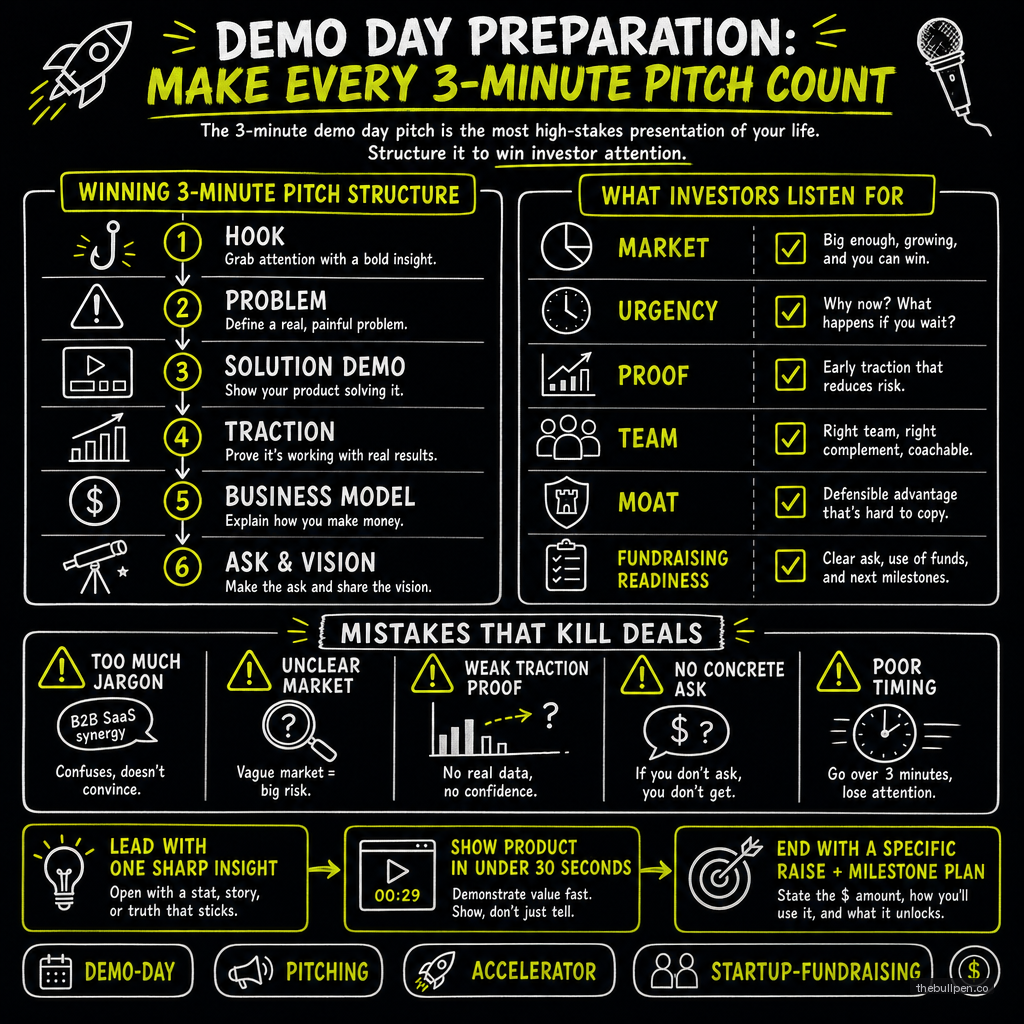
Demo day is a strange invention. You spend three months in an accelerator grinding on your product, your metrics, and your pitch. Then you get three minutes on a stage to convince a room full of investors that your company is worth their attention.
Three minutes is not a lot of time. It's roughly the length of a song. In that window, you need to establish a problem, present your solution, show traction, explain your market, describe your team, and ask for money. Most founders try to cram too much in and end up communicating nothing.
The best demo day pitches don't try to be comprehensive. They try to be memorable. Investors see 40 to 60 pitches in a single demo day. They will not remember the one that had the most slides. They will remember the one that made them feel something.
Related: The Ultimate Guide to Startup Accelerators
The Structure
Every great demo day pitch follows the same arc. You have about three minutes and roughly 500 words. Here's how to use them.
The hook (20 seconds). Start with a single sentence that makes the problem visceral. Not "enterprises struggle with data integration." That's abstract. "It takes the average Fortune 500 company 18 months to connect their CRM to their data warehouse." That's specific and painful. The hook is the only part of your pitch that every investor in the room will hear. Make it count.
The problem (30 seconds). Expand on the hook. Explain who feels the pain, how much it costs them, and why existing solutions don't work. Use one specific example or statistic. Don't list three. One is enough if it's the right one.
The solution (40 seconds). Show what you built and why it's different. A live demo is ideal if you can make it work in under 30 seconds. A screenshot with a clear before-and-after is the backup. Don't explain how it works. Explain what it does and why it matters.
The traction (40 seconds). This is the most important section. Investors at demo day are looking for signal that real people are using your product. Revenue is best. User growth is second best. Engagement metrics are third. Anything that proves demand. Show a chart, not a list of logos. A hockey-stick graph is worth a thousand customer logos.
The market (30 seconds). How big is this opportunity? Investors need to believe you can build a $100M company. A TAM slide with a single compelling number is enough. Don't read the analyst report. Just state the number and explain why you're positioned to capture it.
The ask (20 seconds). What are you raising and what will it get you? Be specific. "$1.5M to hire three engineers and a salesperson, reach $500K ARR in 12 months." That's concrete and believable. "We're raising to scale" is abstract and forgettable.
The close (10 seconds). Repeat your company name and what you do. Investors should leave knowing exactly who you are and what you're building.
The Three Mistakes That Kill Demo Day Pitches
Reading from slides or notes. This is the most common mistake and the most damaging. Investors want to feel like they're having a conversation with a confident founder, not watching a presentation. The best demo day presenters know their script cold and deliver it like they're telling a story, not reciting a memorized speech.
Showing too many slides at the wrong time. If you flip through slides faster than investors can read them, they'll stop trying to follow along. One slide per 30 to 45 seconds is the right pace. If you have 3 minutes, that's 6 to 8 slides max. Any more and you're losing them.
Ending without a clear ask. Founders who finish their pitch and say "thanks for listening" without asking for a meeting or an investment have wasted their three minutes. The close should be a direct call to action: "Come find me at table 12 after the session. I'd love to show you the product."
What Investors Are Actually Evaluating
Investors at demo day are not making investment decisions on the spot. They're deciding which companies to learn more about. Your goal is not to close the round in three minutes. It's to get 10 investors to raise their hand and say "I want to know more."
That distinction changes how you should think about the pitch. Don't optimize for closing the deal. Optimize for being memorable enough that an investor adds you to their list of companies to follow up with.
The follow-up after demo day is where the real work happens. Send personalized emails to every investor who expressed interest. Share your full data room. Offer a product demo or a customer reference call. The pitch is the beginning, not the end.
Data references: Y Combinator Demo Day structure and best practices, Techstars Demo Day preparation materials, DocSend data on pitch deck attention spans (average time per slide).
Ready to practice your demo day pitch? Upload your deck to Bullpen for a free AI-powered evaluation across 7 investor categories.
Get weekly pitch tips
One email a week. Actionable advice for founders.
Your Demo Day pitch, evaluated in 2 minutes. Try now →