How Real Founders Raised Their First Million: Lessons from the Trenches
Real stories from founders who have been through it — fundraising wins, failures, pivots, and the lessons they learned building their companies.
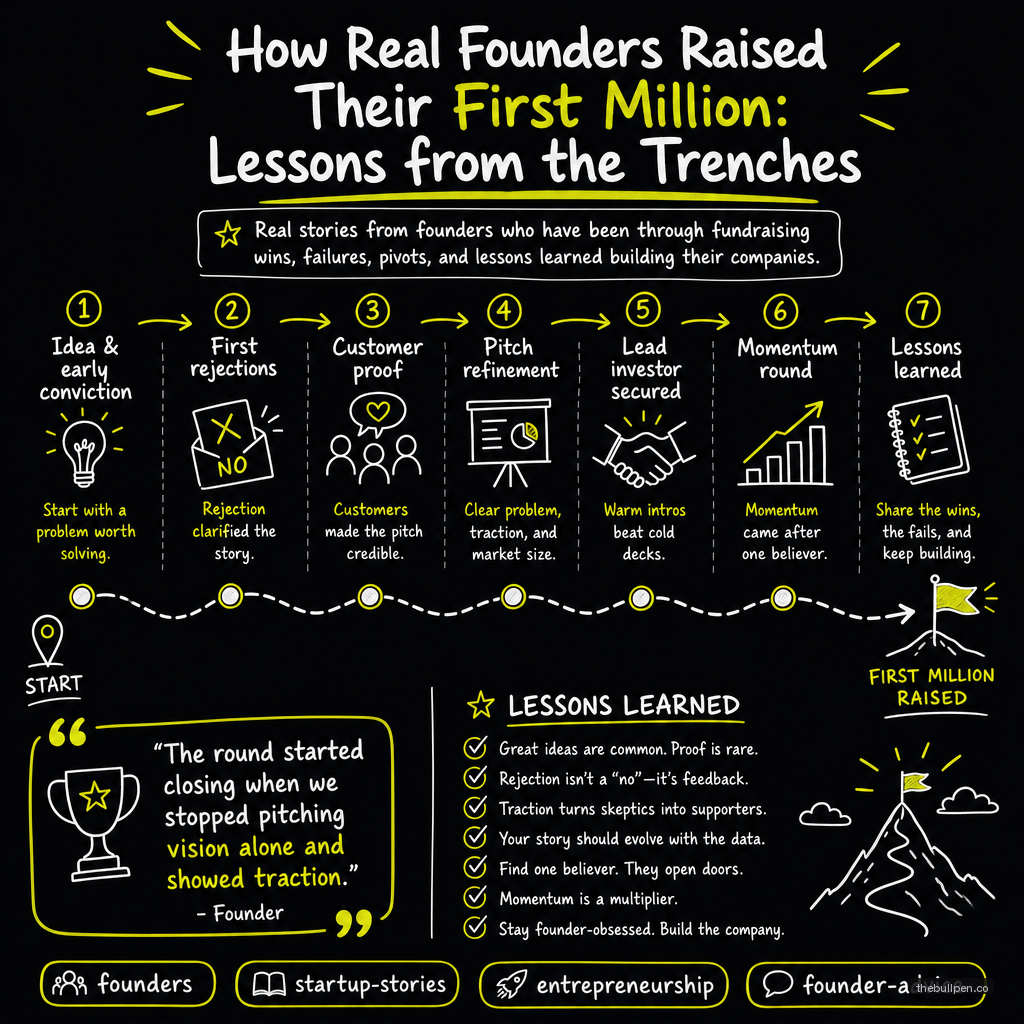
Every founder story is different, but they share DNA. The late nights questioning whether any of this will work. The investor who said no for the 47th time. The pivot nobody saw coming that saved the company. The moment a check finally arrived.
This guide collects the patterns that emerge from real founder journeys — not the sanitized LinkedIn versions, but the messy, honest stuff that actually teaches you something. Because there's no better way to learn fundraising than from people who've been through it and are willing to tell you what they'd do differently.
The Founder Journey: Common Arcs
Most founder stories follow one of a few patterns. Recognizing yours helps you navigate it better.
The Accidental Founder
Some of the best companies started as side projects, consulting gigs, or hobbies. The founders didn't set out to raise venture capital. They built something useful, people paid for it, and suddenly they had a business.
What these founders get right: they build for real users from day one, not for investor slides. What they struggle with: transitioning from builder to CEO, and learning to tell a compelling story about something that started as a side project.
Related: The Accidental Founder: How Side Projects Become Startups (Coming soon — October 12, 2026), Side Project to Startup: The Pivot Story (Coming soon — November 17, 2026)
The Pivot Story
Rare is the startup that launches exactly as planned and succeeds. Most successful founders changed direction at least once — sometimes radically. The pivot isn't a sign of failure. It's a sign of listening.
The best pivots happen when founders acknowledge a signal they've been ignoring. The worst happen when they pivot to chase investor trends without real customer conviction.
Related: Founder Pivot Stories: When Changing Direction Saved the Company, The Founder Who Pivoted 4 Times Before Finding PMF
The Bootstrapper Who Raised
Bootstrapping to revenue first, then raising growth capital, is one of the strongest positions you can be in. You negotiate from strength. You don't need the money, you want it — and investors can tell the difference.
The challenge: bootstrapped founders often undervalue themselves because they're used to running lean. They also struggle with the culture shift from "spend nothing" to "invest in growth."
Related: Bootstrapped to $10M ARR: The Full Story, Bootstrapping vs. VC: Founder Stories
Fundraising: The Human Side
The mechanics of fundraising are well documented. The emotional side is not.
Dealing with Rejection
The average founder hears "no" 50-100 times before their first "yes." That's not an indictment of your company. It's a math problem. Investors have specific mandates, check sizes, and partnership dynamics you know nothing about.
The founders who succeed treat rejection as routing, not judgment. They ask for feedback, refine their pitch, and move to the next name on their list. The ones who take rejection personally burn out before they get to the yes.
Related: Dealing with Investor Rejection: Stories from the Trenches (Coming soon — October 24, 2026)
The Emotional Toll
Fundraising is brutal on mental health. You're essentially asking strangers to judge your life's work, publicly and repeatedly. It brings out imposter syndrome, anxiety, and self-doubt in even the most confident founders.
Founders who protect their mental health during fundraising: maintain exercise routines, set boundaries on meeting schedules, talk openly with co-founders about stress, and remember that fundraising is a sprint, not their identity.
Related: The Emotional Toll of Fundraising: Founder Stories, Founder Mental Health Guide (Coming soon — January 13, 2027)
Imposter Syndrome
Almost every founder feels like a fraud at some point. The secret: investors know this. They've seen hundreds of founders. They're not looking for polished confidence. They're looking for honest self-awareness and resilience.
The best way to combat imposter syndrome is preparation. Know your numbers cold. Know your market. Know your competition. The better prepared you are, the less room imposter syndrome has to operate.
Related: Imposter Syndrome in Founders: Stories and Strategies
Building the Team
Your co-founder and early team are the most important fundraising asset you'll ever have.
Finding the Right Co-Founder
A great co-founder relationship is the single biggest predictor of startup success. It's more important than the idea, the market, or the timing. Yet founders spend more time choosing a vacation destination than choosing a co-founder.
Look for complementary skills, aligned values, and conflict resolution compatibility. The last one is the most overlooked. How you disagree matters as much as how you agree.
Related: How to Find a Co-Founder: A Practical Guide, Co-Founder Equity Splits: Getting It Right (Coming soon — January 9, 2027)
Co-Founder Breakups
Roughly 65% of startups fail due to co-founder conflict. The stories are brutal — products built on trust that shatters, cap tables frozen by dead equity, companies that die because two people can't communicate.
The lesson: vesting schedules, clear role definitions, and regular check-ins aren't bureaucratic overhead. They're insurance against the most common startup killer.
Related: Co-Founder Breakup Stories and Lessons Learned
Hiring Your First 10 Employees
Your first hires set the culture for everything that follows. They need to be adaptable, comfortable with ambiguity, and aligned with your mission — because there's no process manual and no HR department.
The founders who nail early hiring look for T-shaped people: deep expertise in one area and broad competence across others. They also hire slowly and fire quickly, which is harder than it sounds.
Related: Hiring Your First 10 Employees: Stories and Advice (Coming soon — September 24, 2026), Hiring Your First Executive (Coming soon — October 30, 2026)
Building a Board of Advisors
Advisors who've been through it before can save you from the mistakes they made. But not all advisors are created equal. The best ones give specific, actionable advice — not platitudes. They also make introductions.
Structure advisor relationships with clear expectations, equity grants (typically 0.25-1% total), and regular meeting cadences.
Related: Building a Board of Advisors (Coming soon — November 11, 2026)
Business Lessons From the Trenches
The mistakes are where the real learning happens.
First Business Model Was Wrong
Most founders change their business model at least once. The subscription model becomes usage-based. The marketplace becomes a SaaS platform. The agency becomes a product company. The ability to recognize when your model isn't working — and the courage to change it — is what separates successful founders from the rest.
Related: When Your First Business Model Was Wrong (Coming soon — January 21, 2027)
Pricing Experiments
Pricing is the most under-leveraged lever in a startup. A 10% price increase flows almost entirely to the bottom line. Yet most founders underprice out of fear.
The founders who nail pricing run experiments. They test tiers, they test anchoring, they test annual vs. monthly. They don't set pricing once and forget it.
Related: Pricing Experiments from Real Founders (Coming soon — November 29, 2026)
Knowing When You Have PMF
Product-market fit is a feeling before it's a metric. You know you have it when customers are disappointed when you're down, when they tell other people about you without being asked, and when growth feels effortless.
The leading indicator: NPS responses above 40. The lagging indicator: organic growth rate above 5% month-over-month.
Related: How to Know If You Have Product-Market Fit (Coming soon — January 17, 2027), Founder-Market Fit: Science vs. Art
The Startup Almost Died
Almost every successful startup has a near-death experience. Running out of cash. Losing a key customer. A co-founder leaving. The stories of how companies came back from the brink are the ones that teach the most.
The common thread: they found a way to extend runway, they communicated transparently with stakeholders, and they kept building during the crisis.
Related: Startup Almost Died Stories (Coming soon — September 30, 2026), Lessons from a Failed Startup
Operating as a Founder
Founder Burnout
The stats are sobering: 72% of founders report mental health struggles. Founder burnout isn't a badge of honor. It's an operational risk that destroys decision-making, relationships, and company value.
Prevention beats recovery. Set boundaries, delegate, and recognize that rest is a productivity tool, not a luxury.
Related: Founder Burnout: Stories and Prevention
The Solo Founder Journey
Solo founders face an uphill battle with investors. Most VCs prefer multi-founder teams, citing research on lower failure rates. But solo founders can succeed — they just need to be more deliberate about building a support system and advisory board.
Related: Solo Founder Journey: Challenges and Wins
Remote-First Lessons
Remote-first startups have different challenges around culture, communication, and coordination. The founders who make it work invest in async documentation, over-communicate, and create intentional social connection.
Related: Remote-First Startup Lessons (Coming soon — November 23, 2026)
Startup Lessons Nobody Tells You
Things no one warns you about: the loneliness of being the person everyone looks to for answers. The way your identity gets wrapped up in the company. The friendships that change when you're the founder. The constant low-grade anxiety that never fully goes away.
The founders who thrive build community — other founders who get it, mentors who've been there, and a support system outside of work.
Related: Startup Lessons Nobody Tells You, The Worst Advice Founders Receive (Coming soon — January 5, 2027)
FAQ
How do I know if I'm ready to raise?
You're ready when you have clear traction signal (revenue, users, engagement), a compelling narrative about why now, and 5-6 months of runway to run the process. If you're missing any of these, wait.
What's the biggest mistake first-time founders make in fundraising?
Pitching before they have traction. Most first-time founders try to raise with an idea and a deck. Investors want evidence. Get your first 10 customers, prove your unit economics, then raise.
How do I find mentors and advisors?
Start with warm intros through your network. Go to industry events. Apply to an accelerator. Read founder blogs and reach out thoughtfully. The best mentor relationships are specific — "I'd love your feedback on my pricing model" works better than "can you be my mentor?"
Should I tell my investors about problems?
Yes. Early and proactively. Investors who hear about problems from you trust you more. Investors who hear about problems from someone else — or discover them in a board meeting — lose trust. Overcommunicate both wins and challenges.
How do I stay motivated through the hard parts?
Build a support system. Find other founders at your stage. Remember why you started. Celebrate small wins. And accept that startups are hard — not because you're doing it wrong, but because they're genuinely hard for everyone.
Related: Founder Morning Routine: How Leaders Start Their Day, Building in Public: Revenue Transparency
Your founder journey is unique, but you don't have to navigate it alone. Upload your pitch deck to Bullpen for a free AI-powered evaluation that gives you objective, actionable feedback before your next investor meeting.
Get weekly pitch tips
One email a week. Actionable advice for founders.
How does your founder story score? Find out in 2 minutes. Try now →