The Solo Founder's Journey: Building Alone and Winning
Building a startup alone is harder than anyone tells you — but the data on solo founders is more nuanced than the conventional wisdom. Here's what I learned about going it alone, when it works, and when it doesn't.
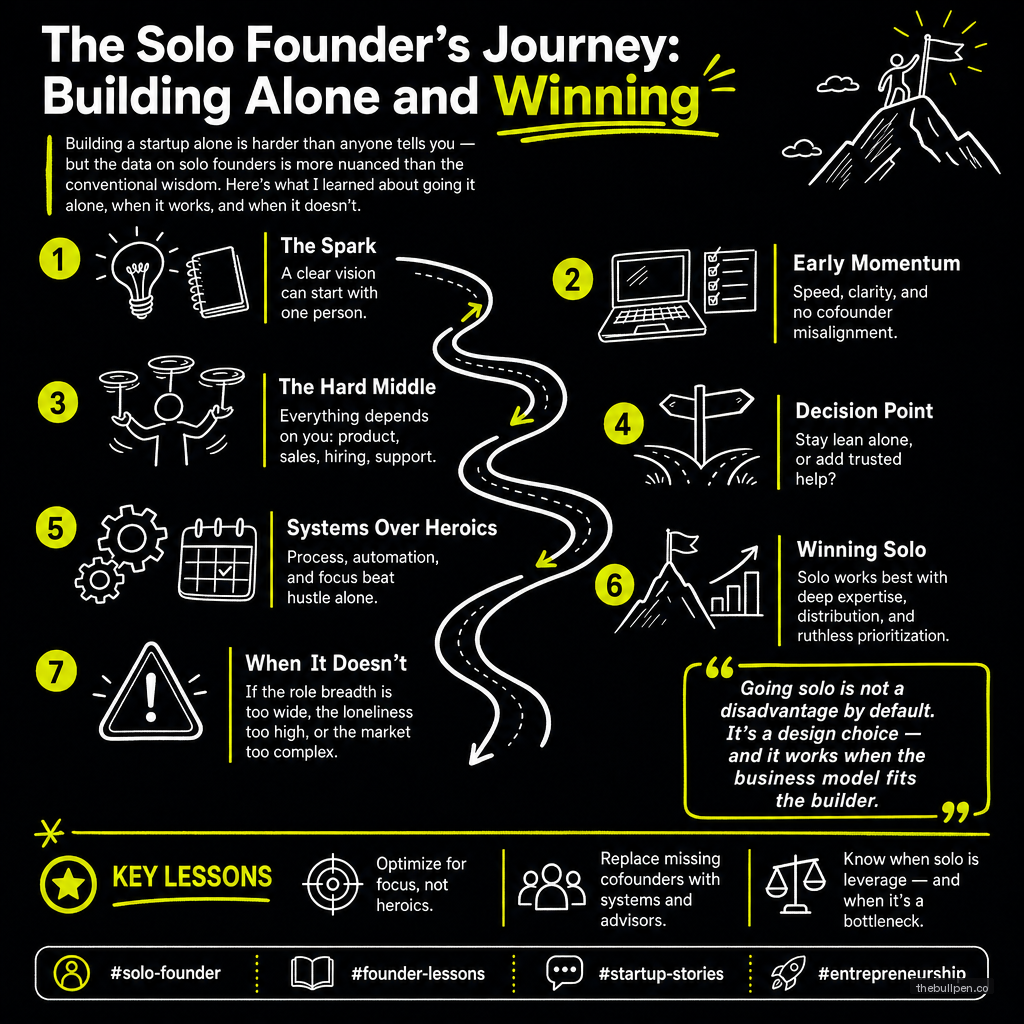
I spent the first 18 months of my startup completely alone. No co-founder. No founding team. Just me, a laptop, and a growing sense that I was making every decision wrong because there was nobody to tell me I was being an idiot.
The conventional wisdom is clear: don't do this. Paul Graham wrote that one of the biggest mistakes founders make is starting a startup alone. Y Combinator's application process explicitly prefers teams — solo founders have historically had lower acceptance rates. VCs say they prefer co-founders by a margin of nearly 3 to 1, according to a PitchBook survey, and only 3% of venture deals go to solo founders.
I read all of that while sitting alone in my apartment, and it made me feel like I'd already lost before I'd even started.
Related: How Real Founders Raised Their First Million: Lessons from the Trenches
The Data Is Real. The Nuance Matters.
The statistics against solo founders are sobering. Harvard Business School research on 2,537 startups found that team-founded companies are 3.6 times more likely to achieve an IPO or high-value exit. Stanford's Noam Wasserman studied 6,000 startups and found solo founders are half as likely to build a billion-dollar company. Solo founders raise 33% less at seed and are 40% less likely to reach Series A, according to PitchBook.
But here's the part of the data that nobody quotes in the blog posts telling you to find a co-founder: solo founders who raise VC have nearly the same survival rates as teams. The disadvantage is front-loaded — it's about getting funded, not about building once you are. And the companies that do make it? The solo founders who succeed capture more equity and more control.
Mailchimp sold for $12 billion. Ben Chestnut built it alone, without VC, without a co-founder. Tumblr sold for $1.1 billion — David Karp started it by himself in his bedroom. Plenty of Fish went for $575 million, built by Markus Frind coding alone in his apartment. These are the exceptions, not the rule, but they prove the rule isn't absolute.
The question isn't whether solo founding is harder. It's whether you're the type of person who can survive the specific ways it's harder.
The Four Things Nobody Warns You About
Decision Fatigue Is Real
Stanford research found that solo founders make 2.5 times more operational decisions per week than their team-founded counterparts. Every choice — from pricing to hiring to which font to use on the landing page — lands on you. There's no backup, no second opinion, no one to blame when you're wrong.
I found myself spending 45 minutes deciding whether to use Stripe or Adyen for payments. That's not a 45-minute decision. That's a 5-minute decision that I stretched to 45 because I was afraid of being wrong and had nobody to check my reasoning.
The Fundraising Bias Is Structural
When investors see a solo founder, they ask different questions. They ask about resilience. They ask about succession. They ask what happens if you get hit by a bus. They don't ask teams the same questions, because teams have built-in redundancy.
This is unfair but it's not irrational. A VC is making a bet on a company surviving long enough to return their fund. A solo founder is a single point of failure — statistically, a riskier bet. The solution isn't to resent the bias. It's to address it proactively: have a plan for key hires, build an advisory board, and show that you're self-aware about your gaps.
The Burnout Curve Is Steeper
Startup Genome data shows solo founders report burnout at nearly double the rate of team founders — 41% versus 22%. We work an average of 12 hours more per week. We take fewer vacations. We have nobody to divide the emotional load with.
I didn't notice the burnout until I was already in it. You can't see it from the inside because every day feels like survival mode. It took a friend telling me I looked terrible for me to realize I hadn't left my apartment in 10 days.
Loneliness Is a Business Risk
Sixty-four percent of solo founders in a YC survey cited isolation as their top challenge. Harvard Business Review found solo founders are three times more likely to experience clinical depression symptoms. Twenty-eight percent say feelings of isolation significantly affect their work, versus 8% of team founders.
This isn't a soft problem. It's a business problem. A founder who can't function can't build a company.
When Solo Founding Works
The data suggests solo founding works best in specific conditions. If you're building something that matches your existing skill set end to end — a technical founder building a developer tool, for example — the lack of a co-founder matters less because you don't have a critical skill gap.
It also works better when you have prior startup experience. Babson College found that solo founders with previous startup experience had no statistical difference in survival rates compared to first-time teams. The solo founder penalty mostly applies to first-time founders.
And if you're building something capital-efficient — bootstrapped or low-burn — the fundraising bias doesn't matter because you don't need venture money to survive. Mailchimp took years to raise any outside capital. By the time they did, they had the leverage to negotiate from strength.
What I'd Tell Someone Starting Alone
If I had to do it again, here's what I'd change:
I'd find a community before I needed one. Y Combinator's co-founder matching platform, founder communities on Slack, local meetups — I should have been in these from day one. Not to find a co-founder necessarily. Just to have people who understand what I'm going through.
I'd build an advisory board early. Not the formal kind with board seats and fiduciary duties. Just three or four experienced founders I could call when I was stuck. The kind of people who would tell me I was making a mistake before I made it, not after.
I'd hire for my weaknesses first. A solo founder's biggest problem isn't too much work. It's not enough perspective. My first hire shouldn't have been an engineer — it should have been someone who could sell, because that's the skill I was missing.
And I'd accept that being a solo founder means moving slower in some dimensions and faster in others. You'll make decisions faster because you don't need consensus. You'll execute slower because you don't have bandwidth. The key is designing your strategy around those asymmetries instead of pretending they don't exist.
Data sources: Harvard Business School (Kerr, Lerner, Schoar — founding team study of 2,537 startups), Stanford GSB (Wasserman — 6,000 startup study), PitchBook solo vs team founder analysis, Y Combinator Startup School survey data, Startup Genome Founder Wellness report, First Round Capital State of Startups, Babson College replication study. Verified solo-founded companies: Mailchimp (Ben Chestnut), Tumblr (David Karp), Plenty of Fish (Markus Frind), DuckDuckGo (Gabriel Weinberg).
Ready to see how an investor would evaluate your solo-built company? Upload your pitch to Bullpen for a free AI evaluation across 7 categories — including team assessment, market sizing, and unit economics.
Get weekly pitch tips
One email a week. Actionable advice for founders.
How does your founder story score? Find out in 2 minutes. Try now →