What I Learned from My First Failed Startup
The honest story of a first startup that didn't make it — what went wrong, what I learned, and why failing early might be the best thing that ever happened to me.
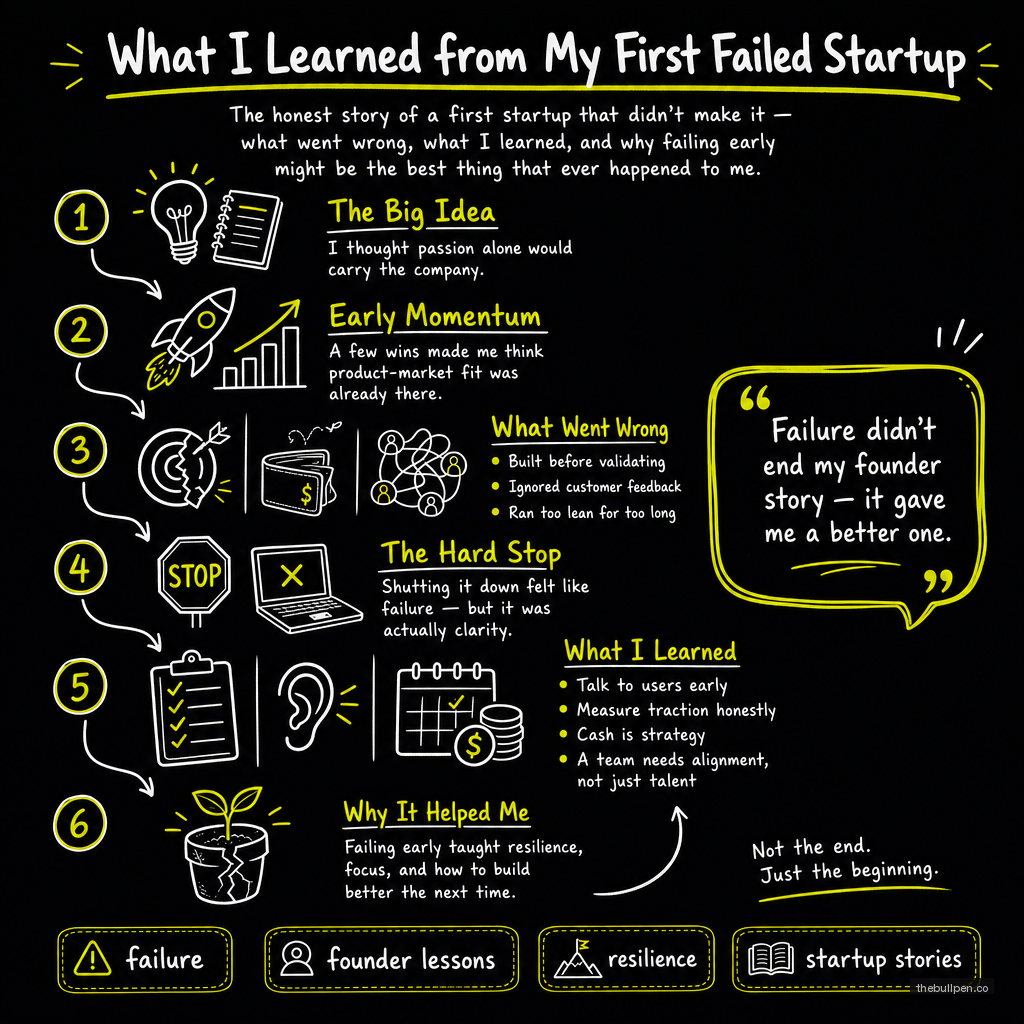
I raised $350K. Hired six people. Built a beautiful product. Got featured in a major tech publication. Had a fancy office with exposed brick and a coffee machine that cost more than my first car.
Then the product-launch party hangover wore off, and I realized nobody was signing up.
Six months later, the money was gone, the team had dispersed, and I was sitting in my parents' basement updating my resume. The startup didn't just fail — it failed in the most instructive way possible, by ticking off almost every item on the startup-failure checklist in sequence, like I was collecting achievements in a video game.
I thought I was building a company. I was actually building a very expensive education.
Related: How Real Founders Raised Their First Million
What Actually Killed My Startup (and Most Others)
CB Insights analyzed over 100 startup post-mortems and found a clear pattern. The top five reasons startups fail haven't changed much in the last decade, and I managed to hit four of them:
| Reason | % of Failures | Did I Do It? | What It Looked Like |
|---|---|---|---|
| No market need | 42% | ✅ Guilty | Built a product for a problem I assumed existed |
| Ran out of cash | 29% | ✅ Guilty | Spent 80% of the raise before finding product-market fit |
| Not the right team | 23% | ✅ Guilty | Hired friends instead of finding people who challenged me |
| Got outcompeted | 19% | ✅ Guilty | Ignored a competitor that launched a simpler version six months in |
| Pricing/cost issues | 18% | ✅ Maybe | Charged too little because I was scared of rejection |
The 42% one hurts the most because it's the most preventable. I built a product for a problem I was certain existed. I had done the market research. I had talked to potential customers. What I hadn't done was separate polite enthusiasm from actual willingness to pay. There's a difference between "that sounds interesting" and "here's my credit card," and I wasn't experienced enough to know the gap existed.
Related: Lessons from Founders Who Almost Lost It All (Coming soon — September 30, 2026)
The Things Nobody Tells You About Failing
The Speed of Burn Is Faster Than You Think
I raised $350K and calculated that I had 18 months of runway. What I didn't calculate: legal fees, accounting, software subscriptions that auto-renewed annually, the deposit on the office I didn't actually need, and the severance I'd have to pay when I laid everyone off.
The real runway was closer to 11 months. By month eight, I was hiding from my bank account.
This is the most common math mistake first-time founders make. They budget for salaries and hosting costs. They forget the 30% of hidden expenses that turn an 18-month runway into a 12-month one. According to Startup Genome's data, 74% of high-growth startups that fail do so because of premature scaling — spending money on growth before proving the product works. I hit that one too.
Your Friends Will Say Yes. That's the Problem.
When you're a first-time founder, the people around you want to be supportive. Your friends say your idea is great. Your family says you're brave. The people you interview for customer research say they'd definitely use your product.
They're being nice. And nice is the enemy of honest feedback.
The only question that matters in early customer discovery is not "would you use this?" It's "will you pay for this now, with a credit card, before we've built it?" If the answer is no, you don't have a customer. You have a well-wisher.
Hiring Friends Is a Mistake
I hired my college roommate as our first engineer. He was talented. He was also someone I couldn't fire, couldn't give honest feedback to, and couldn't have the hard conversations with. When the company needed to pivot, I couldn't tell him his code was going into the trash. When we needed to cut costs, I couldn't tell him his salary was the problem.
The team slides in pitch decks make everything look clean and intentional. The reality is that co-founder and early-employee dynamics are the single biggest predictor of startup failure after market need. Twenty-three percent of startups fail because of team problems — and that number is probably undercounted because nobody writes a post-mortem about the passive-aggressive Slack messages that slowly poisoned the culture.
What I'd Do Differently
Validate Before You Build
If I could go back and do one thing differently, it would be this: I would spend the first three months trying to sell a product that didn't exist yet. I would find 10 people willing to pay me before I wrote a single line of code.
Pre-selling feels terrifying because it forces you to face rejection immediately. But that rejection is information. Every "no" tells you something about your positioning, your pricing, or your market. A startup that pre-sells to 50 people and gets 10 paying customers in month one is infinitely more likely to succeed than one that builds for 12 months and discovers on launch day that nobody cares.
Keep the Team Small Until You Can't
The single biggest financial mistake I made was hiring before I had revenue. Every salary was a bet that the product would work. If the bet failed, I wasn't just out my own time — I was out other people's livelihoods and my investors' money.
The right approach: keep the team as small as possible until revenue justifies growth. A two-person team that generates $10K MRR is worth more than a ten-person team that generates zero. Premature hiring is the fastest way to turn a potentially fixable product problem into an unfixable cash problem.
Know That Failing Once Makes You More Likely to Succeed Later
This is the data point that kept me going. Harvard Business School research shows that founders who have failed before have a 20-30% success rate on their second venture, compared to 10-15% for first-time founders. Stanford GSB found similar results: prior failure gives you a 22% shot at success vs. 18% for first-timers.
The difference is small but real. You learn things from failing that you cannot learn any other way. You learn to spot polite enthusiasm versus actual demand. You learn that burn rate is a feeling until it's a crisis. You learn that the best startup advice comes from people who have no stake in being nice to you.
My second company had none of the problems of the first. Not because I got smarter — I was probably dumber in some ways. But I knew what the signs looked like. I could smell a bad hire before making the offer. I could feel the wrong customer before taking the meeting. I knew that the worst outcome wasn't failing — it was failing slowly enough that I couldn't tell what went wrong.
Data sources: CB Insights "The Top 20 Reasons Startups Fail" (analysis of 101+ startup post-mortems), Startup Genome Report, Harvard Business School (Shikhar Ghosh, Tom Eisenmann), Stanford Graduate School of Business (Gompers, Kovner, Lerner, Scharfstein).
Ready to stress-test your idea before you build? Upload your pitch to Bullpen for a free AI evaluation that will tell you which of the 7 investor categories are your weakest — before you spend the money to find out the hard way.
Get weekly pitch tips
One email a week. Actionable advice for founders.
How does your founder story score? Find out in 2 minutes. Try now →