10 Startup Lessons Nobody Tells You Before You Start
The things I wish someone had told me before I started my first company — about loneliness, culture, luck, and why your first idea is almost certainly wrong.
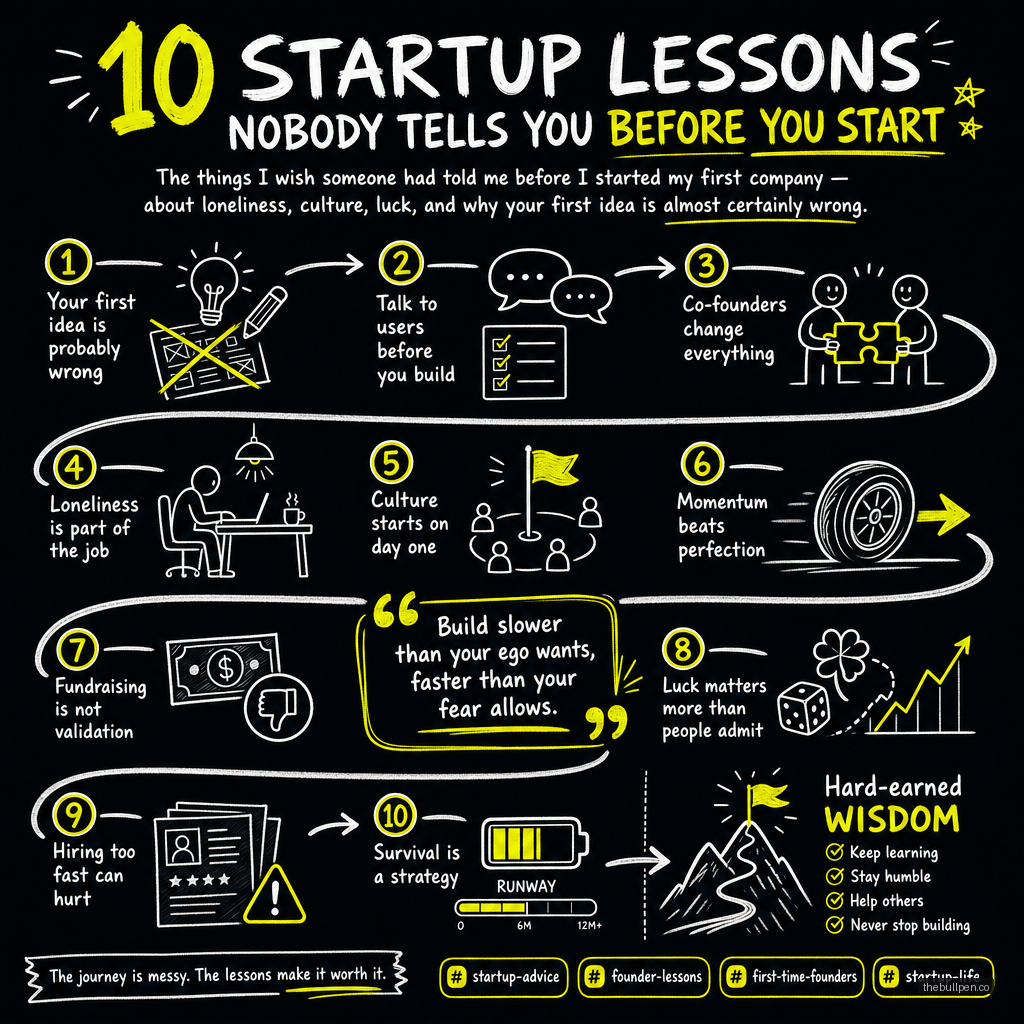
I've collected these lessons from founders who've been through it — the ones who built companies, lost them, sold them, and in some cases built them again. These aren't the things you read in startup blogs. They're the things you learn by doing it wrong first.
Related: What I Learned from My First Failed Startup
1. Your First Idea Is Probably Wrong
Most successful startups don't end up doing what they started doing. The initial idea is a hypothesis, not a plan. Paul Graham has said this for years at YC: the idea is just a starting point. Slack began as a gaming company. Instagram started as a location check-in app. YouTube launched as a video dating site.
The founders who win aren't the ones who guess right on the first try. They're the ones who pay attention when the market tells them they're wrong.
2. You Will Never Be Ready — Start Anyway
Reid Hoffman's line about being embarrassed by your first version has been quoted to death, but there's a reason. Founders wait for the perfect product, the perfect timing, the perfect pitch — and by the time they've achieved perfection, the market has moved on.
Start before you're ready. Ship before it's perfect. The feedback you get from real customers is worth more than any amount of planning.
3. Revenue Won't Fix a Broken Culture
Money amplifies culture. If your culture is healthy, revenue growth makes it stronger. If your culture is broken, revenue growth accelerates the dysfunction. Brian Chesky of Airbnb has been saying this for years: culture isn't a set of values on a wall, it's how people treat each other when things go wrong.
The culture you build in your first 10 employees is the culture you'll have when you have 100. By then it's too late to change it.
4. You Will Be Lonelier Than You Expect
Ben Horowitz wrote an entire book called The Hard Thing About Hard Things about this. Founders face decisions that no one else in the company can help with — whether to lay people off, whether to pivot, whether to take money from an investor they don't trust. The isolation is real, and nobody warns you about it.
The fix is to find peer support. Other founders who are at a similar stage, who have no agenda, who understand what you're going through because they're living it too.
5. Your Biggest Competitor Is Your Own Attention
Sam Altman has observed that startups die because founders lose focus, not because of competition. There's always another shiny opportunity, another feature request from a big customer, another partnership that could change everything. The startups that win are the ones that say no to almost everything and execute relentlessly on the one thing that matters.
6. The Board Should Hear Bad News From You First
The single fastest way to lose an investor's trust is to let them discover bad news from someone else. Experienced founders share bad news voluntarily, immediately, and with a plan. Sequoia's Roelof Botha put it simply: "The best founders tell you the bad news with speed and honesty."
Bad news doesn't kill your relationship with investors. Hiding it does.
Related: Interview: The Founder Who Raised $2M With No Pitch Deck
7. There Is No "Work-Life Balance" — Only Integration
For the first few years, balance is a myth. You will think about your startup when you're supposed to be with your family. You will answer Slack messages on vacation. The founders who survive this phase aren't the ones who achieve perfect separation — they're the ones who integrate work and life in a way that's sustainable for them.
The trick is knowing yourself well enough to set the boundaries that matter most, and accepting that the rest will bleed together.
8. The Best Decisions Are Often Against All Advice
If everyone agrees with your plan, it's probably too conventional. Stewart Butterfield, who built Slack, noted that most successful companies started with an idea that most people thought was bad. When Airbnb launched, the idea of renting your home to strangers seemed absurd. When Stripe launched, everyone said developer tools couldn't be a billion-dollar business.
If you have conviction that the conventional wisdom is wrong, trust it. Most people are wrong about what the future looks like.
9. You Will Fire Friends — and You Need to Be Ready
Early employees are often friends, former colleagues, or people who believed in you before anyone else did. When it's time for them to leave — and it will be — the conversation is brutal. But keeping the wrong person on the team is worse for everyone. It slows the company down and prevents them from finding a role that's a better fit.
Patrick Lencioni said great teams have a high tolerance for conflict and a low tolerance for mediocre performance. Both are required.
10. Luck Is Real — but You Can Make Your Own
Every experienced founder will admit that luck played a role in their success. Right place, right time, right introduction. But luck isn't random. The harder you work, the more often you show up, the more people you talk to, the luckier you get.
Jeff Bezos said "Luck is what happens when preparation meets opportunity." The founders who seem lucky are usually the ones who were prepared when the opportunity arrived.
The Throughline
Every lesson on this list comes back to the same truth: building a startup is harder than it looks, and the parts that are hardest are the ones nobody writes blog posts about. The loneliness, the decisions, the moments when you have to trust yourself against all advice.
If you're starting your first company, you will learn all of these lessons yourself. The goal isn't to avoid the hard parts — it's to know they're coming so they don't surprise you when they arrive.
Published on the Bullpen Blog. New articles every day at 9 AM UTC.
Get weekly pitch tips
One email a week. Actionable advice for founders.
How does your founder story score? Find out in 2 minutes. Try now →