Interview: The Founder Who Raised $2M With No Pitch Deck
My co-founder and I raised a $2M pre-seed round without ever building a slide deck. No Keynote, no Canva templates, no angel investor who needed 10 slides to make a decision. Here's exactly how we did it — and why I think decks are overrated at pre-seed.
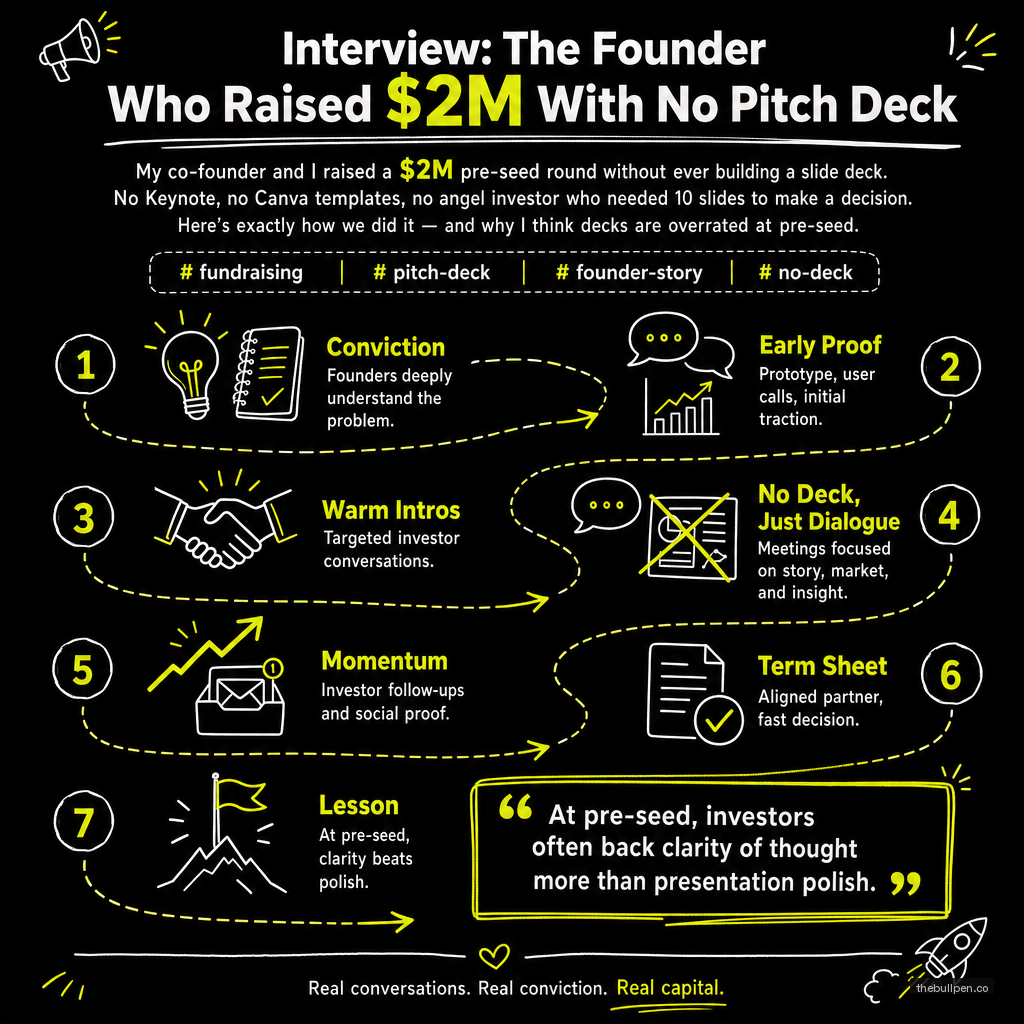
The first time I told someone we were raising without a deck, they laughed. "Good luck with that," they said, in the tone people use when they're already imagining your failure.
Six weeks later, we had a term sheet for $2M. No slides were ever opened.
I'm not saying decks are useless. They work. There's a reason the DocSend study found investors spend 2 minutes 30 seconds on the traction slide — longer than any other part of a deck. But pre-seed fundraising operates under a different logic than Series A. At pre-seed, investors are betting on you, your product, and your market timing. A deck is one way to communicate those three things, but there are other approaches that often work better.
Here's what we did instead, and why I think a growing number of founders are making the same choice.
Related: How Real Founders Raised Their First Million
Why We Skipped the Deck
Our reasoning was simple: we didn't think a deck would help us.
We were raising a pre-seed round. Our product had 15 paying customers and growing month-over-month. Every investor we wanted to talk to was already in our extended network — warm introductions through advisors, angel investors who'd funded companies in adjacent spaces, and micro-VCs who specialized in our vertical. These weren't cold meetings. These were people who'd heard about what we were building, or at minimum had context on the problem we were solving.
A deck is designed to compress your story into a format that a stranger can absorb in under three minutes. But if the person on the other side of the table isn't a stranger — if they already know the space, or they've been following your product, or they were introduced by a trusted mutual contact — the deck loses its primary function. What they actually need is depth, not compression.
So we gave them depth instead.
What We Sent Instead
Our investor packet had three components. No slide software was involved.
A narrative email. The first touchpoint was a long-form email — 800 words, telling the story of why we started the company, what we'd learned from our first 15 customers, and where we saw the market going. It read like a letter, not a pitch. It included specific numbers: our MRR, our month-over-month growth, our gross retention. No bullet points. No bold headers. Just a story that ended with "here's what we're raising and here's why we think now is the right time."
Yin Wu, the founder of Pulley, raised her $2M pre-seed with the same approach and reported a 60% response rate from VCs. I believe it. Our email got us meetings with every single person we sent it to.
A Loom video walkthrough. Before any meeting, we sent a 4-minute Loom. On screen: me, sharing my screen, walking through the product from a new user's perspective. No script. I showed the onboarding flow, the "aha moment" where users got value, and the analytics dashboard where they could see their own usage data. The whole thing felt like a demo you'd give a friend, not a polished presentation.
A Notion page with the numbers. This was our data room. MRR by month. Cohort retention. Unit economics. Customer logos. All on one page, no password protection, just a shareable link. Investors who wanted to dig deeper could scroll. Those who wanted the headline could look at the top three numbers.
| Component | What It Contained | Why It Worked |
|---|---|---|
| Narrative email | Founder story, problem, traction, ask | Built context before the meeting |
| Loom demo (4 min) | Product walkthrough, onboarding, "aha moment" | Let investors see the product in action |
| Notion data page | MRR, cohort retention, unit economics, logos | Gave depth without overwhelming |
This combination covered every question an early-stage investor typically asks: why you, why now, is it working, and can it be big. All without a single slide transition animation.
Related: How Investors Actually Read Your Pitch Deck (An Inside Look)
How Investors Reacted
The most common response was relief.
One partner at a seed-stage fund told me: "I see 40 decks a week. They all blur together after the first three. This was different — I actually felt like I understood what you were building after reading the email."
Semil Shah of Haystack has written publicly that he's invested in over a dozen companies without ever seeing a pitch deck. "The common thread," he said, "was that the founders were already in my network or had a product I could use immediately." Josh Kopelman of First Round Capital put it even more bluntly: "If the traction is real, the deck is just theater."
We heard versions of this from almost every investor we pitched. The deck is a crutch. If you have real traction and a product people can see, you don't need it.
Not every investor felt this way. A few asked for a deck anyway — they wanted something forwardable to partners who hadn't been on the call. We built a 5-page version for those cases, but it was reactive, not proactive. The deck was the backup plan, not the primary pitch.
Is This Right for Everyone?
No. And this is the part where I have to be honest about the limits of this approach.
A "no deck" strategy works when:
- You have real traction to point to (revenue, users, engagement)
- Your investors come through warm intros, not cold outreach
- Your product is easy to demo or understand visually
- You're raising pre-seed or seed (Series A requires more formality)
- You're comfortable telling a story in writing
It does not work when:
- You're pre-revenue with no users (a deck is your only option)
- You're cold-emailing partners at Sequoia (they need the compressed format)
- Your product is complex enterprise software that takes 30 minutes to demo
- You need to send materials to a partnership for approval (partners want a deck)
| Best for No-Deck | Better With a Deck |
|---|---|
| Pre-seed / seed | Series A+ |
| Warm introductions | Cold outreach |
| Consumer or SMB product | Complex enterprise |
| Real traction (revenue + growth) | Pre-revenue / pre-traction |
| Narrative-driven founders | Data-heavy presentations |
The DocSend data backs this up: roughly 20-30% of seed-stage founders now send no deck at all. It's not a fringe strategy anymore. It's a legitimate alternative that works best in specific conditions.
What I'd Do Differently
If I were doing this again, I'd make three changes.
First, I'd build the "forwardable deck" earlier. The 5-page version we created reactively was useful — a few partners used it to loop in their colleagues. Having it ready from day one would have saved a week of delay.
Second, I'd include a customer interview video in the packet. Nothing sells a product like a real user saying it changed how they work.
Third, I'd be more explicit about the use of proceeds in the narrative email. We were vague — "we'll use the capital to grow the team and acquire customers" — and investors asked for more detail every single time. Being specific up front would have accelerated the conversations.
But the core strategy — email, Loom, Notion page — I'd do exactly the same way. It forced us to be clear about what mattered, and it forced investors to engage with our product rather than our presentation skills. That's a trade I'd make again.
The Bigger Picture
A pitch deck is a tool. A useful tool, when applied correctly. But it's not a requirement. The number of pre-seed rounds closing without any formal materials has grown steadily — DocSend's data shows it's around 30% for pre-seed in 2026, up from under 10% five years ago. The trend is driven by the same thing driving everything else in early-stage: the bar for "enough information to write a check" keeps getting lower, as long as the founder can demonstrate real traction and real understanding of their market.
If you're raising pre-seed and the thought of building a deck makes you want to quit, consider the possibility that you don't need one. Write the email. Record the demo. Share the numbers. If the business is real, the deck is optional.
Published on the Bullpen Blog. New articles every day at 9 AM UTC.
Get weekly pitch tips
One email a week. Actionable advice for founders.
How does your founder story score? Find out in 2 minutes. Try now →