Angel Investors vs VC Firms: Who Should You Talk To?
Angels and VCs make decisions completely differently. Approaching them the same way is the fastest way to waste your fundraising window. Here's who to talk to, when, and how.
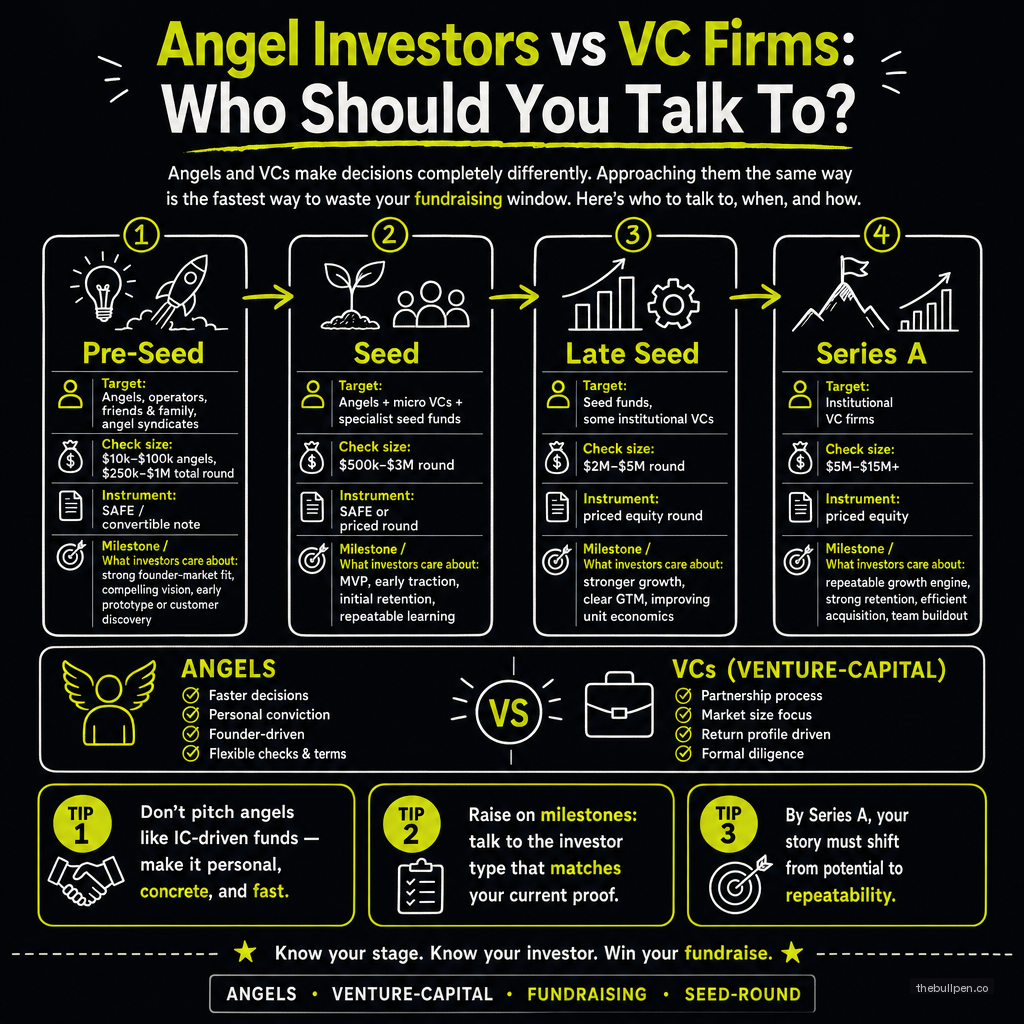
Most first-time founders approach all investors the same way: find an email, send a deck, ask for a meeting. This is a mistake. Angels and VCs operate under completely different decision-making frameworks, and treating them interchangeably wastes time on both sides.
An angel investor is writing a personal check. They're investing their own money, often alongside a job or other portfolio companies. Their decision is emotional as much as rational — they invest in founders they trust, markets they understand, and stories that resonate. The check size is small ($10,000 to $100,000 is typical), the process is fast, and the ongoing involvement ranges from hands-on to nonexistent.
A VC firm is deploying institutional capital from limited partners. Every investment decision goes through a partnership process: one partner champions your deal, but the full partnership votes. The check size is larger ($500,000 to $2 million at seed), the process is longer (4-12 weeks is normal), and the terms are more structured (board seats, pro-rata rights, information rights).
The implications for founders are significant. If you're raising $500K total, you probably want angels or a micro-VC, not a traditional VC firm. If you're raising $2M, you need a lead VC who can write a large enough check to anchor the round, with angels filling the rest. Trying to raise $2M from twenty angels writing $100K checks each is a nightmare of cap table management. Trying to raise $500K from a $500M VC firm that writes $1M minimum checks is a waste of everyone's time.
Related: The Startup Fundraising Playbook: From Pre-Seed to Series A
How Angels Decide
Angels move fast because they can. There's no partnership to convince, no investment committee, no LP memo. A founder who sends a compelling email to the right angel on a Tuesday can have a check wired by Friday.
The typical angel decision framework is three questions:
- Do I trust this founder?
- Do I understand this market?
- Is this a story I want to be part of?
The trust question is the most important. Angels are investing in people, not business plans. A warm introduction from a trusted mutual contact transforms the conversation — the angel already trusts the referrer's judgment, so they start the evaluation from a position of goodwill rather than skepticism.
| Dimension | Angel Investors | VC Firms |
|---|---|---|
| Source of capital | Personal wealth | Institutional LPs |
| Typical check | $10K-$100K | $500K-$10M |
| Decision process | Individual, days to weeks | Partnership, 4-12 weeks |
| Primary driver | Founder trust + personal interest | Market size + traction |
| Board involvement | Observer or none | Board seat for lead |
| Follow-on capacity | Limited (usually) | Significant reserve capital |
| Best at | Pre-seed, $100K-$500K rounds | Seed+, $1M+ rounds |
The most effective way to raise angel money is to build relationships before you need them. Angels invest in people they know, or people who come recommended by people they know. Cold emailing an angel with a deck has a near-zero conversion rate. Getting introduced by a founder they've backed before has a conversion rate above 50%.
How VCs Decide
A VC's decision process is fundamentally different because the money isn't theirs. A partner at a VC firm needs to convince their partnership that your company is worth the risk. This means they need arguments that their partners can debate, agree on, and defend to their LPs later.
The typical VC seed checklist covers four areas:
- Market size and timing. Is this a large, growing market, and is now the right moment to enter?
- Traction as proof. Revenue, growth rate, retention, engagement — evidence that demand exists.
- Team quality. Founder-market fit, domain expertise, demonstrated resilience.
- Defensibility. What prevents a well-funded competitor from copying your product?
The partner who champions your deal is your internal salesperson. They need enough ammunition to convince 3-5 skeptical partners who see 50 decks per week. This is why a compelling narrative deck matters more for VCs than for angels. The deck becomes a tool for your champion to present your case when you're not in the room.
This also explains why VC processes take so long. The champion closes the deal, but the partnership needs to vote. Schedules don't align. Partners get busy with existing portfolio companies. One partner has questions and wants another meeting. The timeline stretches from weeks to months.
When to Take Angel Money vs. VC Money
The decision isn't just about check size. It's about what each type of capital brings — and what it costs.
| Scenario | Best Capital Source | Why |
|---|---|---|
| Raising <$500K, pre-revenue | Angels / Micro-VCs | VCs can't write tiny checks efficiently |
| Raising $500K-$1M | Hybrid: lead angel + angel syndicate | One lead sets terms, others follow |
| Raising $1M-$3M | Lead VC + angel syndicate | VC validates the round, angels fill it |
| Raising $3M+ | Institutional VC | Angels rarely write checks this size |
| Revenue accelerating fast | Angels (stay flexible) | Avoiding institutional governance until valuation is higher |
| Need hands-on support | Strategic angels or small VCs | Large VCs have less time per company |
Angel money is cheaper in terms of governance and control. Angels rarely ask for a board seat. They don't have pro-rata rights in their term sheets. They don't have liquidation preferences. The cost of angel money is the fundraising overhead — sourcing 15 checks instead of one — and the cap table complexity of having 20 small investors instead of 3 institutional ones.
VC money is more expensive in governance terms but cheaper in fundraising efficiency. One term sheet, one closing, one board observer to manage. The cost is the board seat, the information rights, and the strategic constraints that come with institutional capital. A lead VC who takes a board seat becomes a permanent stakeholder in your major decisions.
Related: Seed Round Strategy: Raising $1M to $5M in 2026
The Signaling Problem
Angels and VCs pay attention to each other. The composition of your round sends signals to future investors.
A round led by a top-tier VC firm signals that the firm's partners did diligence and decided to invest. Future investors interpret this as validation. A round with only angel investors, no matter how well-known the individuals, does not carry the same weight.
A round with too many angels — 20-plus separate checks — signals that you couldn't find a lead investor to consolidate the round. Future investors, especially institutional VCs, read this as a red flag. They'll ask why no one wrote a big check, and you'll have to explain a complicated cap table.
The optimal structure for a seed round: one lead VC writing 40-50% of the round, three to five angels writing $25K-$100K each, and maybe a micro-VC or syndicate filling the rest. This gives you the institutional validation of a lead VC, the flexibility of angel capital, and a clean cap table for the Series A.
Building Your Investor List
Most founders start fundraising by searching for investors in their space and emailing them. This is backwards.
The correct order: identify the investors who would be excited about your specific combination of founder, market, and traction. Then find a warm introduction to each one. Then build a relationship before you need money.
For angels: look at companies in adjacent spaces that raised recently. Who invested in their seed rounds? Those angels are likely to understand your space and may invest again if the pattern is similar. LinkedIn and Angellist are the best discovery tools. Having another founder you respect make the introduction is worth 10x more than any deck improvement.
For VCs: look at the firm's portfolio for companies at a similar stage and in a related space. If a VC has backed three companies in financial infrastructure, they'll understand your financial infrastructure startup. If they've only backed B2B SaaS, they'll need more education about why your space works. Read their partners' content. Follow them on social media. Understand their investment thesis before you pitch.
And send the narrative email first. Before the deck, before the Loom video, before the data room. One email that tells the story of why you're the right founder at the right time. If that email doesn't get a response, no deck would have saved it anyway.
Published on the Bullpen Blog. New articles every day at 9 AM UTC.
Get weekly pitch tips
One email a week. Actionable advice for founders.
See how investors will grade your pitch. Try now →