Seed Round Strategy: Raising $1M-$5M in 2026
How seed rounds have evolved — current market expectations, what investors look for, and how to position yourself to raise a seed round in 2026.
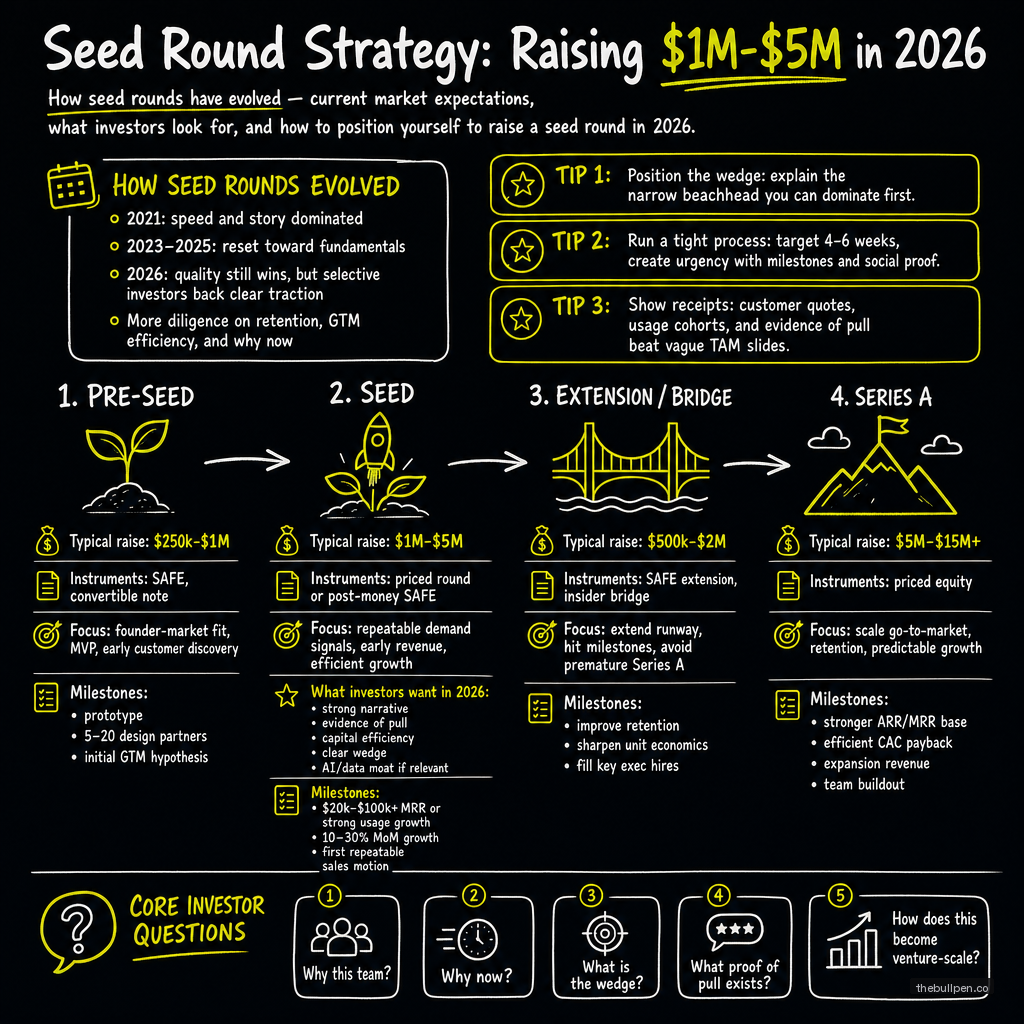
The seed round in 2026 is not the seed round your founder friends raised in 2021. The check sizes are bigger, the expectations are higher, and the gap between what founders think they need to show and what investors actually require has never been wider.
Most founders approach the seed round like it is a slightly larger pre-seed. They raise a bit more money, show a bit more traction, and hope the math works out. This is how you end up with a $3 million seed round, twelve months of runway, and no clear path to the Series A metrics that will let you raise again. The seed round is not a bigger pre-seed. It is a fundamentally different instrument with different expectations, different investors, and a different set of rules.
Related: The Pre-Seed Fundraising Playbook: From Zero to $1M, The Complete Guide to Startup Funding Stages
The Numbers Have Changed
The median seed round in 2025 landed at $2.8 million, according to Carta's seed round data. The top quartile cleared $4.5 million. AI startups routinely raised at $4 million to $6 million, driven partly by compute costs and partly by investor FOMO that has not fully cooled from the 2024 AI boom. Pre-money valuations for seed rounds have compressed slightly from 2021 peaks but remain elevated compared to historical averages — median pre-money sits around $14 million for a priced seed round, with a wide range depending on sector and team quality.
Investors who write seed checks are different from the investors who wrote your pre-seed. The seed is where institutional VCs enter. Firms like Sequoia Capital, a16z, Accel, Index Ventures, and Bessemer participate in seed rounds, but they do so selectively. The bar for a top-tier VC to lead your seed round is higher than it has ever been, not because capital is scarce but because the volume of seed-stage companies has exploded. Carta tracked over 4,500 seed rounds in 2024 alone. The firms that are truly selective see hundreds of deals for every one they invest in.
Related: Angel Investors vs VC Firms: Who Should You Talk To?
What Investors Actually Look For
The seed round is the stage where vague traction stops working. Pre-seed investors might accept a demo and a compelling story. Seed investors want to see a real business forming.
The metric that matters most at seed is not revenue. It is retention. Cohort retention curves that flatten above 80 percent for B2B or above 30 percent for B2C are worth more in a seed round than a spike in topline revenue from a one-time launch event. Investors have seen too many companies with a great launch month followed by a flatline to trust growth without retention. If you can show that users come back without being prompted, you have the one signal that separates seed-stage companies from pre-seed experiments.
The second most important metric is the ratio between your burn and your growth. The Rule of 40 — growth rate plus profit margin, targeted above 40 percent — is a post-Series A framework, but seed investors increasingly use a simplified version: is your growth rate at least three times your burn rate? If you are burning $100K per month, you need to be growing at least $300K in new MRR per month to be on a healthy trajectory. Companies that violate this ratio rarely fix it at scale.
The team question at seed is different from pre-seed too. Pre-seed investors bet on potential. Seed investors bet on demonstrated execution. Have you shipped consistently? Have you shown product-market fit signals? Have you built something that a small number of users actively rely on? The difference is the difference between "we have a great team" and "we have a great team that has proven they can ship a product people use."
Related: Startup Metrics That Matter: What Investors Actually Look For
How Seed Rounds Get Done
The seed round process is longer and more structured than most first-time founders expect. From first outreach to money in the bank, plan on three to six months. The timeline breaks down roughly into three phases.
The first phase is building momentum. You need to create a perception of scarcity and demand. The best seed rounds happen when multiple investors want to lead, which creates competitive tension that benefits the founder on valuation and terms. Building this momentum takes four to six weeks of concentrated meetings. The mistake most founders make is spreading their meetings out over months, which lets the air out of the process. The correct approach is to schedule all partner meetings within a two to three week window, create a deadline (real or constructed), and let the competitive dynamics work in your favor.
The second phase is diligence. Seed diligence is lighter than Series A but more thorough than pre-seed. Expect three to five reference calls with customers, a product demo with a technical partner, a cap table model showing dilution across future rounds, and a detailed burn plan. The cap table model is where most seed founders get tripped up. If your pre-seed investors own 25 percent of the company and the seed investors take another 20 percent, and you have an option pool to create, the math can leave founders with surprisingly little ownership by Series B. Seed investors want to see that you have modeled this and that the math works for everyone.
The third phase is closing. Once a lead commits, the rest of the round typically fills in two to four weeks. Most seed rounds close with one lead VC and two to four additional participants. The lead sets the terms and the valuation, and the participants follow. Your energy during this phase should go toward reference calls and positive signal generation, not toward negotiating with every individual investor.
Related: Cap Table Management for Fundraising
The Stat That Should Change Your Approach
Only about 25 percent of seed-stage companies raise a Series A, according to data from Carta and PitchBook. This number has been relatively stable across the last four years, fluctuating between 22 and 28 percent depending on market conditions.
The implication is not that you should be pessimistic. It is that you should optimize your seed round for the outcome you actually want. If you raise a $4 million seed at a $16 million pre-money, you need to hit Series A metrics within 18 months. If you miss, you will be raising a bridge round or shutting down. The alternative — raising a smaller seed, building more efficiently, and extending your runway — trades dilution for optionality. It is not obviously the right choice, but it is a choice worth making consciously rather than defaulting to the biggest number an investor offered.
The companies that successfully bridge from seed to Series A share one characteristic that is surprisingly rare: they treat the seed round as the beginning of a long-term relationship with their lead investor, not as a financial transaction. The lead investor at seed should be someone you want to work with for the next five years, because they will be your most important board member, your most strategic advisor, and your most credible reference for the next round. Choosing the wrong lead for the sake of a slightly higher valuation is one of the fastest ways to make the seed-to-Series-A transition harder than it needs to be.
Data sources: Carta's 2024 State of Private Markets, PitchBook/NVCA Venture Monitor Q4 2024 and Q1 2025, and Cooley GO Annual Report 2024. Seed round medians and ranges are illustrative and vary significantly by sector, team, and geography.
Ready to see how your pitch deck would be evaluated in a seed round? Upload your deck to Bullpen for a free AI-powered assessment across 7 investor categories.
Get weekly pitch tips
One email a week. Actionable advice for founders.
See how investors will grade your pitch. Try now →