Cap Table Management: A Founder's Guide to Ownership Math
Your cap table is the single most important document you don't think about until it's too late. Here's how to keep it clean, why it matters for fundraising, and the mistakes that cost founders millions.
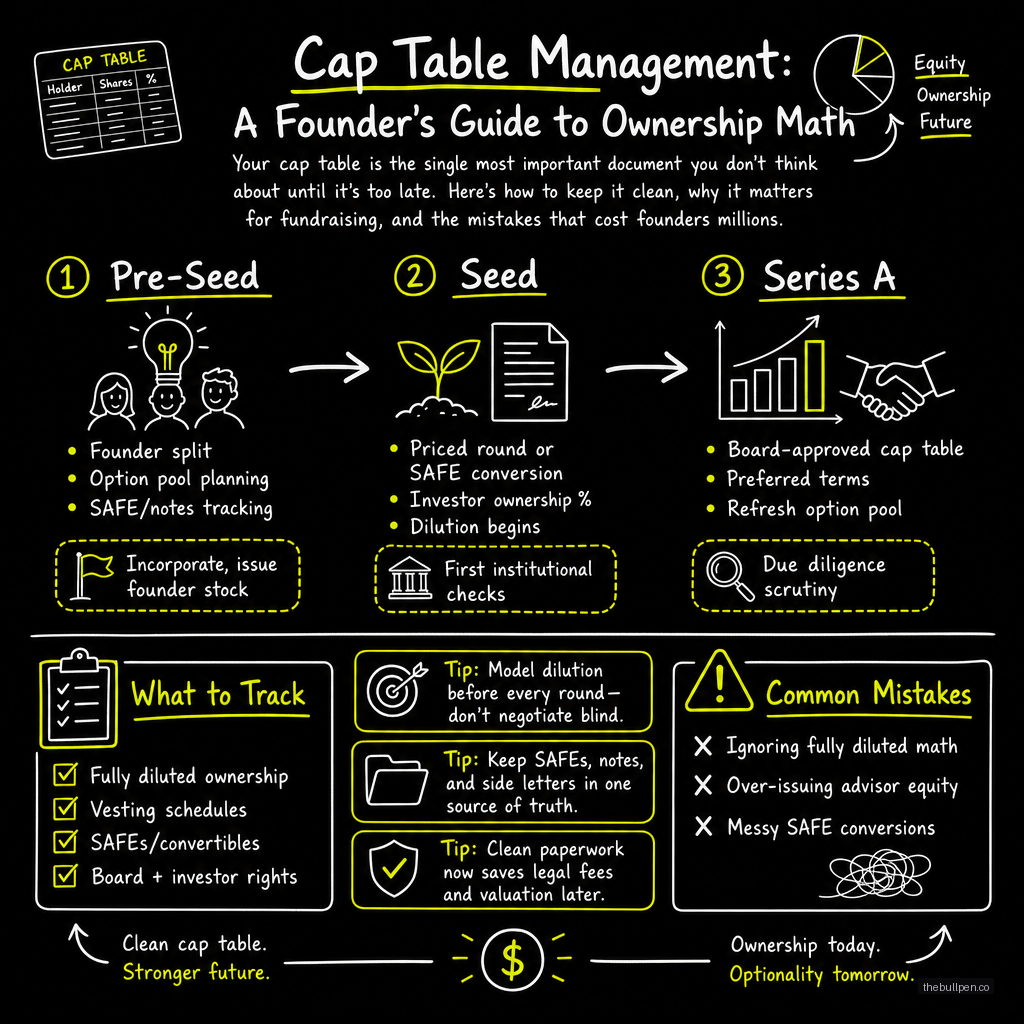
Most founders don't think about their cap table until an investor asks to see it. By then, the mistakes are already baked in — the advisor who got 2% for an introduction, the friend who invested $5K on a handshake, the three convertible notes with three different valuation caps.
A cap table is the record of who owns what in your company. A clean cap table is a strategic asset. A messy one is a liability that compounds over time. It determines how much control you retain, how much you can raise, and whether your company can be sold.
Related: The Startup Fundraising Playbook: From Pre-Seed to Series A
The Three Numbers That Matter
There are three ways to measure ownership. Founders who confuse them end up with unpleasant surprises.
Basic shares outstanding. Common and preferred shares issued. The simplest measure but the least useful — it ignores all future dilution.
Fully diluted shares. Basic shares plus all options, warrants, SAFEs, and convertible notes as if exercised or converted. This is the number investors use. A founder who thinks they own 50% on basic may own 30% on fully diluted once the option pool and SAFEs are included.
Option pool. Shares reserved for future employees, typically 10-20% of the company. Where it sits determines who gets diluted.
| Metric | What It Includes | Used By |
|---|---|---|
| Basic shares | Issued common + preferred only | Quick reference |
| Fully diluted | Basic + options + warrants + SAFEs | Investors, valuations |
| Option pool | Shares reserved for future grants | Fundraising negotiations |
The option pool is where founders lose the most money without realizing it. A $10M pre-money with a 15% option pool included is effectively an $8.5M valuation — the pool comes from the founders' side. Negotiate pool size and inclusion as part of valuation, not as a separate item.
The Tools
Carta is the industry standard — it handles 409A valuations, equity grants, and investor reporting. Pulley is a newer alternative with better pricing for early-stage companies. Both produce the reports investors want.
| Tool | Best For | Pricing |
|---|---|---|
| Carta | Growth-stage | Starts at $99/mo |
| Pulley | Pre-seed to Series B | Free for first 25 stakeholders |
| Shareworks | Pre-IPO | Per-seat pricing |
Common Mistakes
Too many small investors. Every $10K angel who gets a separate cap table line creates future complexity. Fifty small investors spook institutional VCs. YC advises limiting early investors to 15-20. Beyond that, consolidate through a syndicate.
Missing option pool. If you haven't created a pool before Series A, the investor will insist — and it will come from the founders' shares. This single point can cost 5-10 percentage points of ownership.
Wrongfully diluted math. Founders calculate on basic shares. Investors use fully diluted. The difference is dramatic: 4M shares out of 5M basic = 80%. Add a 5M option pool and 1M warrants, fully diluted becomes 11M, and ownership drops to 36%.
Undocumented promises. Verbal equity commitments to early employees that were never documented create a hard conversation when the formal grant comes in lower than expected.
What Investors Look For
- Cleanliness — Too many small holders or unusual terms signal poor governance
- Founder ownership — Should retain 20-30%+ after Series A. Below that, alignment questions arise
- Option pool adequacy — Room for 18-24 months of hiring
- Pro-rata rights — Too many scares off new leads
Fenwick & West found that roughly 70% of Series A investors required cap table cleanup before closing. The cost: $5K-$20K in legal fees plus unknown dilution from buying out small holders. Keep it clean from day one.
Keep It Simple
Issue equity sparingly. Document everything. Model the fully diluted math before every fundraising conversation. A cap table with 15 smart investors, a well-sized pool, and clean documentation will never kill a deal.
Published on the Bullpen Blog. New articles every day at 9 AM UTC.
Get weekly pitch tips
One email a week. Actionable advice for founders.
See how investors will grade your pitch. Try now →