SAFE Notes vs Convertible Notes: Which One Should You Use?
The complete guide to SAFE notes and convertible notes — how they work, which terms matter, what the market standard is in 2026, and when to choose one over the other.
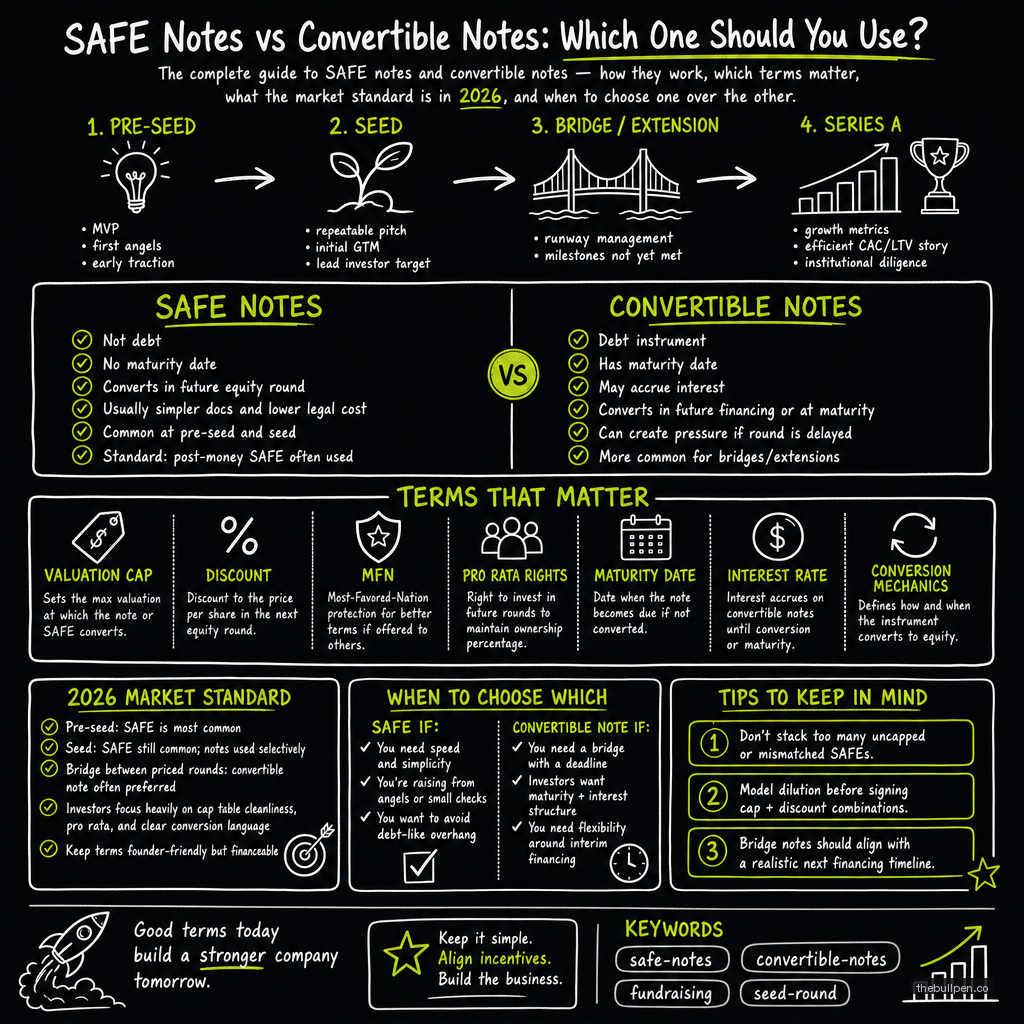
If you're raising a pre-seed or seed round in 2026, you're almost certainly going to use a SAFE. Y Combinator's post-money SAFE has become the standard instrument for early-stage fundraising, and for good reason — it's simpler, faster, and cheaper than any alternative.
But "standard" doesn't mean "right for every situation." Convertible notes still exist for a reason, and priced equity rounds serve a different purpose entirely. Understanding the difference between these instruments — and when to push for one over the other — is one of the most important things you can learn before you start fundraising.
Related: The Startup Fundraising Playbook: From Pre-Seed to Series A
What Each Instrument Is
A SAFE (Simple Agreement for Future Equity) is not debt. It's a contractual right to receive equity in a future priced round. The investor gives you money now, and when you raise a priced round later, their SAFE converts into shares at a discount to that round's price.
A convertible note is debt that converts into equity. The investor loans you money, and the loan converts into shares in a future round — usually with interest and a maturity date. If you don't raise a round before the maturity date, the note comes due and you have to repay it.
| Feature | SAFE | Convertible Note |
|---|---|---|
| Legal structure | Equity right | Debt |
| Maturity date | None | Yes (typically 18–24 months) |
| Interest accrues | No | Yes (typically 2–8%) |
| Simplicity | Very high | Moderate |
| Legal cost | $3K–$8K | $8K–$15K |
| Market standard in 2026 | Yes (post-money SAFE) | No (limited use) |
The maturity date is the most important difference. A convertible note with a maturity date creates a ticking clock. If you haven't raised your next round before the note matures, investors can demand repayment. This puts founders in an impossible position — raise on bad terms or default on your debt.
SAFEs have no maturity date. They convert when you raise a priced round, or when you have a liquidity event, or not at all. This is why SAFEs have become the default: they remove the debt-overhang risk that made convertible notes stressful for founders.
Related: Valuation Methods for Early-Stage Startups
The Key Terms
Whether you use a SAFE or a convertible note, the key economic terms are the same.
Valuation cap. The maximum valuation at which the instrument converts. If you raise a Series A at a $30M valuation and your SAFE has a $10M cap, the SAFE converts as if the company was worth $10M, giving the investor 3x more shares than a Series A investor who paid the full price. Caps typically range from $5M to $15M for pre-seed rounds in 2026.
Discount rate. A percentage discount on the conversion price, typically 15 to 25 percent. If the Series A price per share is $1.00, a 20% discount lets SAFE holders convert at $0.80. Most SAFEs have both a cap and a discount — the investor gets whichever is better.
MFN clause. Most-favored-nation clause. If the company issues a later SAFE with better terms, earlier SAFE holders can adopt those terms. This is standard and protects early investors from getting worse terms than later ones.
Post-money vs pre-money SAFE. In a post-money SAFE (YC's standard), the valuation cap includes the SAFE itself. In a pre-money SAFE, it doesn't. The difference affects how much dilution founders and employees experience. Post-money SAFEs are simpler and more transparent, which is why YC standardized them.
When to Use Each
Use a SAFE for almost every pre-seed and seed round. It's faster, cheaper, and less risky than a convertible note. Most investors in 2026 expect SAFEs and may push back on convertible notes because of the maturity date complexity.
Use a convertible note when an investor specifically requires debt treatment — some international investors, family offices, or debt funds prefer notes for tax or regulatory reasons. Also consider a note if you want a maturity date as a forcing function to raise your next round, though this is usually more stressful than helpful.
Use a priced equity round when you have enough data to justify a valuation and you want the cleanest possible cap table. Priced rounds are standard for Series A and beyond, but some startups do priced seed rounds if they have strong traction and want to avoid the complexity of SAFE conversion later.
The trend is clear. In 2020, roughly half of seed rounds used SAFEs and half used notes or priced equity. By 2024, over 80% of seed rounds used post-money SAFEs. The market has voted, and the SAFE won.
Data references: Y Combinator post-money SAFE documentation (version 2023-2025), Carta 2024 State of Private Markets (SAFE usage stats — 80%+ of seed rounds), Cooley GO Annual Report 2024 (term trend analysis), YC Startup School (SAFE vs convertible note comparison).
Ready to see how investors would evaluate your round structure? Upload your deck to Bullpen for a free AI-powered assessment across 7 investor categories.
Get weekly pitch tips
One email a week. Actionable advice for founders.
See how investors will grade your pitch. Try now →