Bootstrapping vs VC: 3 Founders Share Their Choices
Founders who chose different funding paths share their real experiences — what they gained, what they gave up, and whether they'd do it again.
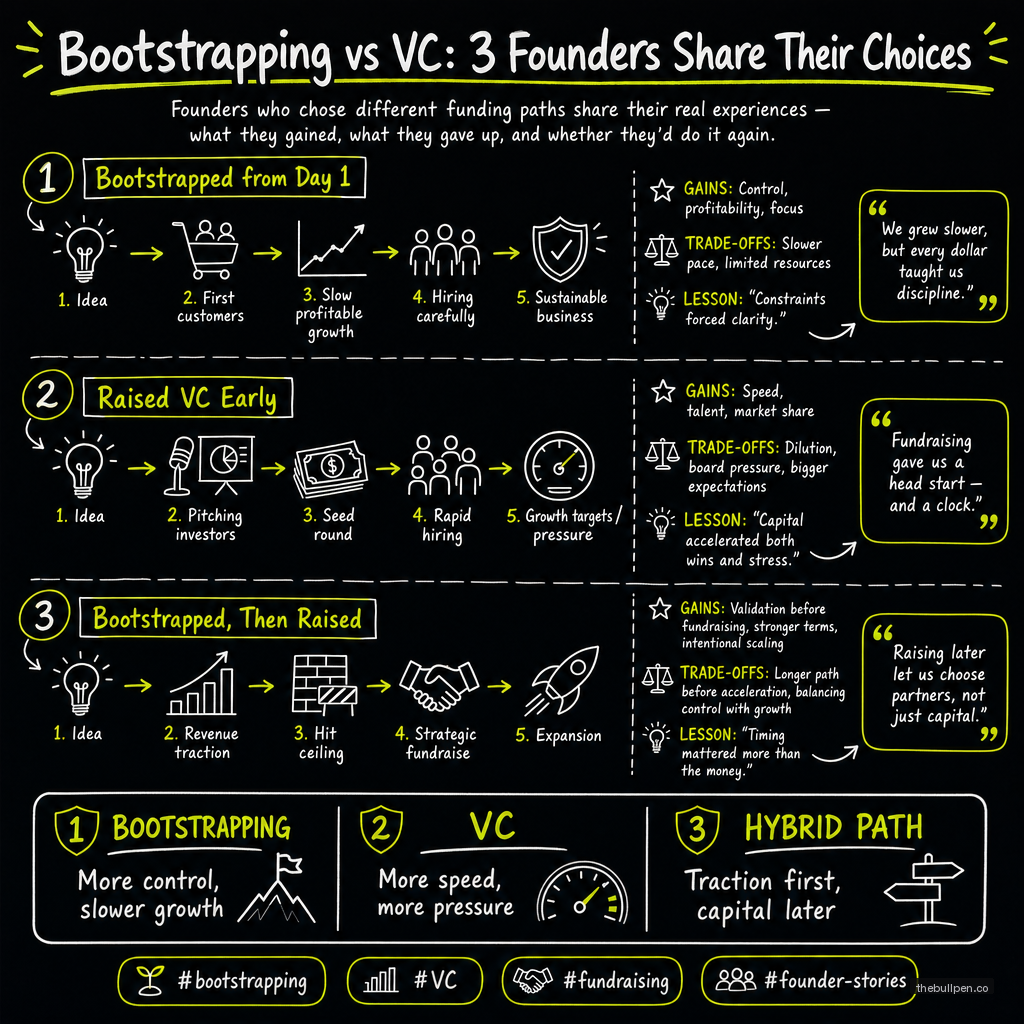
Most founders will tell you the single biggest decision they make isn't what to build — it's how to fund it. Raise venture capital, or bootstrap from the start? The conviction runs deep on both sides, and the data doesn't settle the debate cleanly. But the founders who've lived it have sharper insights than any hot take.
Three founders. Three different paths. One uncomfortable question behind all of them: what are you actually optimizing for?
Basecamp: The Original Bootstrapping Evangelists
Jason Fried and David Heinemeier Hansson (DHH) started 37signals in 1999 as a web design shop. They didn't raise a dollar. They didn't write a pitch deck. They just built a project management tool called Basecamp on the side, charged customers for it from day one, and watched it grow into a business generating $25-30 million in annual revenue — profitable every single year since 2004.
"It's the ultimate filter," Fried said in a 2023 interview. "Bootstrapping forces you to build something people actually want and will pay for early on. There's no checking account full of investor money to mask whether anyone actually cares."
That last point is the core of the Basecamp philosophy. When you have $5 million in the bank, you can convince yourself the empty product-market fit signal is just a timing problem. When you have rent due next month and a credit card bill, you either sell something or you're done.
The trade-off? Basecamp could have grown faster with VC money. They could have subsidized pricing to capture market share. They could have hired faster, expanded internationally sooner. But they didn't want to trade ownership for velocity. Fried and DHH have said repeatedly that building a sustainable, independent company was always the goal — not a consolation prize.
"Bootstrapping isn't about being anti-growth," DHH wrote. "It's about being anti-dependency."
Basecamp has outlasted virtually every well-funded competitor that emerged in the project management space over two decades. Trello (sold to Atlassian for $425M), Asana (went public at a $10B peak, now $4B). Basecamp just kept printing money and staying small enough to care about the product.
Related: Solo Founder Journey
Mailchimp: $12 Billion Without a Single Investor Dollar
If Basecamp is the proof of concept, Mailchimp is the nuclear option. Ben Chestnut and Dan Kurzius started the email marketing platform in 2001 as a side project while running a web design agency. They never took venture capital. They never needed to.
By 2019, Mailchimp was generating $700 million in annual revenue — completely bootstrapped, completely profitable, completely owned by the founders and early employees. When Intuit acquired the company in 2021 for $12 billion, Chestnut and Kurzius controlled the entire exit.
"We were profitable from the beginning," Chestnut told Inc. "We just wanted to build a good business. We didn't want to take money from investors and then have to justify every decision to a board."
That freedom shaped Mailchimp's product decisions in ways investors might have vetoed. The company invested heavily in a distinctive brand voice , the Freddie the chimp mascot, the quirky copy, the playful UI. Venture investors typically hate "different" because it introduces variance. Mailchimp's differentiation became its moat.
The bootstrapping strategy also forced disciplined spending. Mailchimp reached $100M in revenue with fewer than 300 employees. The company didn't blow cash on enterprise sales teams or expensive marketing campaigns , they built a product that sold itself through word of mouth and freemium conversion.
Chestnut admits the path isn't for everyone. "Bootstrap means you can't hide behind a pile of money," he said. "You have to actually make something people want, and you have to do it without burning through someone else's cash."
Mailchimp's journey is the strongest argument against the "scale fast or die" narrative that dominates tech media. For 20 years, the company grew at its own pace, on its own terms, and ended up selling for more than 99.9% of VC-backed companies will ever be worth.
Related: Raised Without Pitch Deck
Gumroad: The Founder Who Regretted Raising Money
Sahil Lavingia's story is the cautionary tale that bootstrapping advocates send around most often , because it comes from someone who did raise money and wishes he hadn't.
In 2011, Lavingia was a 19-year-old designer who'd just left Pinterest (employee #2). He built Gumroad, a platform for creators to sell digital products directly to their audience. The product was legitimately useful. Investors agreed. In 2012, Lavingia raised $1.2 million from some of the best names in Silicon Valley.
"I thought raising money was a sign of success, but it actually made things worse," Lavingia wrote in his 2021 book, The Minimalist Entrepreneur. "It set expectations that were completely out of line with what the business really was."
The $1.2 million came with an implicit contract: grow fast enough to justify a much larger Series A, or shut it down. Gumroad's business was solid , profitable, growing, beloved by creators , but it wasn't "venture-scale." The company had found product-market fit, but the market size wasn't large enough to produce the venture returns investors were banking on.
Lavingia spent years trying to force the business toward the growth trajectory investors wanted. He hired aggressively, expanded into new verticals, chased bigger numbers. The company never crashed, but it never hit the venture home run either. In 2016, Lavingia laid off most of the team and restructured Gumroad as a one-person business. The company survived. It even thrived again , but only after Lavingia stopped running it like a VC-funded startup.
"If I could go back, I would have bootstrapped from day one," Lavingia said. "We would have built a smaller, healthier, happier company , and I would have kept 100% of it instead of giving away a huge chunk for money I didn't actually need."
Gumroad today is profitable, serves hundreds of thousands of creators, and operates with a tiny team. It looks a lot like what Lavingia originally wanted to build. The venture capital just got in the way.
Related: Founder Stories
The Data: What the Numbers Actually Say
The anecdotes are compelling, but the aggregate data adds a harder edge. The Kauffman Foundation found that 55% of bootstrapped startups survive five years, compared to just 25% of VC-backed companies. That's not because bootstrapped founders are better operators , it's because VC-backed companies are forced into high-risk, high-growth trajectories. They're playing to win the fund, not to survive.
And most don't win. CB Insights reports that more than 90% of VC-backed startups fail to return the fund , meaning the investors who backed them lost money on the deal. The power law of venture returns means a handful of companies have to generate 100x-1000x returns to cover the failures of everyone else. That's a brutal game to play if you don't have a billion-dollar outcome in your DNA.
| Factor | Bootstrapping | Venture Capital |
|---|---|---|
| Ownership | Founders keep 100% | Diluted across rounds, often <20% at exit |
| Control | Full decision-making autonomy | Board seats, investor approval required |
| Growth pace | Organic, customer-funded | Forced , raise or die trying |
| Failure rate (5-year) | ~45% (Kauffman) | ~75% (Kauffman) |
| Return potential | 10x-50x on founder effort | 100x-1000x for fund , but most fail |
| Time horizon | Forever, as long as profitable | 7-10 year fund life clock |
| Best for | Niche markets, lifestyle businesses, sustainable growth | Large TAM, winner-take-all markets, aggressive scale |
The Counterpoint: When VC Makes Sense
Not every founder regrets raising money. Ryan Petersen, founder of Flexport, raised hundreds of millions in venture capital and wouldn't trade the experience.
"VC gave us the resources to build a global logistics platform quickly," Petersen said. Flexport grew from a freight forwarding startup to a company valued at $8 billion, digitizing an industry that had barely changed in 50 years. That kind of transformation required capital-intensive investments , a physical network, regulatory compliance across dozens of countries, enterprise sales teams , that bootstrapping couldn't support.
Flexport's story matters because it illustrates the real nuance. Venture capital isn't good or bad , it's a tool. The question is whether the tool fits the job. A $30 million revenue SaaS business with high margins and a narrow niche doesn't need VC. A capital-intensive platform play in a massive, fragmented market probably does. The mistake founders make is treating VC as validation rather than a specific financial instrument with specific costs.
The Verdict
The three founders above arrived at different answers to the same question, but their reasoning converges on one point: the default assumption that VC is the goal is wrong. Basecamp proved a bootstrapped company can dominate a category for decades. Mailchimp proved you can build a $12 billion company without a single investor dollar. Gumroad proved that even "successful" fundraising can be a net negative.
The next time a founder asks whether to raise money, the honest answer starts with another question: do you want to build a business, or do you want to play the venture game? They're not the same thing.
Published on the Bullpen Blog. New articles every day at 9 AM UTC.
Get weekly pitch tips
One email a week. Actionable advice for founders.
How does your founder story score? Find out in 2 minutes. Try now →