Founder Burnout: 5 Stories of Recovery
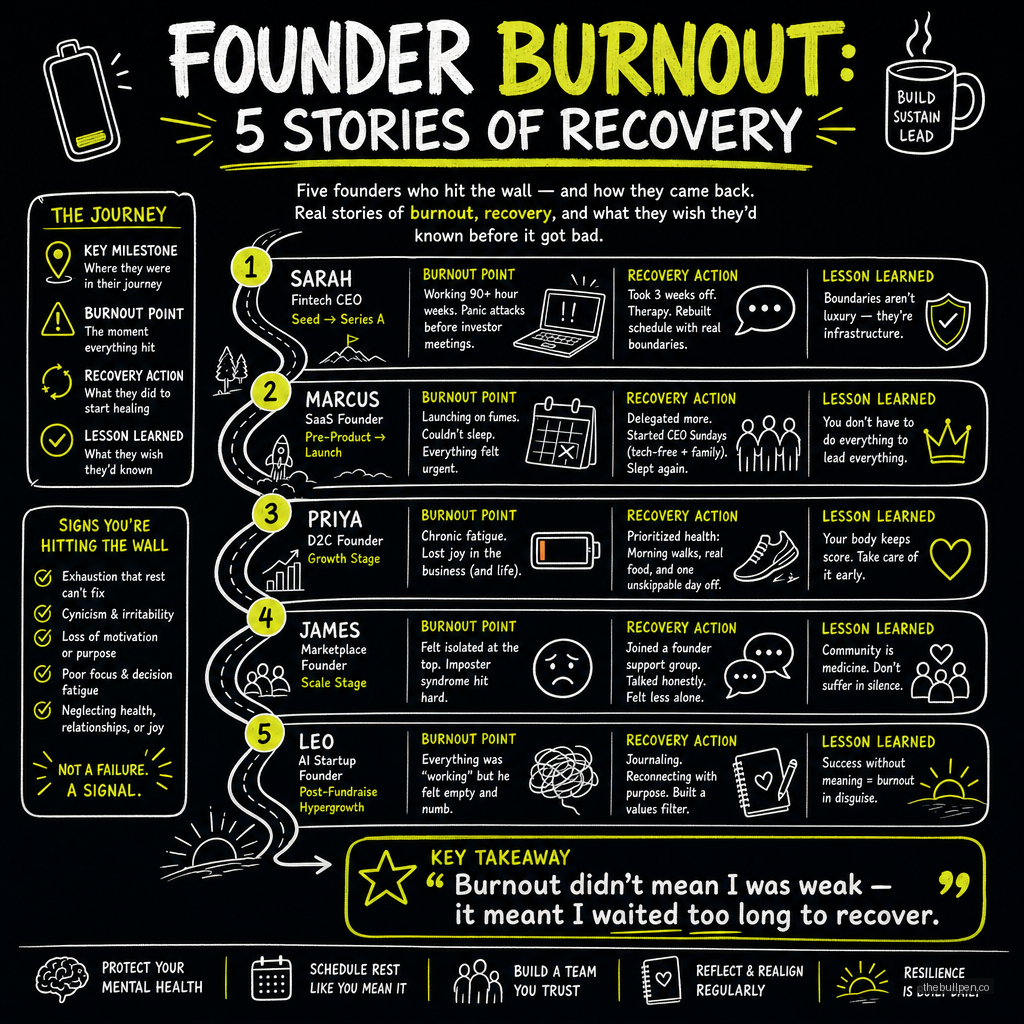
Five founders who hit the wall — and how they came back. Real stories of burnout, recovery, and what they wish they'd known before it got bad.
I don't know a single founder who hasn't come close to breaking. Not one. The ones who tell you they're fine are either lying or six weeks from a crash they don't see coming.
The numbers back this up. Harvard Business Review found founders are twice as likely to report a mental health condition as the general population. First Round's State of Startups survey put the number at 27% experiencing burnout frequently. A KPMG survey found 68% of founders said entrepreneurship negatively affected their mental health at some point. And a Stanford/Startup Genome study found that founder well-being was the single best predictor of startup survival — more than market timing, team size, or even initial traction.
I've collected five stories from founders who went through it and came out the other side. Some names you'll recognize. Some you won't. All of them got honest about what happened and what it took to recover.
Related: How Real Founders Raised Their First Million
1. Sahil Lavingia: The Crash and the Pivot
Sahil Lavingia raised $1.1M for Gumroad, a platform for creators to sell digital products. The company was growing. The investors were excited. And Sahil was working 100-hour weeks, losing joy, and feeling constantly on edge.
The burn got bad enough that Gumroad nearly went bankrupt. Sahil wrote about it publicly — a detailed post called "Reflecting on My Failure to Build a Billion-Dollar Company" that became one of the most-read startup essays of its era. He laid off most of the team, stripped the company down to its essentials, and turned Gumroad into a lean, profitable single-founder business.
The recovery wasn't fast. Sahil had to rebuild his relationship with work from the ground up. He started prioritizing sleep. He went to therapy. He stopped chasing the VC growth model and started running a company that could sustain itself without burning him alive. Gumroad is still running today, profitable and independent.
The lesson: the thing you think you need to do to succeed — grow as fast as possible at any cost — might be the thing that destroys both you and your company.
2. Ryan Hoover: The Sabbatical That Saved Him
Ryan Hoover built Product Hunt from a side project into the most important product launch platform in tech. He did it by being relentlessly available — answering every email, shipping constantly, being everywhere at once.
In 2019, he hit a wall. Physical exhaustion, loss of motivation, questioning his purpose. He wrote about it in a post titled "The Loneliest Period of My Life." The man who had built a community of millions felt completely isolated.
His recovery strategy was radical for a founder: he took three months off. Full sabbatical. Delegated CEO responsibilities to his team. Started therapy. Committed to exercise and a regular sleep schedule. Came back with a clearer head, a stronger team, and eventually sold Product Hunt to AngelList on good terms.
The hardest thing Ryan did wasn't taking the sabbatical. It was admitting he needed one in the first place.
Related: The Solo Founder's Journey: Building Alone and Winning
3. Kathryn Minshew: The Coach Who Changed Everything
Kathryn Minshew built The Muse, a career platform, through years of relentless execution. She was the CEO who was always on — answering Slack at midnight, never taking a real vacation, feeling like the entire company depended on her being available every hour of every day.
In 2017, she described a burnout spiral that started small: dreading email, losing her appetite, waking up with a sense of dread. She felt guilty when she wasn't working and exhausted when she was.
The turning point was hiring a coach. Not a therapist — a coach who specialized in founder psychology and leadership. The coach helped Kathryn see that her availability was actually holding her team back. By being always available, she'd prevented her team from learning to make decisions without her. The fix was counterintuitive: step back more, not less.
She stopped working weekends. Built a leadership team that could run the company without her. Took her first real vacation in five years — and discovered the company ran better without her constant involvement. She now speaks openly about the importance of building a culture that prevents burnout, not just treating it when it arrives.
4. Zach Holman: The Escape
Zach Holman was one of GitHub's earliest engineers and most visible personalities. During GitHub's hypergrowth years, he coded 16 hours a day. He felt like he couldn't stop — there was too much to build, too many users depending on him, too much momentum to slow down.
Eventually his body made the decision for him. Chronic back pain. Insomnia. Depression. He couldn't keep going, and he couldn't imagine stopping.
His recovery was the most extreme of the five: he left GitHub entirely, moved to a farm in Colorado, and stopped working for over a year. No side projects. No consulting. No startup ideas. Just living on a farm.
He came back to work eventually, but on his own terms — independent projects, no Slack, no on-call rotations, hard boundaries around when he works and when he doesn't. The experience changed his relationship with technology and ambition permanently. Some people need to extract themselves completely to see the path forward.
5. Ellen Huerta: Building the Solution
Ellen Huerta had a successful startup exit, but the journey left her with severe anxiety, insomnia, and an inability to focus. She had poured everything into building the company and had nothing left for herself afterward.
Her recovery was unusual: she built a mental health app called Mend (later part of Modern Health) specifically to help other people going through emotional recovery. The product was informed by her own experience — she built what she needed.
The recovery strategies she adopted became non-negotiable: morning walks, blocks of time with no meetings, weekly therapy, and a deliberate separation between work and identity. She also found that helping other founders with their mental health was therapeutic in itself — the thing she built to heal others helped heal herself in the process.
What They All Had in Common
Five different founders, five different companies, five different recovery paths. But the pattern was the same in every case:
- They denied the problem existed until their bodies or teams forced them to acknowledge it
- They isolated themselves — feeling like they were the only ones struggling
- They struggled to delegate, convinced that no one else could do it as well
- Recovery required a structural change, not a weekend off
The Stanford data makes the business case clear: founder well-being is the single best predictor of startup survival. A burned-out founder makes poor decisions, alienates the team, and loses investor confidence. The cost of prevention — therapy, coaches, boundaries, rest — is trivial compared to the cost of a crash.
If you recognize yourself in any of these stories, the best time to make a change was six months ago. The second best time is today.
Published on the Bullpen Blog. New articles every day at 9 AM UTC.
Get weekly pitch tips
One email a week. Actionable advice for founders.
How does your founder story score? Find out in 2 minutes. Try now →