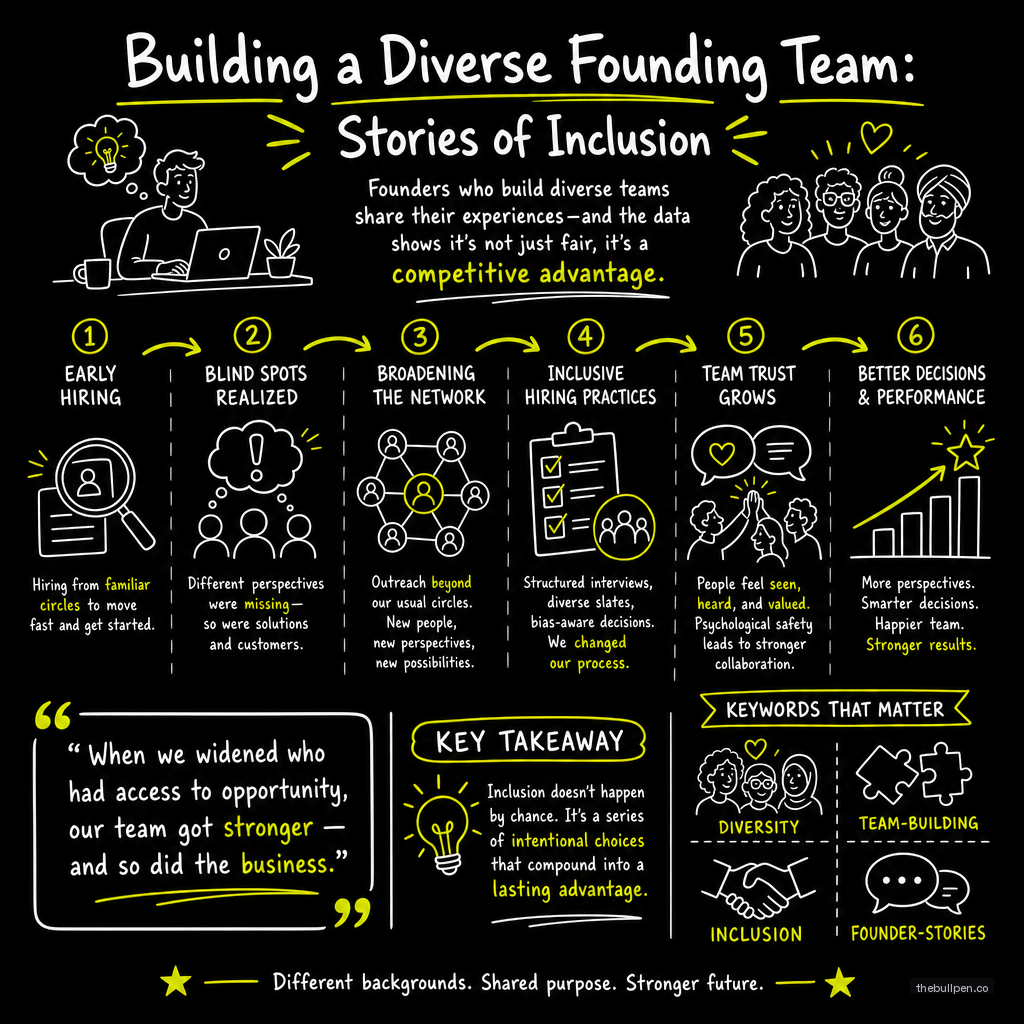
Building a Diverse Founding Team: Stories of Inclusion
Founders building diverse teams share their experiences — and the data shows it's not just fair, it's a competitive advantage.
The numbers are stark. In 2024, all-female founding teams captured just 2% of venture capital dollars. Black founders received 1%. Latino founders received 2%. Combined, every underrepresented group together pulled in less than 3% of total VC funding in the United States.
But here's what those numbers don't capture: the founders who refused to wait for the system to change.
Arlan Hamilton: Building Her Own Door
In 2015, Arlan Hamilton was homeless, sleeping on the floor of the San Francisco airport, couch-surfing when she could, and carrying nothing but a laptop and a conviction that the venture capital industry was leaving billions of dollars on the table by ignoring founders of color.
She had no finance background. No Ivy League degree. No network in Silicon Valley. What she had was a deep understanding of the talent being overlooked — because she was one of them.
"I was on the outside looking in, and I decided to build my own door."
That door became Backstage Capital, a venture fund dedicated to investing in underestimated founders: women, people of color, and LGBTQ+ entrepreneurs. Hamilton raised more than $20 million and invested in over 200 startups led by underrepresented founders. Her thesis was simple but radical: talent is evenly distributed; opportunity is not. And the market was mispricing an entire segment of investable companies.
Backstage's portfolio companies have gone on to raise follow-on funding, generate exits, and prove that Hamilton's conviction was never a gamble — it was an arbitrage play the rest of the industry was too slow to see.
The lesson for any founder building a team today: if the room you're trying to enter won't open its doors, build your own entrance. Then leave it open behind you.
Related: How to Find a Co-Founder
Kathryn Finney: Making the Invisible Visible
Kathryn Finney is no stranger to data. As the founder of DigitalUndivided, she created the ProjectDiane report, a research initiative that tracks the state of Black women founders in venture capital. What the data revealed was gutting — and galvanizing.
"Black women have raised just 0.34% of all venture capital since 2018," Finney says. "We are the most underfunded entrepreneurial group in America, yet we are also the fastest-growing group of entrepreneurs."
That statistic — 0.34% . became a rallying cry. Finney didn't just document the gap; she built infrastructure to close it. DigitalUndivided runs programs, convenings, and investment readiness initiatives specifically designed to support Black women founders. Because the data makes one thing unmistakably clear: the problem isn't a pipeline problem. Black women are starting companies at a faster rate than nearly any other demographic. The problem is a capital allocation problem.
Finney's work surfaced a truth that applies to founding teams of all kinds: you cannot fix what you refuse to measure. When Finney published the first ProjectDiane report, she gave the industry an undeniable, data-backed mirror. The $2.3 trillion annual GDP contribution from Black women entrepreneurs , against 0.34% of VC funding , is not a talent gap. It's a system failure.
For founders assembling a team today, Finney's approach offers a blueprint: measure the gap, name it clearly, and build the infrastructure that routes capital and opportunity to the people the market has overlooked.
Related: Founder Stories
Tristan Walker: Proving the Market Exists
Tristan Walker started Walker & Company Brands in 2013 with a deceptively simple observation: no major consumer goods company was building personal care products specifically for people of color. Razors that didn't cause razor bumps. Shampoo formulated for textured hair. Deodorants that actually worked on melanin-rich skin.
The market wasn't small , it was ignored. Walker calculated that Black male grooming alone represented a $2 billion-plus opportunity. And yet the shelf was empty.
"When we started, people said there wasn't a market," Walker recalled. "But the data told a different story. People of color spend disproportionately more on personal care than the general market. We were just being ignored, not measured."
Walker & Company launched Bevel, a shaving system designed for coarse and curly hair, and Form, a hair care line for textured hair. The company built a loyal customer base, proved unit economics the major brands couldn't argue with, and in 2018 was acquired by Procter & Gamble.
The acquisition was a watershed moment. P&G didn't buy Walker & Company out of charity , they bought it because Walker had demonstrated a profitable, scalable, defensible market that the incumbents had missed for decades. He didn't ask permission to serve his customers. He built the product, proved the demand, and let the numbers speak.
For founders thinking about team composition, Walker's story carries a specific weight: diversity isn't a concession to political pressure. It's a market intelligence advantage. A founding team that reflects the actual customer base will see opportunities homogeneous teams literally cannot perceive.
Related: Technical vs Non-Technical Founders
What the Data Says About Diverse Teams
These three founders represent a broader pattern that researchers have been quantifying for years. The business case for diverse founding teams is no longer anecdotal , it's empirical.
| Metric | Source | Finding |
|---|---|---|
| Profitability (ethnic diversity) | McKinsey, 2020 | 36% higher for top-quartile diverse companies |
| Profitability (gender diversity) | McKinsey, 2020 | 25% higher for top-quartile gender-diverse companies |
| Revenue per employee | BCG / Hello Alice, 2020 | 1.7x more revenue for diverse startups |
| Patent output | BCG / Hello Alice, 2020 | 2.3x more patents filed by diverse teams |
| Successful exit likelihood | Forbes, 2023 | 30% more likely for diverse founding teams |
The BCG and Hello Alice study is particularly instructive: across a dataset of hundreds of startups, those with above-average diversity on the founding team generated nearly double the revenue per employee and filed more than twice as many patents. Diversity correlates with innovation , not because of token representation, but because teams with different lived experiences ask different questions, challenge different assumptions, and spot different opportunities.
McKinsey's 2020 analysis of 1,000+ large companies in 15 countries reinforced the finding. The relationship between diversity and financial outperformance has only strengthened over time. Companies in the top quartile for ethnic diversity were 36% more likely to outperform their peers on profitability. For gender diversity, that number was 25%.
And the exit data from Forbes in 2023 adds an outcome-oriented capstone: diverse founding teams are 30% more likely to achieve a successful exit , acquisition, IPO, or equivalent liquidity event. The same Forbes analysis noted that exits for diverse teams tend to happen faster, suggesting that diverse perspectives help startups find product-market fit more efficiently.
Building for the Market That Exists
The common thread across Hamilton, Finney, and Walker is not that they overcame bias through sheer grit. It's that they recognized a structural market inefficiency and built companies to exploit it. Diversity wasn't a value-add , it was the thesis.
When you're building a founding team, the question isn't "Should we prioritize diversity?" The question is "Are we structuring our team to see the full opportunity surface?" A founding team that looks the same, thinks the same, and networks in the same circles will systematically underestimate markets they don't personally inhabit.
The $2 trillion in annual consumer spending by Black, Latino, and Asian American households isn't a niche. The surge of women-led businesses , which now account for 42% of new enterprises in the US , isn't a trend. These are the dominant market forces of the next decade.
Founders who build diverse teams aren't checking a box. They're building the only kind of team that can see the full board.
Published on the Bullpen Blog. New articles every day at 9 AM UTC.
Get weekly pitch tips
One email a week. Actionable advice for founders.
How does your founder story score? Find out in 2 minutes. Try now →