From Corporate Job to Y Combinator in 6 Months
Quitting a stable corporate job to apply to Y Combinator sounds like a fantasy. Here's how real founders made the transition — the timelines, the sacrifices, and what actually got them in.
Six months before they got into Y Combinator, Graham was a product manager at Microsoft and his co-founder Addison was a software engineer at Amazon. They met at a startup meetup two months before leaving their jobs. Six months before that, neither of them had started anything.
The narrative that YC only accepts founders who've been building since college is wrong. YC accepts people who quit corporate jobs all the time. Dalton Caldwell, a YC partner, has said publicly that leaving a $300K job to build something and showing 100 users is a stronger signal than a college student with 10,000 users. The domain expertise, the network, the understanding of how real businesses work — these are advantages, not drawbacks.
But the transition is brutal. Taking a 90% pay cut. Losing the identity of being employed at a prestigious company. The first three months of building something that nobody wants before you figure out what they actually need. The founders who make it through have a specific approach in common.
Related: How Real Founders Raised Their First Million
The Timeline
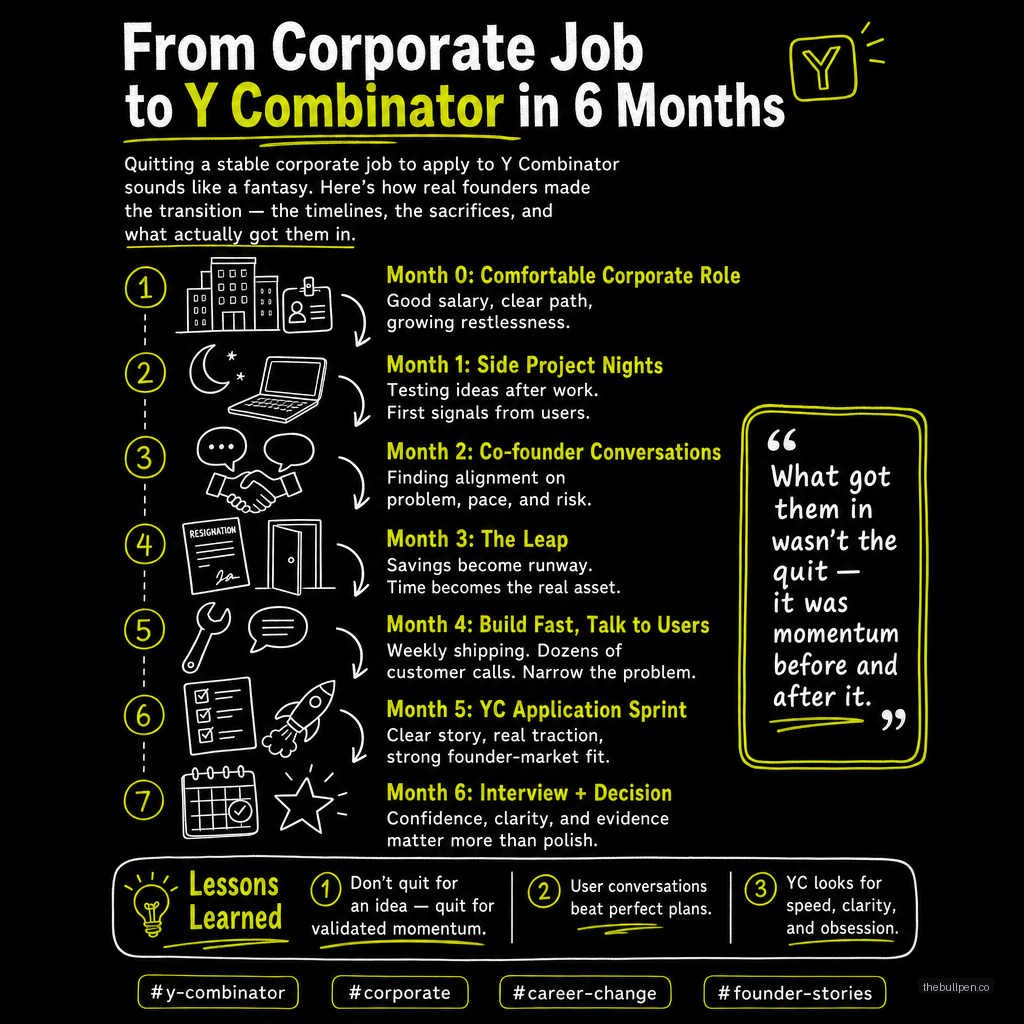
The fastest path from corporate job to YC acceptance takes about six months. It breaks down into three phases.
Months 1-3: Validate while employed. The most successful corporate-to-YC founders don't quit first. They build on nights and weekends while still drawing a paycheck. They talk to potential customers. They create a landing page and start a waitlist. They build a minimal prototype that demonstrates the core idea works.
This phase is grueling because you're working two jobs. Graham and Addison met during this phase, built a prototype of their B2B SaaS product for commercial real estate access, and validated the idea by talking to facility managers while still employed. By the time they quit, they had a waitlist of interested companies.
Months 3-5: Full-time build. After quitting, you have roughly 8-12 weeks before the YC application deadline. This is the phase where most founders either find product-market fit or discover their idea doesn't work.
The founders who succeed in this phase ship constantly. They launch on Product Hunt. They post on Hacker News. They write about what they're building. They get their first users — even if it's just 10 people. Rujul Zaparde, who got into YC after leaving Deloitte, built his MVP using no-code tools and rented equipment to test his demand hypothesis before writing a line of code.
Month 6: Apply and interview. The YC application itself is short — roughly 10 questions. The video is one minute. The interview, if you get one, is 10 minutes. The founders who get invites have one thing in common: they can articulate what they've built, why it matters, and what they've learned from real users.
| Phase | Duration | Key Milestone |
|---|---|---|
| Night-and-weekend build | 1-3 months | Working prototype, 20+ customer conversations |
| Full-time sprint | 2-3 months | MVP launched, first real users, early traction signal |
| Application | 2-4 weeks | Written app + 1-min video + traction evidence |
| Interview | 10 minutes | Clear articulation of problem, solution, and why now |
Related: The Complete Y Combinator Application Guide
What YC Actually Looks For
YC's evaluation criteria don't change based on your background. They fund great founders, not necessarily young founders. For someone leaving a corporate job, three signals matter most.
Domain expertise is a superpower. You spent years in an industry. You know the inefficiencies, the regulatory hurdles, the enterprise sales motion. An outsider can't match that depth. One YC-accepted founder spent 8 years at a large insurance company as a data analyst before building an AI claims assistant. His industry knowledge was the moat.
Resourcefulness over pedigree. Can you build the MVP yourself? Can you do sales? Can you handle customer support at 2 AM? Corporate managers who expect to hire a team immediately don't succeed in YC. Founders who learn to code, or use no-code tools, or do their own cold outreach — those founders get accepted.
Evidence of traction. Even $100 in MRR from a stranger is a stronger signal than a polished application with no users. One YC alumnus who had been a marketing manager at a Fortune 500 company built her product entirely in public on Twitter, gained 500 followers, and got her first paying customer before applying. The traction was modest, but it was real.
How to Quit
The practical question is always about money. Y Combinator's standard deal is $500K ($125K for 7% plus $375K in uncapped SAFE). But you won't see that money for 1-3 months after acceptance. You need personal runway to cover the gap.
Most successful corporate-to-YC founders save 6-12 months of personal expenses before quitting. Some move back in with parents. Some take on consulting work. Some have a spouse with income. The specific solution varies, but the principle is universal: don't quit until you can survive a year without income.
The founders who fail this transition are the ones who quit too early — before they have validation, before they have savings, and before they've tested their idea against reality. The ones who succeed quit at the right moment, when the evidence that their idea might work is strong enough to justify the risk.
The Bottom Line
Leaving a corporate job to start a company is the hardest career transition most people will ever make. The pay cut, the identity shift, the uncertainty — all of it is real. But YC doesn't penalize late-career founders. It rewards them for the depth they bring and the risk they've taken.
If you're considering it, the formula is simple: start before you quit, save before you leap, and ship before you apply.
Published on the Bullpen Blog. New articles every day at 9 AM UTC.
Get weekly pitch tips
One email a week. Actionable advice for founders.
How does your founder story score? Find out in 2 minutes. Try now →