Building in Public: 3 Founders Share Their Revenue Numbers
Buffer, Baremetrics, and Pieter Levels all shared their revenue publicly. Here's what they gained, what they lost, and whether you should do the same.
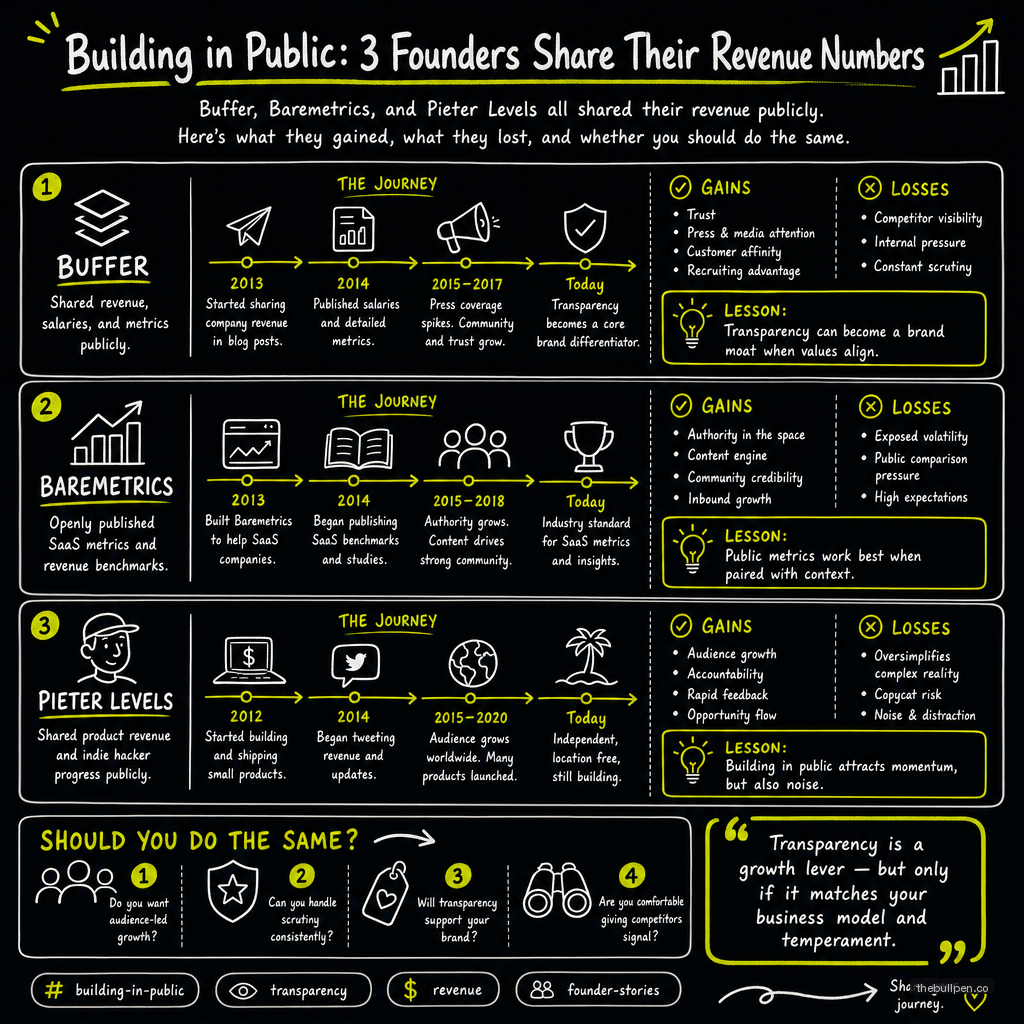
There is a specific kind of fear that comes with publishing your revenue numbers publicly. You stare at the dashboard, refresh it one more time, and realize that once you post this, you can't take it back. Every good month becomes a celebration. Every bad month becomes a public event.
The founders who do it anyway tend to be the ones who have nothing to hide and everything to gain from trust. But the stories are more nuanced than the "transparency is always good" narrative suggests. Some built movements. Some built traps. The difference is worth understanding.
Related: How Real Founders Raised Their First Million: Lessons from the Trenches
Buffer: The Transparency That Built a Brand
In 2011, Joel Gascoigne did something that was almost unheard of. He published the formula that calculated every Buffer employee's salary. Then he went further — sharing equity distribution, real-time revenue, monthly MRR growth, and even board deck slides.
The impact was immediate. Buffer was a social media scheduling tool in a crowded space. There was nothing technically unique about it. But the transparency made Buffer famous. TechCrunch covered the salary formula. Forbes wrote about the open culture. Thousands of people applied to work there because they could see exactly what they'd earn before they interviewed.
By 2015, Buffer had grown from zero to over $10M ARR. The transparency strategy was a core driver of that growth.
But it wasn't free. Gascoigne later wrote about the anxiety that came with constant public scrutiny. Employees sometimes felt exposed by having their salaries public. Competitors could see pricing changes before they were announced. Every down month was a data point that a competitor could weaponize.
The lesson: transparency compounds trust, but it also compounds pressure. If you're going to build in public, you need to be ready for the scrutiny that comes with it.
"Transparency is a double-edged sword. It forces you to be better, but you can never take a day off from being public."
Baremetrics: The Courage to Show the Bad Months
Josh Pigford took transparency further than almost anyone. He published a live dashboard showing MRR, churn, LTV, and refunds — including the months where churn spiked and MRR dropped. He wrote about product struggles, co-founder conflict, and the near-death moments that most founders keep private.
The honesty built a different kind of trust. Baremetrics became the go-to resource for SaaS founders who wanted to understand metrics. The transparency drove sign-ups because users felt they could trust a company that was willing to show its failures.
Pigford grew Baremetrics to roughly $200K MRR at its peak. The transparency also created a direct feedback loop — users saw what he was building and told him what they needed next.
The cost was personal. "It felt like wearing a live microphone on stage," he wrote. Every mistake was public. Every bad churn month was a data point that competitors could screenshot and share. The pressure to perform never stopped.
| Pros of Building in Public | Cons of Building in Public |
|---|---|
| Builds a loyal audience that buys and advocates | Competitors see your weak spots |
| Drives free press and word-of-mouth | Constant pressure to show growth |
| Creates accountability — you ship faster | Hard to walk back transparency |
| Attracts investors who trust the data | Employees may dislike exposure |
| Strengthens customer relationships | Legal and regulatory risks |
Pieter Levels: The Indie Founder Who Never Stopped Sharing
Pieter Levels runs Nomad List, Remote OK, and a handful of other solo-built businesses. He shares everything: revenue numbers, user stats, failed projects, even the embarrassing moments when things break.
His public revenue dashboard shows every dollar of MRR in real time. When a project fails, he writes about why. When a new feature launches, he tweets the metrics within hours.
The impact? Over 200,000 Twitter followers. A bestselling course on building in public. A community of indie makers who look to him as a model for how to build alone.
The downside is that every product he launches gets copied within days. Competitors see his pricing, his feature set, and his revenue, and they build clones. Levels seems unfazed by this — his advantage is speed and audience, not secrecy.
For indie founders, building in public has become almost required. The audience becomes your marketing team, your focus group, and your support network all at once. The ones who don't share stay invisible. The ones who do share can build a following that no amount of paid advertising can replicate.
Does Transparent Revenue Help with Fundraising?
The answer depends on who you're raising from.
For indie investors, micro-VCs, and crowdfunding campaigns, transparency is a superpower. Buffer raised $3.5 million from investors who already had access to their full data room. Gumroad raised capital from thousands of small investors after publishing public revenue numbers. The transparency reduced due diligence friction and built trust before the first meeting.
For top-tier VC firms, the calculus is different. Some prefer to control the narrative around your traction. Having your numbers public means competitors, journalists, and potential acquirers all see the same data. It reduces your optionality.
The trend is moving toward more transparency overall. Investors increasingly expect at least some public traction signals before taking a meeting. But the decision depends on your stage, your fundraising goals, and whether your numbers tell the story you want them to tell.
If your revenue is growing fast and your unit economics are healthy, share everything. The upside outweighs the downside. If your numbers need work, build the traction privately first. Open the kimono when you have something to show.
Related: How Real Founders Raised Their First Million: Lessons from the Trenches
Data references: Joel Gascoigne (Buffer — salary formula, 10-year retrospective), Josh Pigford (Baremetrics — Open dashboard), Pieter Levels (levels.io — public revenue, MRR dashboards), Sahil Lavingia (Gumroad — public fundraising, revenue transparency).
Ready to shape your founder story before you share it? Upload your pitch to Bullpen for a free AI-powered evaluation across 7 categories.
Get weekly pitch tips
One email a week. Actionable advice for founders.
How does your founder story score? Find out in 2 minutes. Try now →