The Co-Founder Breakup: When to Walk Away
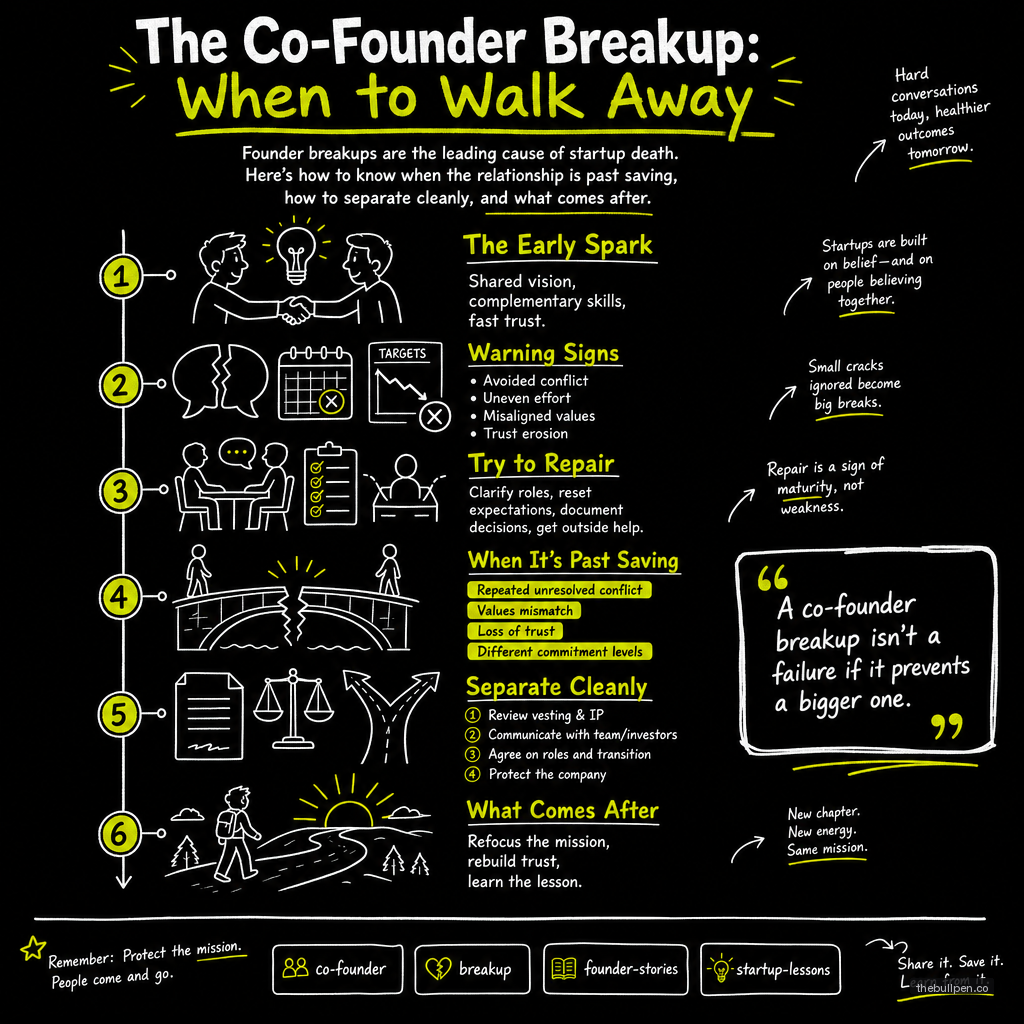
Founder breakups are the leading cause of startup death. Here's how to know when the relationship is past saving, how to separate cleanly, and what comes after.
The most dangerous risk in a startup isn't competition, market timing, or running out of money. It's the co-founder relationship.
CB Insights data shows that co-founder conflict is a contributing factor in roughly 20% of startup failures. That's higher than pricing problems, product issues, or poor marketing. Only "no market need" and "ran out of cash" rank higher — and those are often symptoms of a broken co-founder dynamic that prevented the founders from addressing the real problems.
Every co-founder relationship goes through rough patches. The question is whether the rough patch is a normal part of building a company together, or a sign that the partnership is structurally broken and will eventually kill the business.
Related: What I Learned from My First Failed Startup
Signs It's Time to Walk
Not every disagreement means you should split. Founders who work well together disagree constantly — that's how good decisions get made. But there are patterns that signal a terminal problem.
Different commitment levels. One founder works 80-hour weeks while the other works 30. One takes every weekend off while the other never stops thinking about the business. Over months, the gap in contribution creates resentment that no conversation can fix. The split is inevitable; the only question is when it happens and how much damage it does before then.
Mismatched risk tolerance. One founder wants to raise maximum capital and go all-in on growth. The other wants to bootstrap and stay lean. These are valid strategies, but they're mutually exclusive at the execution level. A company can't simultaneously be optimized for hypergrowth and profitability. When founders disagree on the fundamental strategy, every decision becomes a fight.
Broken communication. If you can't tell your co-founder bad news, or they can't hear it without getting defensive, the relationship is past repair. Trust requires honesty, and honesty requires safety. A partnership where hard conversations are avoided is one where bad decisions fester.
Erosion of respect. You don't have to like your co-founder at every moment. But you have to respect their judgment. When you find yourself dismissing their ideas before hearing them, or rolling your eyes at their suggestions, the partnership is broken. Respect rarely returns once it's gone.
| Signal | Warning | Breaking Point |
|---|---|---|
| Effort gap | One consistently works 2x the other | Resentment affects all decisions |
| Strategy mismatch | Disagree on growth vs profitability | Every major decision becomes a negotiation |
| Communication breakdown | Avoiding hard conversations | Problems go unaddressed for months |
| Lost respect | Dismissing each other's ideas | No productive debate possible |
How to Separate Cleanly
When the decision to split is made, do it fast and do it fairly. A drawn-out separation destroys months of productivity and burns bridges that could be rebuilt later.
Get everything in writing. Vesting agreements, equity splits, IP assignment — all of it should be documented before you separate. The most expensive mistake is a verbal agreement about who owns what. If the company needs to raise money later, investors will want to see clean documentation of the split.
Buy out or vest out. If the departing co-founder has unvested equity, it should cancel. Vested equity can be repurchased by the company at fair market value or a pre-agreed price. If the company can't afford to buy out the equity, negotiate a vesting schedule that returns the shares gradually.
Communicate to the team. Don't let rumors fill the gap. Tell your team what happened, what it means for them, and what the plan is going forward. Be honest without being negative about your former co-founder. The team's trust in the remaining leadership depends on how this conversation goes.
Communicate to investors. Investors have seen this before. A clean, professional separation is a green flag — it shows mature decision-making. A messy, public breakup is a red flag. Tell investors the facts, the plan, and how the company will continue without missing a beat.
What Comes After
Most founders who go through a co-founder breakup worry that it's the end of the company. For many, it's the beginning of a better version.
When the wrong partner leaves, the remaining founder often finds that decision-making gets faster, morale improves, and the company's direction becomes clearer. The energy that was spent managing the relationship is now available for building the business.
The key is not to let the experience make you afraid of partnership. A bad co-founder relationship doesn't mean all co-founder relationships are bad. The next time, you'll know what signals to watch for.
How to Avoid It in the First Place
The best way to handle a co-founder breakup is to prevent it. Vesting schedules with a 1-year cliff and 4-year vesting. A co-founder agreement that covers what happens if someone leaves. Regular check-ins about the health of the relationship. The same rigor you apply to product development should apply to the partnership that's building it.
The founders who survive co-founder breakups are the ones who see the warning signs early, make the hard decision quickly, and protect the company through the transition. The company is bigger than any two people. If the partnership isn't working, the company deserves a chance to survive beyond it.
Published on the Bullpen Blog. New articles every day at 9 AM UTC.
Get weekly pitch tips
One email a week. Actionable advice for founders.
How does your founder story score? Find out in 2 minutes. Try now →