Technical vs Non-Technical Founders: A False Dichotomy
The endless debate about whether founders need to code is missing the point. The real divide isn't technical skill — it's founder-market fit.
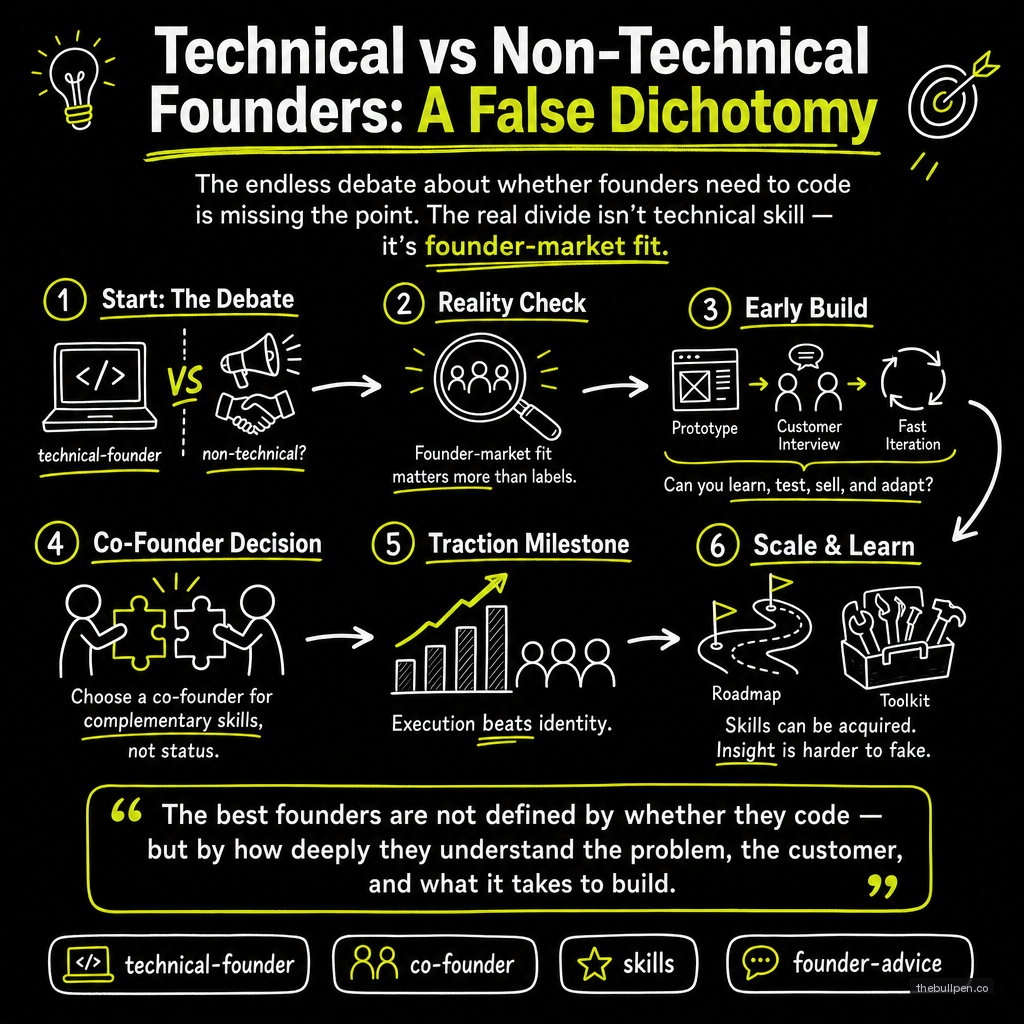
I used to believe the technical founder thing. I thought that if you couldn't code, you couldn't build a meaningful tech company. The logic seemed airtight: how can you lead an engineering organization if you can't write a pull request? How can you evaluate technical talent if you don't know what good looks like? How can you make product decisions if you don't understand the architecture?
Then I watched a non-technical founder build a $50M ARR company while his CTO handled the engineering side. And I watched a brilliant technical founder struggle to sell his product because he couldn't communicate value to non-technical buyers. And I realized the debate was framed wrong from the start.
The real question isn't whether you can code. It's whether you have the right skills for what your company needs right now.
Related: How Real Founders Raised Their First Million: Lessons from the Trenches
The Obsession with Technical Founders
There's a well-documented bias in venture capital toward technical founders. Paul Graham wrote that the best founders are " relentlessly resourceful" and that technical founders have an advantage because they can build the product themselves. Y Combinator's application process has historically favored teams with technical co-founders. Many VCs won't even meet with a solo non-technical founder.
The data partially supports this. A study by Harvard Business School's Tom Eisenmann found that startups with a technical co-founder are more likely to reach product-market fit and less likely to fail due to execution problems. First Round Capital's research showed that companies with at least one technical founder raised 30% more on average.
But this creates a dangerous assumption: that "technical" is a binary trait, and that non-technical founders are inherently disadvantaged in a way that can't be compensated for.
The best non-technical founders I know don't compete on technical skill. They compete on sales, vision, hiring, and culture. They build deep relationships with their technical co-founders based on trust and mutual respect, not on an ability to review code. They learn enough technical literacy to have informed conversations without pretending to be engineers.
And the best technical founders I know don't rely on their coding ability as their primary value. They learn to sell, to hire, to communicate vision, and to build culture. The ones who stay heads-down and never develop those skills hit a ceiling around 10 employees.
Related: The Solo Founder's Journey: Building Alone and Winning
What Actually Matters
Founder-market fit is the real variable. Do you have deep domain expertise in the space you're building for? Do you understand the customer's problem because you've lived it? Do you have a network in the industry that you can leverage for early customers, partnerships, and talent?
A non-technical founder who spent 10 years in healthcare and is building software for hospitals has founder-market fit that no amount of coding ability can substitute. They know the buyer. They know the workflow. They know the regulatory constraints. They can sell the product because they've been the customer.
A technical founder building developer tools for data engineers has founder-market fit because they are the customer. They understand the pain intuitively. They can build the first version themselves. They have credibility with their audience.
Both are valid. Both can succeed. The mistake is assuming that one path is universally superior.
| Founder Type | Superpower | Blind Spot |
|---|---|---|
| Technical | Can build the product, deep credibility with dev audience, controls the roadmap | May struggle with sales, hiring, culture, and investor communication |
| Non-technical | Deep domain expertise, strong sales and relationships, better at org building | Can't build the product alone, must find and trust a technical co-founder |
| Both (ideal) | Combined coverage of build + sell, redundant perspectives, better decision-making | Co-founder conflict risk, equity split complexity |
The data supports the obvious conclusion: the ideal is having both. Startups with a technical founder and a non-technical founder who complement each other have the highest success rates. But not every founder has the luxury of choosing — and plenty of great companies were built by a single founder who developed both skill sets over time.
What I'd Tell a Non-Technical Founder
If you can't code, you need to do three things that technical founders don't have to worry about as much.
Find a technical co-founder who trusts you. This is the hardest and most important task. A technical co-founder who doesn't respect your non-technical contributions will eventually resent you. One who sees your sales ability, your domain expertise, and your vision as complementary to their technical skill will build a durable partnership.
Learn enough technical literacy to have informed conversations. You don't need to write code. You need to understand what's hard, what's easy, and what's impossible. You need to know the difference between "we need to rebuild the database" and "we need to change a CSS class." You need to be able to evaluate technical talent even though you can't do the technical work yourself.
Focus on what only you can do. Your job as a non-technical founder is not to manage the engineers. It's to sell the product, raise the money, hire the team, set the vision, and remove obstacles. If you're spending your time trying to learn to code, you're neglecting the things that only you can do. Delegate the engineering. Own everything else.
What I'd Tell a Technical Founder
If you can code but can't sell, you have the opposite problem — and it's harder to see because nobody tells you it's a problem until you're running out of money.
Invest as much in your sales and communication skills as you do in your technical skills. The ability to explain what you're building and why it matters is not optional. It's the difference between a company and a hobby.
Hire for your weaknesses. Your first hire should probably not be another engineer. It should be someone who can sell, someone who can build the organization, someone who fills the gaps you don't even know you have.
And get out of the building. Technical founders have a tendency to optimize the product while the market changes around them. The best technical founders spend as much time talking to customers as they do writing code — and they don't see those as competing activities.
The Labels Are the Problem
The real problem with the "technical vs non-technical" framing is that it's a lazy proxy for something more nuanced. The question isn't whether you can code. The question is whether you can build a company. Those are different skills, and very few people have all of them at the outset.
The founders who win are the ones who recognize their gaps, are honest about them, and find ways to fill them — through co-founders, through hiring, through learning, or through all three. The ones who lose are the ones who let a label define what they think they're capable of.
Data references: Harvard Business School (Tom Eisenmann — failure patterns, technical founder advantage), First Round Capital (State of Startups — fundraising outcomes by founder type), Y Combinator Startup School (founder-market fit, co-founder dynamics).
Ready to see how investors would evaluate your founder team? Upload your pitch to Bullpen for a free AI-powered assessment across 7 investor categories — including team assessment, market positioning, and unit economics.
Get weekly pitch tips
One email a week. Actionable advice for founders.
How does your founder story score? Find out in 2 minutes. Try now →