Corporate Accelerators: Are They Worth It?
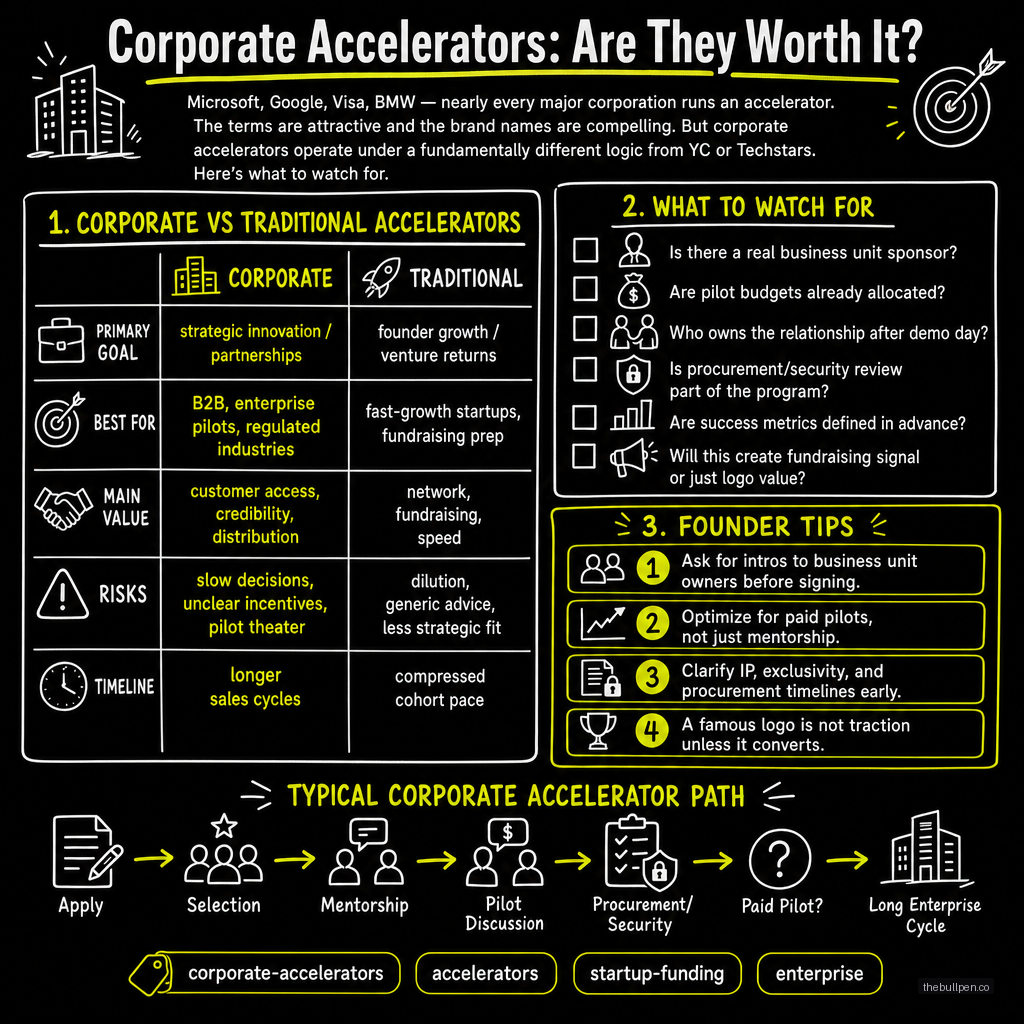
Microsoft, Google, Visa, BMW — nearly every major corporation runs an accelerator. The terms are attractive and the brand names are compelling. But corporate accelerators operate under a fundamentally different logic from YC or Techstars. Here's what to watch for.
Microsoft runs one. Google runs one. Visa, BMW, SAP, Citigroup, and a dozen other Fortune 500 companies all operate accelerator programs under their corporate brands. The pitch to founders is compelling: access to enterprise customers, technical resources, and potential acquisition paths, all with minimal equity dilution.
But corporate accelerators are not Y Combinator. They're not Techstars. They operate under a fundamentally different logic that serves the corporation's strategic interests first. Understanding that logic is the difference between a partnership that accelerates your startup and one that wastes six months of your runway.
Related: The Ultimate Guide to Startup Accelerators
How Corporate Accelerators Work
Corporate accelerators typically offer a small cash investment ($20K-$120K) for minimal equity (0-5%), combined with access to the corporation's technology platform, customer network, and expertise. The program runs 8-16 weeks, usually with a demo day at the end.
The corporation's motivation is different from an independent accelerator. YC invests in startups to generate financial returns. A corporate accelerator invests in startups to serve strategic goals: identifying acquisition targets, creating ecosystem lock-in, generating innovation that the corporation's internal R&D can't produce, or building relationships with emerging technology companies.
| Dimension | Corporate Accelerator | Independent Accelerator (YC/Techstars) |
|---|---|---|
| Primary goal | Strategic alignment for corporation | Financial return for investors |
| Investment | $20K-$120K, often grant-like | $120K-$500K for equity |
| Equity taken | 0-5% (sometimes none) | 6-10% |
| Key benefit | Enterprise customer access | Brand, network, fundraising |
| IP concerns | Significant — read the terms | Minimal |
| Decision speed | Slow — multiple corporate stakeholders | Fast — partner decides |
| Post-program support | Varies widely | Strong alumni network |
The Good: What Works
The most valuable thing a corporate accelerator can offer is customer access. If you're building a product that integrates with Microsoft Azure, Google Cloud, or Salesforce, going through their accelerator can open doors that would take years to open on your own.
Startups in corporate accelerators often get direct introductions to the corporation's enterprise customers, preferred pricing on the corporation's platform (free cloud credits, reduced API fees), and a potential acquisition path — the corporation gets to evaluate you as a strategic investment over several months rather than a weekend of diligence.
The equity terms are usually better than independent accelerators. Some corporate programs take no equity at all, offering the investment as a grant. Others take 2-5%, compared to 7% for YC or 6% for Techstars.
The Bad: What to Watch For
Strategic conflicts. The corporation's goals are not your goals. They're interested in your technology for specific applications that serve their business. If your startup pivots into a direction that doesn't align with the corporate parent's strategy, the relationship becomes friction rather than fuel.
Slow decision-making. Corporate accelerators involve multiple stakeholders — the accelerator team, the business unit sponsoring the relationship, legal, compliance, and possibly the CEO's office. Decisions that take a day at YC take weeks in a corporate accelerator.
IP concerns. This is the biggest trap. Corporate accelerator agreements often grant the corporation broad rights to your intellectual property — either outright ownership, royalty-free licenses, or "right of first negotiation" that can scare away other investors. Read the IP clause carefully and have a lawyer who specializes in startup acceleration review it before signing.
| Red Flag | What It Means | What to Do |
|---|---|---|
| Broad IP assignment | Corporation owns your technology | Negotiate down to non-exclusive license or remove entirely |
| Right of first refusal | You can't sell to anyone else without offering it to the corporation first | Cap the duration and scope |
| No-shop clause | You can't raise funding during the program | Keep it under 90 days |
| Exclusivity in your vertical | You can't partner with competitors | Limit to the program duration only |
Related: Techstars vs Y Combinator: Which Accelerator Is Right for You?
Who Should Do One
Corporate accelerators make sense in specific scenarios.
You're building on their platform. If your product runs on Microsoft Azure, Google Cloud, or Salesforce, their accelerator gives you technical resources, integration support, and co-marketing that's genuinely valuable. The platform integration can become a defensible moat.
Your customer is their enterprise base. If you're selling to Fortune 500 companies, a corporate accelerator can provide warm introductions that cut your sales cycle from 12 months to 3. The accelerator cohort also gives you social proof — "we were part of Microsoft's Accelerator" signals stability to risk-averse enterprise buyers.
You want to be acquired. If your endgame is an acqui-hire or strategic acquisition, a corporate accelerator is effectively a 3-6 month interview with a potential buyer. They get to evaluate your team and technology up close, and you get to evaluate whether their culture is one you want to join.
Who Should Skip
Corporate accelerators are a bad fit for most consumer startups, companies with technology that could be competitive with the corporate parent, startups at a stage where speed of iteration is critical (corporate processes will slow you down), and founders who are actively fundraising from VCs (the strategic relationships can complicate term sheets).
The Bottom Line
A corporate accelerator is a partnership, not a funding round. The value is in the relationship, not the check. If the corporation's strategic interests align naturally with what you're building, the program can accelerate your growth in ways that YC and Techstars can't. If the alignment is forced or the IP terms are restrictive, you'll spend three months fighting internal processes instead of building your company.
Go in with eyes open. Read the contract. And ask yourself honestly: would I take this deal from this company if the brand name weren't attached?
Published on the Bullpen Blog. New articles every day at 9 AM UTC.
Get weekly pitch tips
One email a week. Actionable advice for founders.
Your Demo Day pitch, evaluated in 2 minutes. Try now →