The Ask Slide: How to Present Your Funding Round Without Looking Desperate
The ask slide is the most straightforward slide in your deck and the easiest to get wrong. Here's how to present how much you're raising, what you'll spend it on, and what milestones it buys.
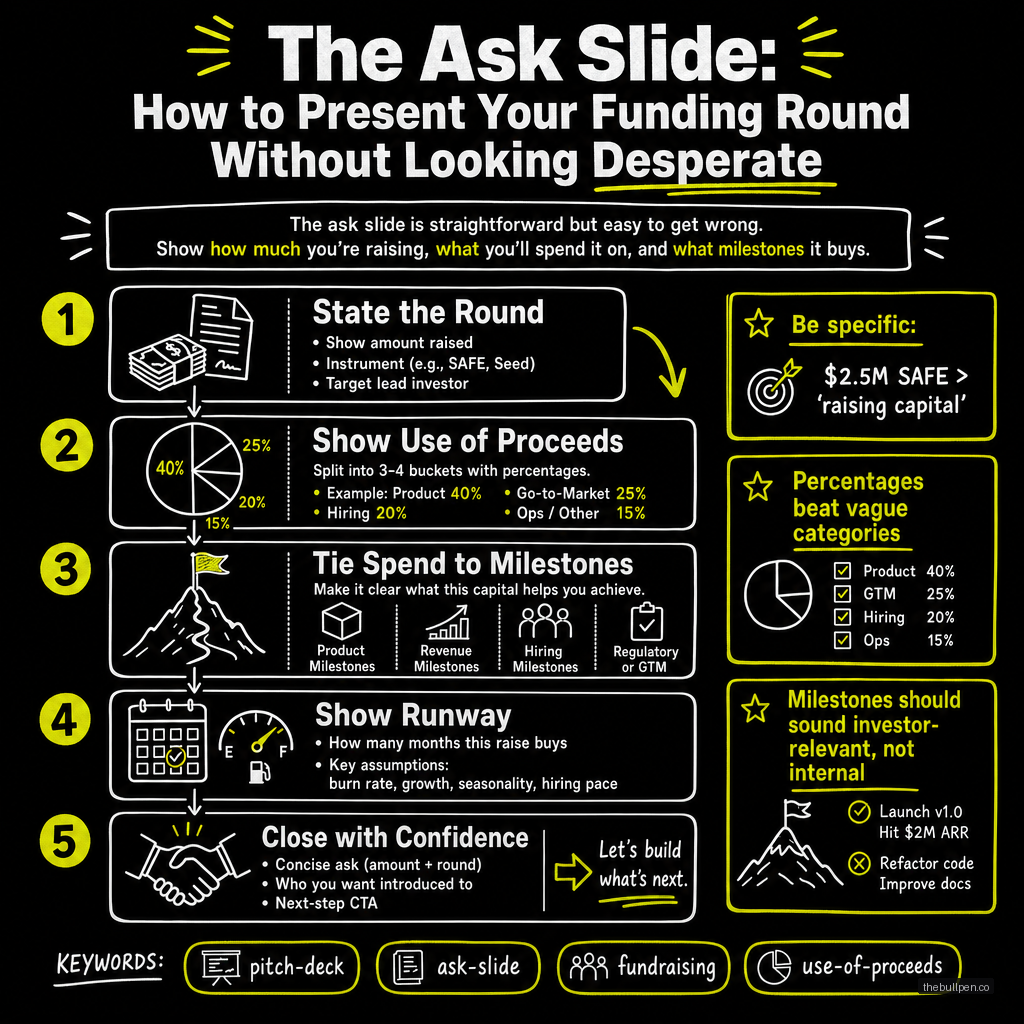
The ask slide should be the simplest slide in your deck. You're telling investors how much you're raising, what you'll spend it on, and what milestones you'll hit. Yet somehow, this is where many decks fall apart — numbers that don't tie to the traction slide, vague use of proceeds, or an amount that doesn't match the company's stage.
The ask slide has one job: make it easy for an investor to say yes. If they're interested in the company, the ask slide should give them everything they need to start writing a term sheet in their head.
Related: The Complete Guide to Building a Pitch Deck
What to Include
Three elements cover everything the ask slide needs.
The amount. A single number: $500K, $1.5M, $3M. No ranges. No "we're raising $500K to $1M." Pick a number that's based on your plan and stick to it. Investors interpret a range as "they haven't figured out how much they need."
The use of proceeds. A breakdown of where the money goes. Typically 60-70% on hiring, 20-30% on sales and marketing, 10-20% on operations. The categories should match the narrative of the rest of the deck. If you're a product-led growth company, most spend should be on product and engineering. If you're sales-led, most should be on sales headcount.
The milestones. What will the company achieve with this capital? 12-18 months of runway. A specific ARR target. A certain number of customers. A product launch date. Investors want to see what the company will look like when it's ready to raise the next round.
| Element | What to Show | Common Mistake |
|---|---|---|
| Amount | Single number, justified by plan | Range or "as much as we can get" |
| Use of proceeds | Pie chart or simple table | Vague "operations and growth" |
| Milestones | Clear 12-18 month targets | No milestones, just "we'll build" |
How Much to Ask For
The right amount is the smallest number that gets you to your next milestone. If you need $500K to reach $100K MRR in 18 months, raise $500K. If you need $3M to reach $2M ARR in 18 months, raise $3M.
Most founders raise too much because they think more money equals more success. More money means more dilution, more board pressure, and a harder path to the next round. The optimal amount gives you enough runway to hit your milestones but not so much that you lose the discipline of efficiency.
A common formula: estimate monthly burn for 18 months, add 20% buffer, and that's your target. If monthly burn will be $50K, you need roughly $1.1M.
The Use of Proceeds Breakdown
A specific use of proceeds section signals that you've planned the business. A vague one signals that you haven't.
The strongest use of proceeds slides show the number of hires planned, the departments they'll join, and the expected impact on growth. "Hire 3 salespeople ($150K) and 2 engineers ($200K)" is more convincing than "grow the team."
The breakdown should tie to your traction. If you have 10 customers acquired through outbound sales and ask for $2M to spend mostly on product, the investor will ask why. The numbers should reinforce the story, not contradict it.
Related: Traction Slide Examples: What Seed-Stage Investors Want
The Milestones
The milestones section answers the question investors will ask after the meeting: what does success look like after this round?
The best milestones are specific and measurable. "$2M ARR in 18 months" is better than "significant revenue growth." "Launch in 3 new markets" is better than "expand geographically." Showing that you understand the funding roadmap signals experience.
The Template
The Ask

Amount: $X · Runway: 18 months

Use of proceeds:
- Hiring: $X (X%)
- Sales & Marketing: $X (X%)
- Operations: $X (X%)

Key milestones:
- Revenue: $X ARR
- Team: X employees
- Product: [launch milestone]
Get weekly pitch tips
One email a week. Actionable advice for founders.
Upload your deck. Get scored in 2 minutes. Free. Try now →