Your Team Slide Is Probably Boring. Here's How to Fix It.
The team slide gets the least investor attention — roughly 75 seconds per DocSend — but it's the slide investors flip to first after the opener. Here's how to make those seconds count.
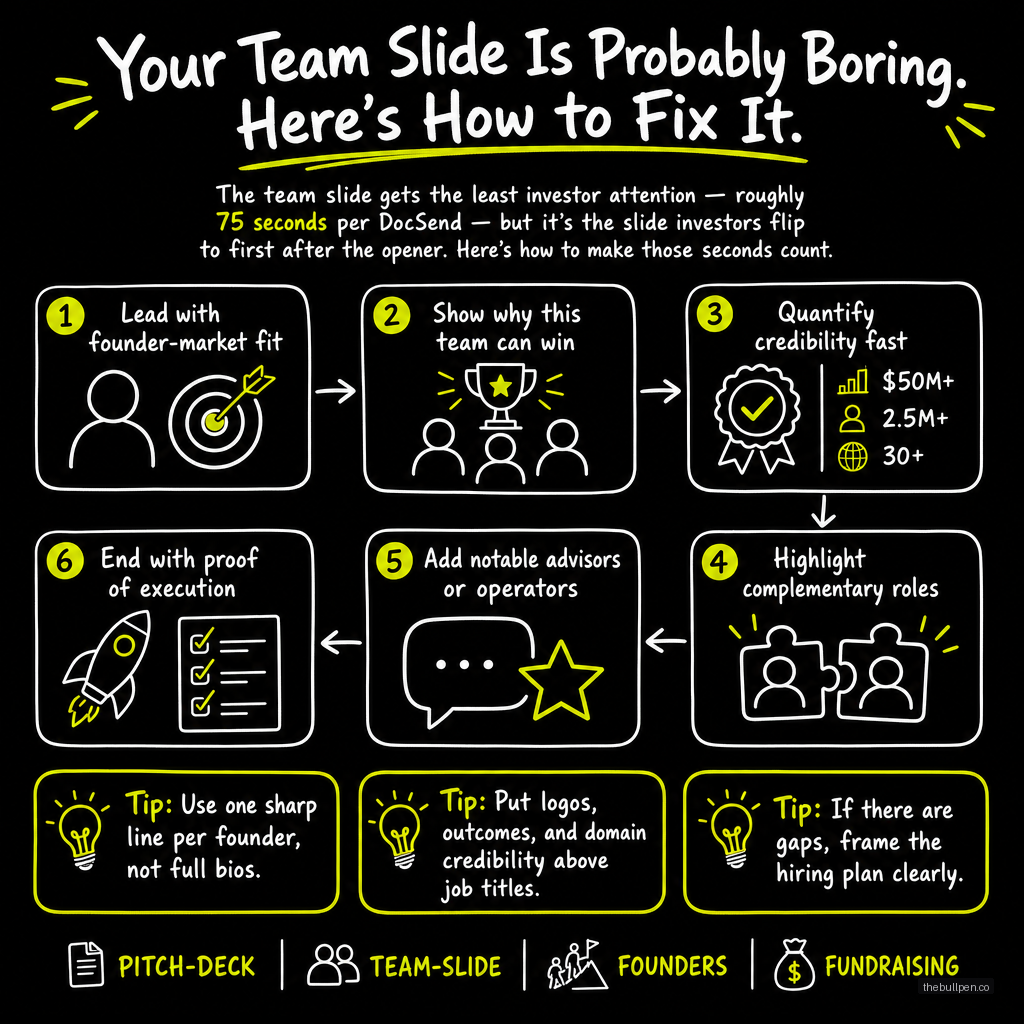
The team slide is the most underperforming slide in most pitch decks. Founders spend hours agonizing over the problem slide, the solution slide, and the traction chart, then throw up a headshot grid with names and titles as if that fulfills the requirement.
DocSend's eye-tracking data is brutal: investors spend roughly 75 seconds on the team slide — less than half the time they spend on traction. But here's the part that doesn't show up in the averages: the team slide is one of the most-flipped-to slides in the deck. Investors jump to it early, skim it quickly, and decide whether to take the rest of the deck seriously based on what they see. If your team slide doesn't communicate founder-market fit in the first glance, you've already lost a point of conviction.
The team slide's job isn't to list names and faces. It's to answer one question: why is this specific group of people the best in the world to solve this specific problem?
Related: The Complete Guide to Building a Pitch Deck
What Investors Actually Look For
Investors evaluate teams across three signals. Getting any of them wrong undermines the entire deck.
Domain expertise. Do you have deep knowledge of the industry you're entering? A founder who spent five years working in logistics can build a logistics startup with an insider's understanding of the pain points. A founder who read a report about the logistics market and decided it looked promising cannot. This is the single most important signal on the team slide.
Founder-market fit. Do you have a personal connection to the problem? A founder who experienced the problem firsthand has a conviction that a professional observer can't replicate. Investors know this and weight it heavily.
Track record. Have you done something hard before? It doesn't have to be a prior startup exit. Scaling a product at a major company, building a well-known open source project, or leading a team through a crisis all qualify.
| Signal | What It Proves | Weak Version | Strong Version |
|---|---|---|---|
| Domain expertise | Insider knowledge reduces execution risk | "Advised by industry experts" | "5 years as VP of product at a competitor" |
| Founder-market fit | Personal conviction drives persistence | "We're passionate about this space" | "I built this because I lived this problem" |
| Track record | Past execution predicts future | Previous title without context | "Scaled product from $0 to $10M ARR" |
What to Put on the Slide
Each founder gets one sentence that connects their past to the company's mission. The format is dead simple: name, role, one relevant accomplishment.
Airbnb's early deck did this perfectly. Brian Chesky's "Lead designer at MIT Media Lab" explained why he drove product. Joe Gebbia's background in industrial design explained why he handled brand. The deck didn't list every job they'd ever had. It selected the one accomplishment that mattered most.
Notion's seed deck showed just two founders with one line each: "Ivan built a startup that did $1M ARR at 18." That single number was more convincing than paragraphs of biography.
Common Mistakes
Headshots with no context. A name, title, and company logo tell the investor nothing. Every slide looks the same. The investor has to guess whether the "VP of Engineering at Google" on your team built a critical infrastructure system or managed three interns.
Too many people. Listing every advisor clutters the slide. Seed-stage investors only care about the 2-5 people who will make or break the company. Everyone else goes in the appendix.
Skipping the story. An org chart communicates hierarchy, not narrative. The team slide should tell a story about why this group came together to build this company. A functional narrative beats a grid of headshots every time.
Ignoring gaps. If you're a solo founder, address it directly. "Hiring CTO — currently advised by former Twitter infrastructure lead" shows you have a plan. Pretending the gap doesn't exist is worse than acknowledging it.
The Template
Team

[Name] — [Role] — [One relevant accomplishment]

[Co-founder] — [Role] — [One relevant accomplishment]

[If applicable: Hiring for: [role]]
Four names max. One sentence per person. Every sentence should make an investor think "that's why they're building this."
Published on the Bullpen Blog. New articles every day at 9 AM UTC.
Get weekly pitch tips
One email a week. Actionable advice for founders.
Upload your deck. Get scored in 2 minutes. Free. Try now →