The Competitive Matrix: How to Show You're the Best Without Looking Insecure
The competition slide is the most nerve-wracking part of any pitch deck. Most founders either claim they have no competitors (naive) or bash them aggressively (insecure). Here's how to build a competitive matrix that builds investor confidence instead.
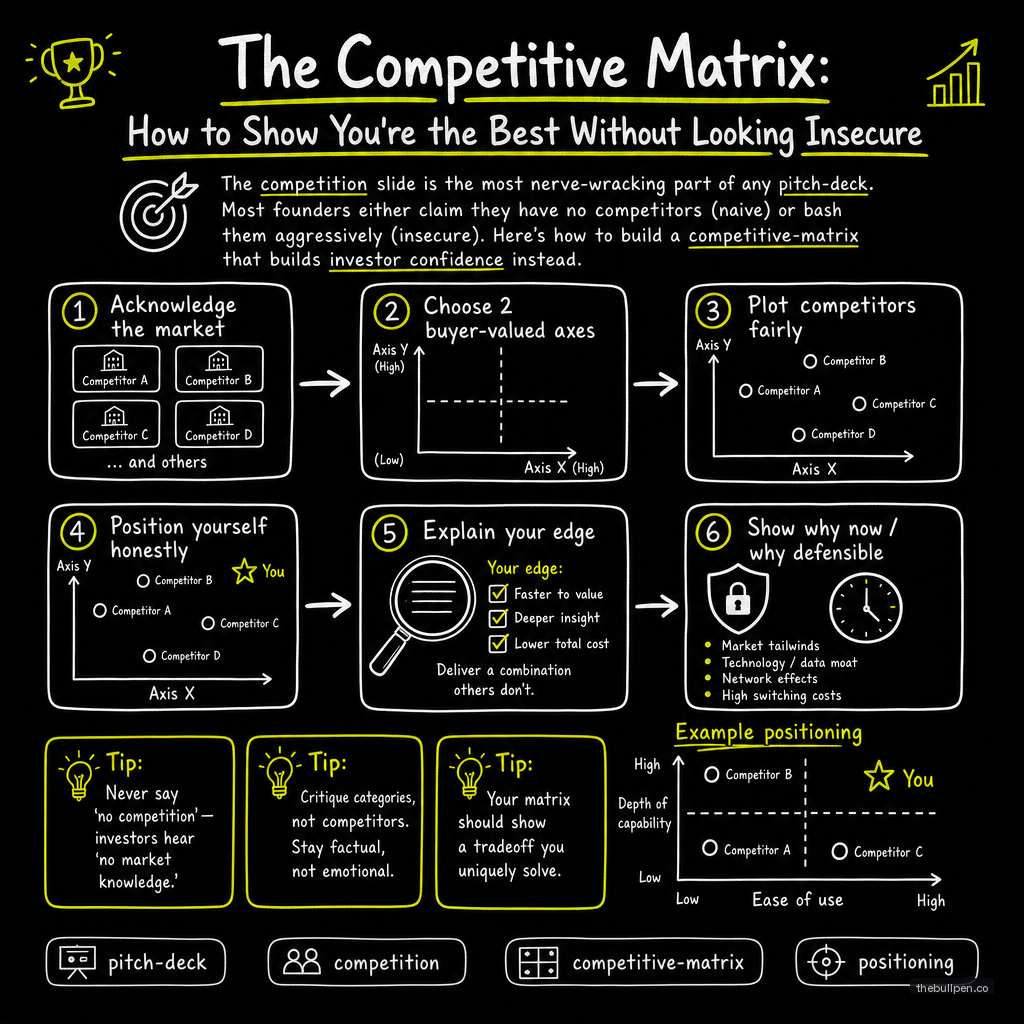
Founders make two mistakes on the competition slide. The first is claiming they have no competitors. The second is listing fifteen competitors in a 2x2 grid that makes the space look like a red ocean of interchangeable products.
Both mistakes come from the same place: insecurity. If you claim no competitors, you're hoping the investor won't notice. If you list everyone, you're trying to show you've done your homework by naming every company that exists in a 20-mile radius of your space. Neither strategy inspires confidence.
The competition slide's real job is to show that you understand the landscape deeply enough to identify the one axis where you win. Not five axes. Not a feature table with checkmarks for both products. One clear, defensible difference that makes your startup the obvious choice for a specific set of customers.
Related: The Complete Guide to Building a Pitch Deck That Raises Capital
The Two Formats That Work
There are two formats for a competition slide, and they serve different purposes.
The 2x2 matrix. Two axes form four quadrants. Your company sits in the top-right quadrant (high value, high differentiation) while competitors fall into the other three. This format is best for showing strategic positioning — you're not just better, you're playing a different game. Airbnb's classic positioning against hotels and Couchsurfing used this format. Uber's early deck showed a 2x2 with taxis, limos, and public transit in three quadrants and Uber in the fourth.
The feature comparison table. A table with competitors as columns and features as rows. Your product has checkmarks in every row. Everyone else has gaps. This format is best for B2B products with clear feature differentiation. Notion's early deck used this against Confluence and Evernote. The risk: if your features look too similar to competitors', the table exposes your weakness instead of highlighting your strength.
| Format | Best For | Risk |
|---|---|---|
| 2x2 matrix | Consumer, marketplace, or platform plays | Axes must be carefully chosen to tell your story |
| Feature comparison table | B2B SaaS with clear functional differentiation | Makes you look like a clone if features overlap too much |
| The "anti-portfolio" | Highly differentiated products | Can come across as arrogant if not done well |
There's a third option that works well for genuinely novel products: the "anti-portfolio." Instead of comparing yourself to competitors directly, you list the alternatives your customers currently use — including the manual workaround. A project management startup's competitors aren't just Asana and Monday. They're also spreadsheets, sticky notes, and email threads. Showing that you understand the invisible competition is often more convincing than a comparison grid.
Related: How to Nail the Problem Slide
How the Best Decks Did It
The most effective competition slides from funded startups share a common structure: one clear axis of differentiation, three competitors max, and a narrative that explains why the difference matters.
Airbnb's positioning against hotels. Brian Chesky's early deck didn't spend much time on competition, but when it did, the framing was clean: hotels are expensive and impersonal. Couchsurfing is free but unreliable. Airbnb sits in the middle — affordable and personal. Two competitors, one clear gap, a massive addressable market.
Notion vs Evernote and Confluence. Notion's competitive matrix was a feature table where they out-checked both incumbents. Evernote had notes and sync but couldn't handle databases or wikis. Confluence had wikis and collaboration but was heavy. Notion did all three in a single tool. The story was clear: pick any two other products and Notion replaces them both.
Uber vs taxis, limos, and transit. Uber's early 2x2 grid had reliability on one axis and price on the other. Taxis were unreliable and mid-price. Limos were reliable and expensive. Transit was cheap and unreliable. Uber was reliable and affordable. The axes were chosen to make the point inevitable.
| Company | Format | Axis / Differentiator | Competitors Listed |
|---|---|---|---|
| Airbnb | 2x2 matrix | Price × Personalization | Hotels, Couchsurfing |
| Notion | Feature table | Notes + Wikis + Databases | Evernote, Confluence |
| Uber | 2x2 matrix | Price × Reliability | Taxis, Limos, Transit |
| Buffer | Feature table | Simplicity × Transparency | Hootsuite, Sprout Social |
The pattern is the same in every case: exactly one dimension of differentiation, three or fewer competitors, and a positioning that makes the competition feel like they're fighting yesterday's war.
Choosing Your Axes
The 2x2 matrix is only effective if your axes tell the right story. Wrong axes make you look like every other competitor. Right axes make the market structure obvious.
The best axes are based on fundamental trade-offs that your competitors can't easily copy. If your axis is "price," a well-funded competitor can undercut you. If your axis is "ease of use," a competitor can redesign their UI. But if your axis is "integrated platform vs point solution" or "consumer-grade UX vs enterprise-grade control," those are structural trade-offs that are hard for competitors to bridge without alienating their existing users.
The most common effective axes:
- Platform depth vs simplicity (the classic: Salesforce vs HubSpot)
- Enterprise vs SMB (the coverage gap)
- Vertical specialization vs horizontal (the focused vs generalist split)
- Manual process vs automation (the time-value divide)
- Consumer UX vs enterprise features (the design trade-off)
Related: Market Sizing: How to Present TAM, SAM, and SOM
Common Mistakes
The mistakes on competition slides are predictable enough that experienced investors can spot them in the first three seconds.
Listing too many competitors. If your matrix has fifteen logos, you're not showing you understand the landscape — you're showing you're in a crowded, commoditized space. The best competitive matrices have three to five competitors max. The rest are noise.
Putting yourself in the middle. A 2x2 matrix where your company sits squarely in the center, surrounded by competitors on all sides, is not a positioning — it's a confession. Investors read this as "we're average at everything."
Flag-planting on every competitor. If you claim your product is better than everyone else at everything, you look either dishonest or naive. Acknowledge where competitors are strong. Investors respect honesty more than they respect chest-thumping.
The "blue ocean" trap. Some founders try to avoid the competition question entirely by claiming they operate in a "blue ocean" with no competitors. Peter Thiel famously said "competition is for losers," but he also acknowledged that pretending competition doesn't exist is the fastest way to lose an investor's trust. If your market has zero competitors, it probably has zero customers too.
No mention of invisible competition. The most dangerous competitor is rarely named. It's the spreadsheet. It's the status quo. It's the internal team doing the job manually. If your competition slide only lists other startups and misses the fact that your target customers are currently solving the problem with duct tape and elbow grease, you haven't done the market research.
The Winning Formula
If you need a starting point, this structure has appeared in hundreds of funded seed decks:
Competition

[2x2 matrix or feature comparison, 3-5 competitors max]

Key Insight: [One sentence explaining why the competitive dynamic works in your favor]

Our advantage: [One defensible difference — network effects, data moat,
vertical focus, or integration depth]
Three competitors. One axis. One defensible advantage. That's all the competition slide needs to do. If you can't explain why you win in one sentence, a matrix won't save you.
Published on the Bullpen Blog. New articles every day at 9 AM UTC.
Get weekly pitch tips
One email a week. Actionable advice for founders.
Upload your deck. Get scored in 2 minutes. Free. Try now →