How to Write a One-Liner That Makes Investors Want to Read More
The mechanics of a great tagline: length, structure, testing methodology — and why most founders waste their deck's most valuable real estate.
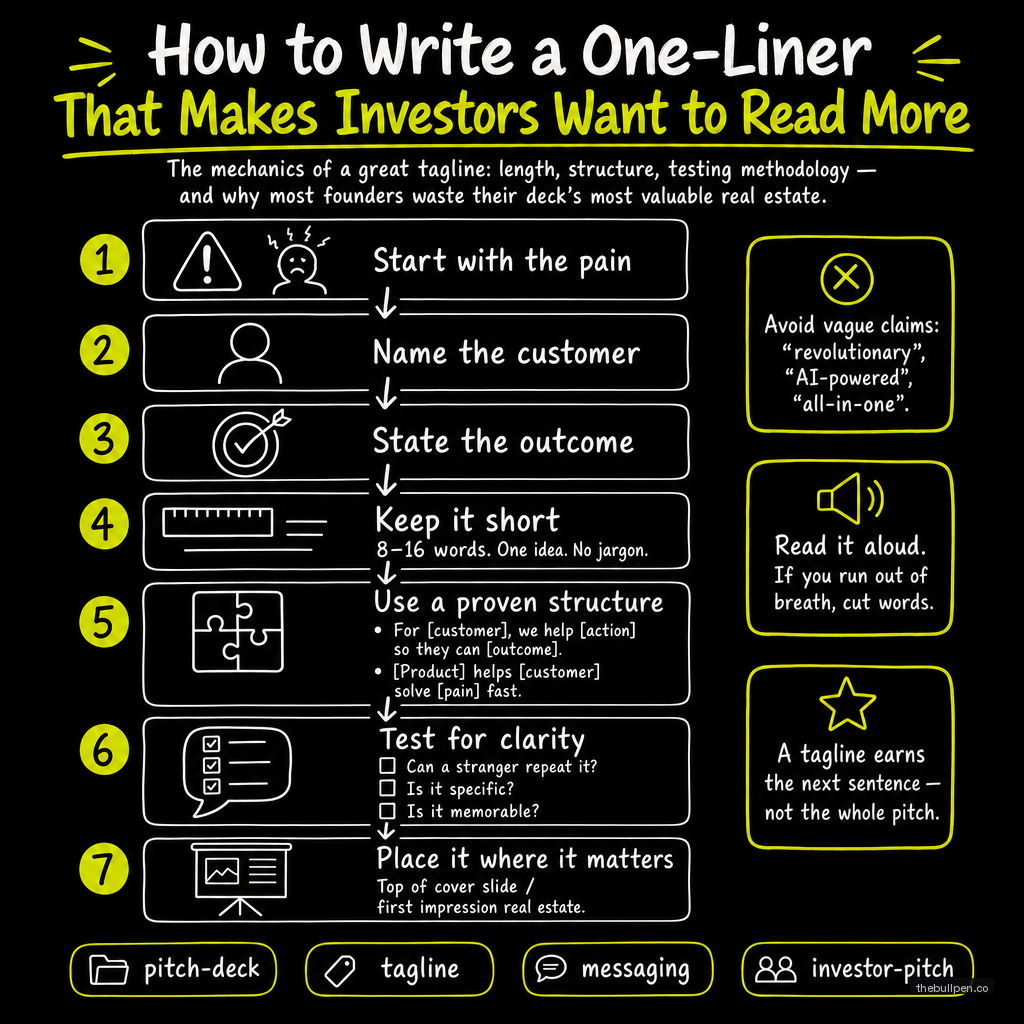
Your one-liner is not a summary of your business. It is a filter that determines whether the investor reads slide two or closes the tab.
DocSend studied over 200 pitch decks and found that investors spend an average of 2 minutes and 30 seconds reviewing an entire deck. The first slide gets roughly 20 seconds of that. If the tagline does not make the investor want to understand more within those 20 seconds, nothing else in the deck matters. They will never get to your traction slide, your team slide, or your market size analysis. The deck gets closed and the next one opens.
The mistake most founders make is treating the one-liner like a mission statement. "We empower businesses to leverage cutting-edge AI to drive transformative outcomes" is a sentence that means nothing. The investor reads it and still does not know what you do. Twenty seconds gone, replaced with the question mark that kills every pitch: what does this company actually make?
Related: The Complete Guide to Building a Pitch Deck That Raises Capital, The Problem Slide: How to Frame the Pain
The Formula That Survived Every Batch
After analyzing hundreds of funded pitch decks across every stage and sector, a consistent pattern emerges. The taglines that work share three structural elements, and removing any of them measurably reduces investor comprehension.
The customer. Who is this for? The best taglines name the specific buyer, not a demographic. Not "small businesses" but "independent insurance agents." Not "enterprises" but "VP-level data engineers building stream processing pipelines." The more specific the customer, the more the investor can visualize the opportunity. Stripe's original tagline was "Payments for developers." It named the exact buyer and the exact value. It did not need a second sentence.
The verb. What does this product do for that customer? Active, concrete, specific. "We make it easy to accept payments online." "Book rooms with locals rather than hotels." "The easiest way to send money to anyone." Every one of these uses a simple verb that a normal human would use in conversation. No one says "leverage" or "streamline" or "optimize" when describing what they built to their friends. Your tagline should pass the bar test: if someone asked what you do at a bar, would you say it this way?
The differentiation. Why this over every alternative? This is the element most founders skip. "We are a platform for project management" tells the investor nothing because there are forty project management platforms. "Project management for creative teams who hate spreadsheets" tells the investor exactly where you fit and who will love you. The differentiation does not need to be explicit. Airbnb's "Book rooms with locals, rather than hotels" implicitly differentiates against every hotel booking site in a single phrase.
Related: Investor Psychology in Pitch Decks
What the Data Says
DocSend's research correlated the length of the tagline with investor engagement. Taglines under twelve words consistently outperformed longer ones on the metric that matters most: time spent on slide two. If the investor read the tagline and immediately found something to be curious about, they advanced. If the tagline left them confused or unimpressed, they did not.
HubSpot analyzed their own pitch deck from 2007, where the tagline was "Software for inbound marketing." At the time, no one used the term "inbound marketing." The tagline did not explain what the company did to anyone outside the founder's network. The deck took three years to raise a Series A. Today, HubSpot's descendent versions use clearer positioning. The lesson is not that you need to invent a category. The lesson is that if your tagline requires the investor to already know your category, you have already lost half the room.
Buffer's original pitch deck used "Social media scheduling made simple." The tagline was not clever. It was not category-defining. It was immediately clear. Buffer raised seed funding on that deck and grew to over twenty million dollars in annual revenue before being acquired. Clarity beats cleverness every time.
The worst taglines fall into three buckets. The vague claim: "Revolutionizing the future of work." The jargon sandwich: "AI-powered omnichannel engagement platform." The non-answer: "We're like Uber for X" where X is so specific that the analogy breaks on inspection. All three share the same failure mode: they force the investor to do work to understand what you do. If the tagline requires a second read, it has already failed.
Related: Pitch Deck Design Principles, How to Present Financial Projections
The Framing Choices That Actually Matter
There are three common framing patterns for one-liners, and each works best in specific conditions.
The problem-solution frame leads with the pain and then names the fix. "Hotels are expensive and impersonal. Book a room in a local's home instead." This frame works best when the pain is universal and visceral. Everyone has had a bad hotel experience. Airbnb's pitch barely needed a market slide because the first sentence did the work.
The X for Y frame borrows an existing mental model and applies it to a new context. "Stripe is payments for developers." "Uber for dog walking." This frame works when the analogy is immediately clear and the existing category is well understood. It fails when the analogy requires explanation. If you need to explain why you are the Uber of industrial supply chain logistics, you are not the Uber of anything.
The category-creation frame names something new. "Software for inbound marketing." "The operating system for your company." This frame works only when the founder has the credibility and the product-market fit to back up the category claim. It is the highest-risk, highest-reward pattern. Most category-creation taglines sound like nonsense until they become obvious.
The frame matters less than the specificity within it. An investor who reads "We help sales teams close more deals" has learned nothing. An investor who reads "We help B2B SaaS sales teams send the right message at the right time based on prospect behavior" has learned exactly what the product does and who it is for. The second tagline is ten words longer but saves ten minutes of questions.
Related: Pitch Deck Storytelling: Building the Narrative Arc
Testing Your Tagline
The way to test a tagline is not to ask your friends if they like it. The test is to hand someone the tagline with no other context and ask them to describe what the company does in one sentence. If they can do it accurately, the tagline works. If they guess wrong, it does not matter how clever the phrasing is.
The second test is the email subject line test. If this tagline were the subject line of an email to an investor you have never met, would they open it? Most taglines fail this test because they sound like a company description rather than something an investor would want to learn more about. The best taglines sound like the beginning of a conversation an investor wants to have.
The third test is harder to simulate but more accurate: put the tagline on a slide with no other content, show it to someone for five seconds, and ask what they remember. If they remember the customer and the value, the tagline is doing its job. If they remember a buzzword or nothing at all, rewrite it.
Most founders get three or four drafts deep before they find the tagline that works. The ones who stop at draft one because the tagline sounds good to them are the ones whose decks get closed before slide two.
Data sources: DocSend's "We Analyzed 200 Pitch Decks" research report, HubSpot's public pitch deck history, Buffer's transparent deck shared by founder Joel Gascoigne, and analysis of public decks from Airbnb, Stripe, and Uber.
Ready to see if your pitch deck's one-liner passes the test? Upload your deck to Bullpen for a free AI-powered evaluation across 7 investor categories.
Get weekly pitch tips
One email a week. Actionable advice for founders.
Upload your deck. Get scored in 2 minutes. Free. Try now →