Payback Period: How Fast Do You Earn Back Your CAC?
CAC payback period tells investors how capital-efficient your growth is. Here's what healthy looks like by business model, how to calculate it correctly, and why it matters more than raw CAC.
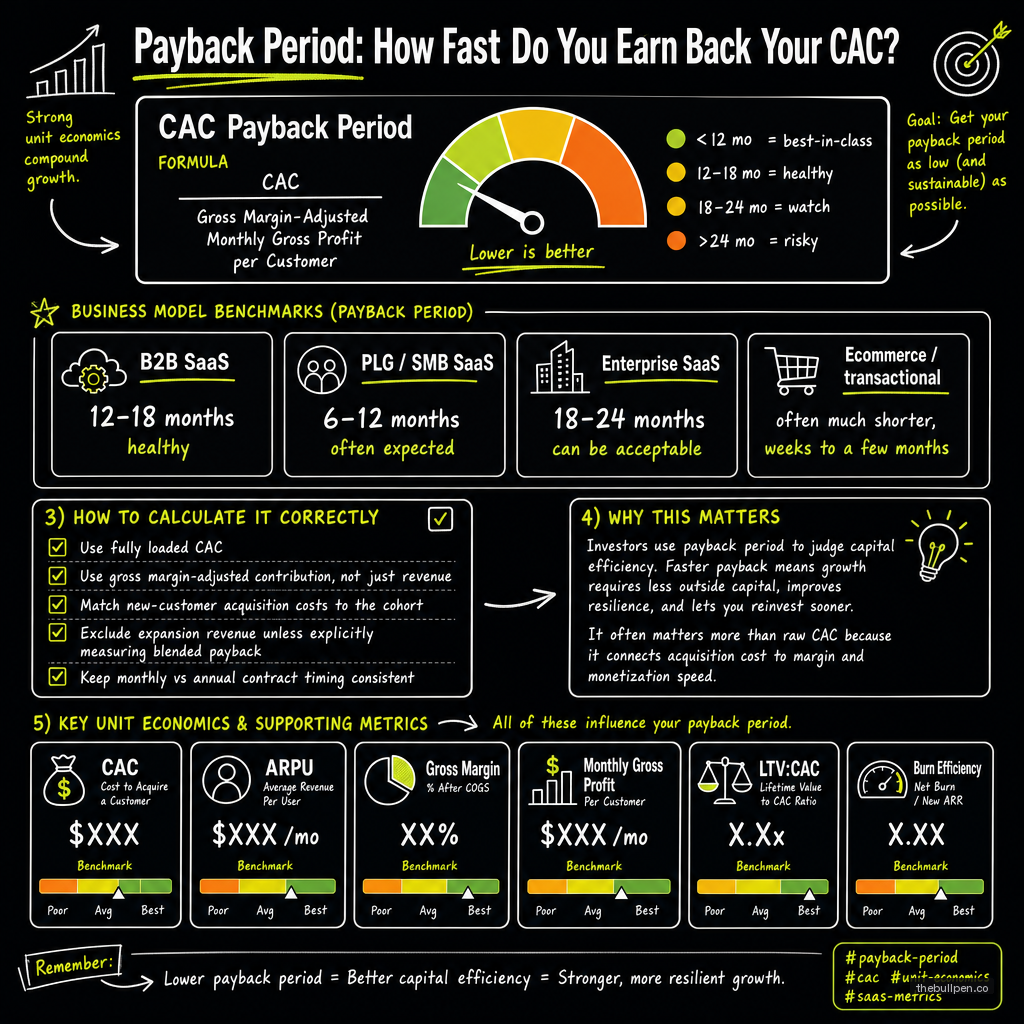
CAC payback period answers a simple question: how many months does it take to earn back what you spent acquiring a customer?
That question matters because it tells you — and your investors — how capital-efficient your growth is. A company with a 6-month payback period can reinvest its customer revenue into new acquisition every six months, creating a compounding growth engine. A company with a 24-month payback period needs outside capital to sustain growth, because existing customers aren't paying for themselves fast enough.
The math is straightforward: CAC divided by monthly gross profit per customer. If you spend $3,000 to acquire a customer who generates $500 a month in gross profit, your payback period is six months.
But the benchmark varies dramatically by business model, and that's where most founders get confused.
Related: Startup Metrics That Matter: What Investors Actually Look For
What Healthy Looks Like
The payback period benchmark depends on your revenue model and stage.
| Model | Excellent | Standard | Warning |
|---|---|---|---|
| Self-serve / PLG | Under 6 months | 6–12 months | Over 18 months |
| Mid-market sales | Under 12 months | 12–18 months | Over 24 months |
| Enterprise sales | Under 18 months | 18–24 months | Over 36 months |
Self-serve products should have the shortest payback because the CAC is low and the sales cycle is fast. If your PLG product has a 24-month payback period, something is wrong — either your pricing is too low, your onboarding is losing users, or your acquisition channels are inefficient.
Enterprise products can sustain longer payback periods because the ACV is high and the contracts are annual. A $50K CAC on a $100K ACV deal with an 80% gross margin pays back in about 7.5 months. That's excellent for enterprise. The same $50K CAC on a $20K ACV with the same margin pays back in 37.5 months — which is a death spiral unless you have massive expansion revenue.
The key insight: payback period is a ratio, not an absolute number. It tells you whether your CAC is appropriate for your revenue model. A $10K CAC is fine for a $50K ACV enterprise deal. It's catastrophic for a $50/month self-serve product.
Related: Complete Guide to Customer Acquisition Cost
The Two Payback Calculations
There are two ways to calculate payback period, and investors look at both.
Gross payback period is CAC divided by monthly gross profit. It assumes no expansion revenue and no upsells. It's the conservative number. If your gross payback period is 12 months, it means your base subscription alone pays back the acquisition cost in a year.
Net payback period includes expansion revenue. If your average customer expands their spend by 20% per year, the net payback period will be shorter than the gross payback period because the monthly gross profit is increasing over time.
Investors prefer gross payback as the primary metric because it's more honest. Net payback can disguise a bad unit economics problem if the expansion is unpredictable or inconsistent. A company with a 24-month gross payback and a 12-month net payback is relying on expansion to make the math work — which is fine if the expansion is structural, but risky if it's based on a small sample of early customers.
The Payback-Runway Connection
The most practical use of payback period is understanding how it relates to your runway.
If your payback period is 18 months and you have 12 months of runway, you will run out of money before your customers pay for themselves. This means you're dependent on outside capital to survive. Every dollar of growth requires a dollar of investment, which means your business is not self-sustaining.
If your payback period is 6 months and you have 12 months of runway, you're in a completely different position. Your existing customers start generating positive cash flow before you spend all your capital, creating a self-funding growth engine. This is the difference between a business that needs constant fundraising and one that can grow on its own revenue.
Investors look at this relationship directly. If your payback period is shorter than your runway, you have a capital-efficient business they want to invest in. If your payback period is longer than your runway, you're dependent on them to keep the lights on — which makes you a riskier bet.
How to Improve Payback Period
There are three levers, and they're the same ones that fix your LTV:CAC ratio.
Increase your average price per customer. A 20% price increase reduces payback period by roughly 17%, assuming constant CAC and conversion. This is the fastest fix.
Increase gross margin. Improving margin from 70% to 80% reduces payback by about 12%. This is harder than raising prices but more sustainable.
Reduce CAC. A 20% reduction in CAC reduces payback period by exactly 20%. This is the most reliable lever but requires channel optimization or product improvements that make acquisition more efficient.
The best approach is all three. A company that raises prices by 15%, improves margin from 70% to 80%, and reduces CAC by 10% will see its payback period drop by roughly 35%. That's the difference between a "needs work" and "excellent" rating in an investor's mind.
Related: The LTV:CAC Ratio: What's Healthy?
Data references: KeyBanc Capital Markets SaaS Survey (payback period benchmarks by segment), OpenView 2021 Benchmark Report (payback by ACV tier), SaaStr / Jason Lemkin (payback period frameworks, PLG vs enterprise benchmarks).
Ready to see how your unit economics stack up? Upload your deck or financials to Bullpen for a free AI-powered evaluation across 7 investor categories.
Get weekly pitch tips
One email a week. Actionable advice for founders.
Benchmark your metrics against investor expectations. Try now →