Logo Churn vs Revenue Churn: Why You Need to Track Both
Losing 10% of your customers might be fine if they're your smallest ones. Losing 2% of your customers might be catastrophic if they're your biggest. Here's why tracking logo churn and revenue churn separately changes how you run your business.
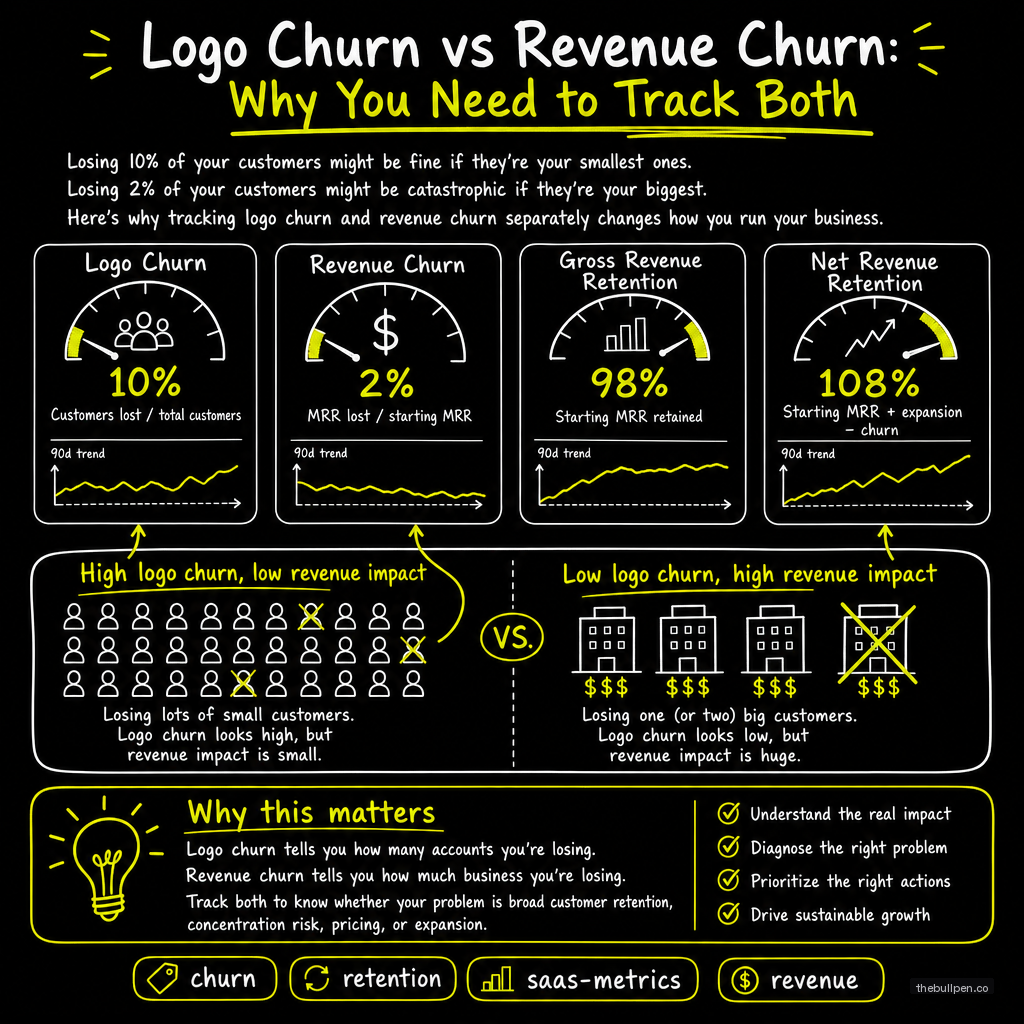
If your SaaS dashboard shows a single churn number, you're making decisions blind.
Logo churn and revenue churn measure fundamentally different things. Logo churn tells you how many customers you're losing. Revenue churn tells you how much revenue you're losing. They often move in opposite directions, and the divergence tells you more about your business than either metric alone.
A company losing 10% of its customers per month might seem like it's in crisis — until you learn that the churned customers are all free-tier users who were never going to convert, while paid enterprise accounts have 99% retention. Conversely, a company with 2% logo churn looks healthy until you discover that the two customers who left represented 40% of total revenue.
Related: Startup Metrics That Matter: What Investors Actually Look For
Why They Diverge
The divergence happens because customer value follows a power law. In most SaaS businesses, the top 10% of customers generate 30-50% of revenue. The bottom 30% of customers generate less than 5%.
| Scenario | Logo Churn | Revenue Churn | What's Happening |
|---|---|---|---|
| Losing many small customers | 10% monthly | 2% monthly | Freemium or PLG funnel working as designed |
| Losing a few large accounts | 2% monthly | 15% monthly | Enterprise churn — one customer wipes out dozens of small ones |
| Even churn across tiers | 5% monthly | 5% monthly | Healthy distribution — churn is proportional |
| Gradual downgrade pattern | 3% monthly | 7% monthly | Customers aren't leaving, but they're spending less |
The classic example is Slack. Slack had enormous logo churn among free and small-team users — people who signed up, used it for a week, and disappeared. But once a team upgraded to paid, they expanded seats aggressively. Slack's net revenue retention was above 130% even while logo churn on the free tier was through the roof. Investors who understood the divergence knew the business was strong. Analysts who only looked at logo churn were confused.
Zoom showed the same pattern after the pandemic. Small businesses dropped off in waves, creating a logo churn spike. But enterprise contracts — schools, large corporations, healthcare — stuck. Revenue churn remained low.
Related: Net Revenue Retention: The Metric That Predicts Startup Success
Benchmarks by Segment
Churn benchmarks vary dramatically by customer type. Comparing your overall churn to a blended SaaS benchmark without segmenting by ACV is meaningless.
| Segment | Typical ACV | Logo Churn (Annual) | Revenue Churn (Net Annual) |
|---|---|---|---|
| SMB / Self-serve | Under $5K | 50-70% | 15-25% |
| Mid-market | $5K-$50K | 25-40% | 10-18% |
| Enterprise | Over $50K | 10-20% | 5-10% |
An SMB business with 60% annual logo churn is within normal range. A mid-market business with 60% annual logo churn is in crisis. An enterprise business with 30% annual logo churn has a product problem.
The revenue churn numbers tell a different story. A company with high logo churn but low revenue churn (like Slack or Zoom) has a healthy core business with a leaky acquisition funnel. A company with low logo churn but high revenue churn is losing value faster than customers — which often means existing customers are downgrading or being outcompeted.
How to Present Churn to Investors
The most convincing churn slide in a pitch deck shows both metrics with cohort segmentation.
Start with the blended numbers, then immediately segment by customer size. A table like this is more useful than any single metric:
Churn by Customer Tier

Tier          Logo Churn (Mo)   Revenue Churn (Mo)   % of MRR
Enterprise    0.5%              0.3%                 45%
Mid-Market    2.1%              1.8%                 35%
SMB/Self      8.5%              2.2%                 20%
Blended       4.2%              1.1%                 100%
This tells investors exactly where the risk sits. Enterprise customers are sticky. SMB customers churn fast but don't drive enough revenue to matter. The blended number is useful for benchmarking but the segmented view is what drives decisions.
Investors will ask: why is SMB churn high, and what are you doing about it? The right answer is often "nothing, because the unit economics still work" — as long as you show that SMB customers pay back their acquisition cost before they churn.
When to Worry
- High logo churn + high revenue churn in the same segment = product-market fit crisis. Customers at every level are leaving.
- Rising revenue churn in your largest segment = your best customers are finding alternatives. This is the most dangerous trend.
- Low logo churn + falling revenue per customer = your customers are staying but spending less. Downgrade patterns, consolidation, or pricing pressure.
- Improving logo churn + declining revenue churn = you're keeping bad customers (or getting worse at monetizing the ones you keep).
Tracking both metrics and understanding their divergence separates founders who know their business from founders who look at dashboards.
Published on the Bullpen Blog. New articles every day at 9 AM UTC.
Get weekly pitch tips
One email a week. Actionable advice for founders.
Benchmark your metrics against investor expectations. Try now →