Startup Runway: How Long Before You Run Out of Money
Runway is the most important number in your business. Here's how to calculate it correctly, what founders get wrong, and how to extend it when you're running low.
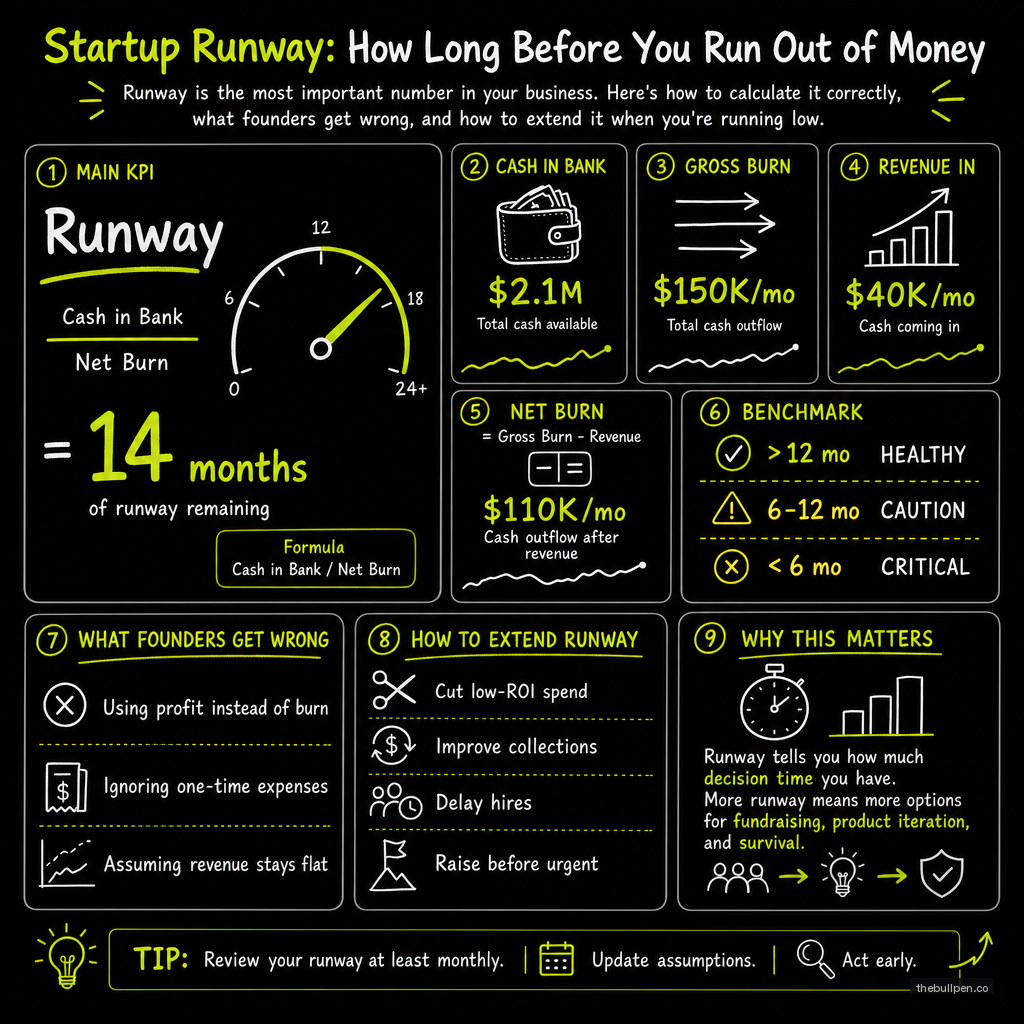
Most founders calculate runway wrong. They take their bank balance, divide by monthly burn, and call it a day. They don't account for the expenses that hit quarterly, the hire they're about to make, or the payroll taxes they forgot to include.
Runway = cash on hand / monthly cash burn. It's a simple formula with a deceptively large number of inputs. Getting any of them wrong means you think you have 14 months when you really have 9, and when you discover the mistake, it's too late to raise.
Related: Startup Metrics That Matter: What Investors Actually Look For
How to Calculate It Correctly
Start with your actual cash balance. Not your ARR. Not your committed revenue. The cash in the bank today.
Then calculate your monthly net burn: all cash outflows minus all cash inflows. Include: payroll (with taxes and benefits), rent and utilities, software subscriptions (annual ones on a monthly basis), contractor payments, marketing spend, legal and accounting fees, one-time expenses like conference attendance or equipment.
Most startups underestimate burn by 15-25% because they forget quarterly or annual expenses. A $12K annual software subscription should be included as $1K/month, not ignored until the invoice arrives. Legal fees from your last round don't disappear — the next round's legal costs will arrive eventually.
| Category | Monthly Cost | Annualized | Often Missed? |
|---|---|---|---|
| Payroll + taxes + benefits | $X | $X × 12 | ✅ Payroll tax, workers comp |
| Software (annual billed) | X/12 | X | ✅ Annual subs treated as one-time |
| Contractor payments | X | X × 12 | ✅ Inconsistent month to month |
| Legal + accounting | X | X × 12 | ✅ Quarterly or event-driven |
| Marketing spend | X | X × 12 | ✅ Variable by campaign |
Once you have your real monthly burn, divide your cash balance by it. That's your runway in months. If you have $600K in the bank and your real monthly burn is $50K, you have 12 months. But that's the optimistic number, because it assumes nothing changes.
The Adjustments
The simple calculation assumes your burn stays constant. It won't.
If you're planning to hire, your burn will increase. Add the cost of each new hire to your burn for the month they start. If you hire two people at $10K/month each starting in month 4, your burn jumps from $50K to $70K. Runway drops accordingly.
If you're raising revenue, your burn will decrease. But revenue growth is rarely linear. Some months you'll blow past projections. Others you'll fall short. Use conservative revenue estimates when calculating runway.
The safest approach: calculate three scenarios. A base case (current burn, no hires, current revenue), a growth case (planned hires, projected revenue), and a worst case (no new revenue, key people leave, burn stays high). Know your runway in all three.
When to Start Fundraising
The rule is simple: start fundraising when you have 5-6 months of runway remaining. The process takes 2-4 months on average, and you want a buffer. If you wait until 3 months of runway, you're negotiating from desperation, and investors will smell it.
A 12-18 month post-funding runway is the target after closing your round. Less than 12 months means you'll be back fundraising before you've made meaningful progress. More than 18 months can breed complacency. The sweet spot is 15-16 months.
Related: Burn Multiple: The Metric That Tells You If You're Dying Efficiently
How to Extend Runway
If your runway is shorter than you'd like, you have three levers.
Cut burn. The fastest way to extend runway is to spend less. Pause hiring. Cancel unused software subscriptions. Renegotiate vendor contracts. Move to a cheaper office or go fully remote. Every dollar you don't spend extends your runway by a dollar.
Increase revenue. The best way to extend runway is to sell more. Raise prices for new customers. Offer annual plans with a discount for upfront payment. Launch a higher-tier product. Every dollar of additional MRR reduces your net burn.
Raise bridge financing. If you can't cut enough or grow fast enough, raise a bridge round. A bridge from existing investors — typically on a SAFE with a discount — can give you 6-12 more months. It's more expensive than a full round but cheaper than running out of money.
The Warning Signs
Founders who ignore runway math make predictable mistakes.
Hiring before revenue justifies it. The single biggest runway killer. Each new hire adds $10K-$20K/month to burn. If you hire 5 people before you have the revenue to support them, you've added $50K-$100K in monthly burn. Your runway just collapsed.
Counting committed revenue as cash. A signed contract is not cash in the bank. Until the invoice is paid, it doesn't affect your runway. Net-30, Net-60, or Net-90 payment terms mean you're financing your customers for months.
Not tracking cash vs. accrual. Your P&L might show profitability while your bank account drains. Happens all the time with annual contracts, prepaid expenses, and accounts receivable. Track cash, not just revenue.
Ignoring personal runway. Founders often forget to pay themselves. You need to eat. Include your own salary in the burn calculation. A founder who doesn't pay themselves is a founder who will need to quit when the money runs out.
Know your runway. Track it weekly. And when you hit the 5-month mark, start raising.
Published on the Bullpen Blog. New articles every day at 9 AM UTC.
Get weekly pitch tips
One email a week. Actionable advice for founders.
Benchmark your metrics against investor expectations. Try now →