Gross Margin in SaaS: Why It's the Unsung Hero
Gross margin is the quietest metric on your financials — and the one that tells the most about whether you have a real business. Here's what counts as COGS, what healthy looks like, and why investors care so much.
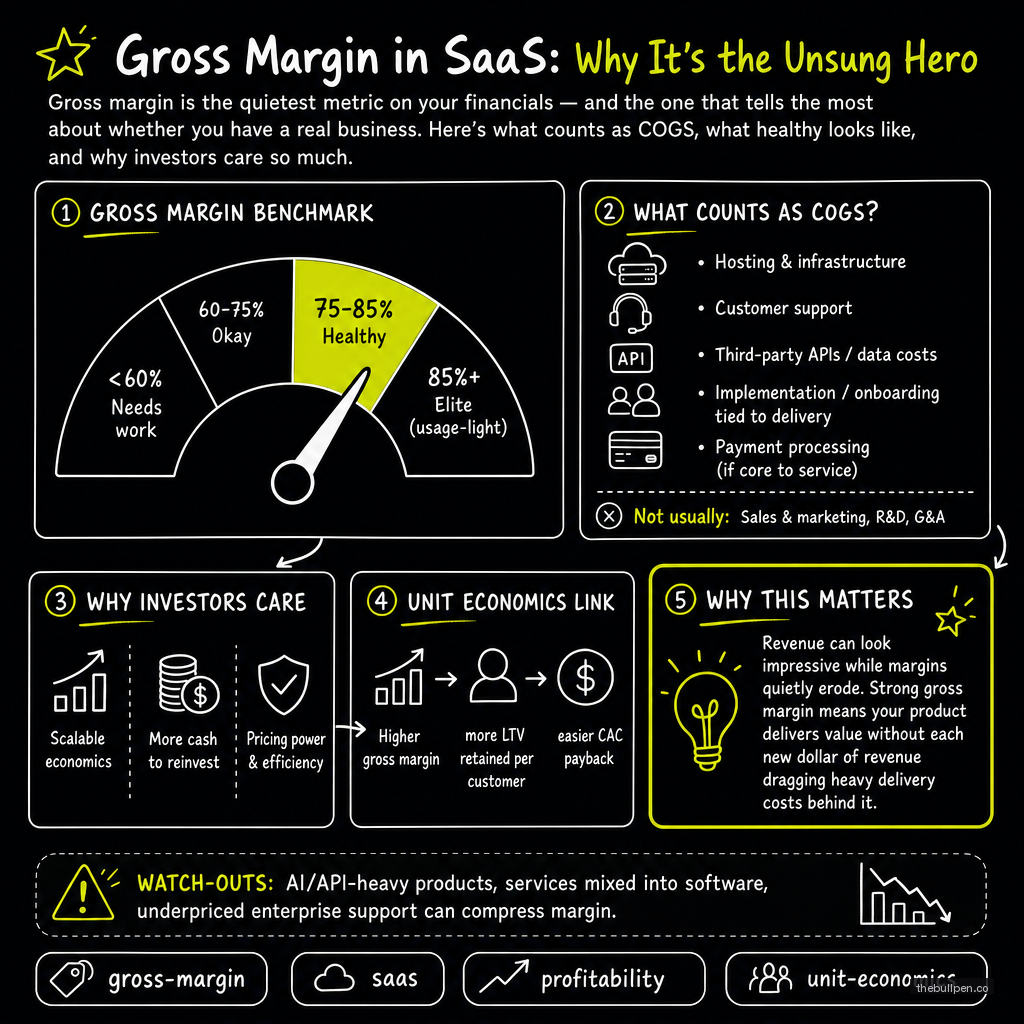
Gross margin is the least exciting metric in your financials. Revenue gets the attention. Growth gets the headlines. Churn gets the anxiety. But gross margin is the quiet foundation that makes everything else work — or doesn't.
Here's why investors care so much. Gross margin determines how much of every dollar of revenue is available to cover your operating costs. A company with 80% gross margin keeps $0.80 of every dollar to spend on sales, marketing, R&D, and overhead. A company with 40% gross margin keeps $0.40. The second company needs to be twice as efficient at everything else just to break even.
Gross margin also compounds. If you grow revenue from $1M to $10M, an 80% margin company generates $7.2M in gross profit to reinvest. A 40% margin company generates $3.6M. The difference — $3.6M — is money that could have been spent on engineering, sales, or growth.
Related: Startup Metrics That Matter: What Investors Actually Look For
What Counts as COGS
The most common gross margin mistake is undercounting COGS. Founders think gross margin is (Revenue - Hosting Costs) / Revenue. It's not.
COGS for a SaaS company includes: cloud infrastructure (AWS, GCP, Azure), third-party APIs and data sources, payment processing fees, customer support headcount (if directly tied to delivery), implementation and onboarding costs, and any hardware or licensing costs required to deliver the product.
COGS does not include: sales and marketing salaries, R&D and engineering, general and administrative costs, office rent, or legal and accounting fees. Those are operating expenses, not cost of goods sold.
| What's In COGS | What's Not |
|---|---|
| Cloud infrastructure | Sales and marketing salaries |
| Third-party APIs | Engineering and R&D |
| Payment processing | General and admin costs |
| Support team (delivery) | Office rent |
| Implementation costs | Legal and accounting |
The test: if the expense would go away if you stopped serving a specific customer, it's probably COGS. If it would remain regardless, it's an operating expense.
What Healthy Looks Like
For pure SaaS products, gross margins should be between 70% and 85%. Top-quartile public SaaS companies consistently report margins above 80%. Below 70% raises questions about your cost structure. Below 60% suggests you might have a services business disguised as a product business.
Low gross margin businesses are not necessarily bad. Professional services firms operate at 30% to 50% gross margins and can be excellent businesses. Marketplaces, hardware companies, and businesses with significant fulfillment costs also run lower margins. The problem is when a founder claims to have a high-margin SaaS business but reports numbers that look like a low-margin services business.
If your gross margin is below 60%, you need a clear explanation. Is your cloud infrastructure unusually expensive because of your data processing requirements? Are you including implementation costs that will decrease over time? Do you have a land-and-expand model where early customers are expensive to serve but later ones are not?
The best approach is to report product gross margin and services gross margin separately. A company with 75% product margin and 35% services margin is honest about its mix. A company that blends them into a 55% blended margin is hiding the fact that the product business is fine and the services business is dragging it down.
Why Investors Care
Gross margin correlates with long-term value creation more strongly than almost any other metric. A SaaS company at 80% margin with modest growth will eventually become profitable and self-sustaining. A company at 40% margin with high growth will lose money forever unless it finds a way to improve the unit economics.
When investors model your business, gross margin is one of the first assumptions they test. They ask: what happens if margins compress by 10 points due to competition or infrastructure cost increases? If a 10-point margin drop pushes your business from barely profitable to deeply unprofitable, you have a structural vulnerability.
The fix is rarely about cutting infrastructure costs. It's about pricing. If your gross margin is low, the fastest fix is to raise prices. A 20% price increase on an 70% margin product pushes margin to roughly 75%. That's more effective than any infrastructure optimization you can make.
Related: Lifetime Value: How to Calculate and Improve LTV
Data references: KeyBanc Capital Markets SaaS Survey (gross margin benchmarks by sector — median 75%, top quartile 82%), OpenView 2021 Benchmark Report (margin by ACV tier), ProfitWell gross margin analysis (COGS classification framework).
Ready to see how your gross margin looks to investors? Upload your financials to Bullpen for a free AI-powered evaluation across 7 investor categories.
Get weekly pitch tips
One email a week. Actionable advice for founders.
Benchmark your metrics against investor expectations. Try now →