The Fundraising Story: How to Pitch Without a Deck
How to craft a compelling verbal pitch that works in 30 seconds or 3 minutes — with real stories of founders who raised millions without a single slide.
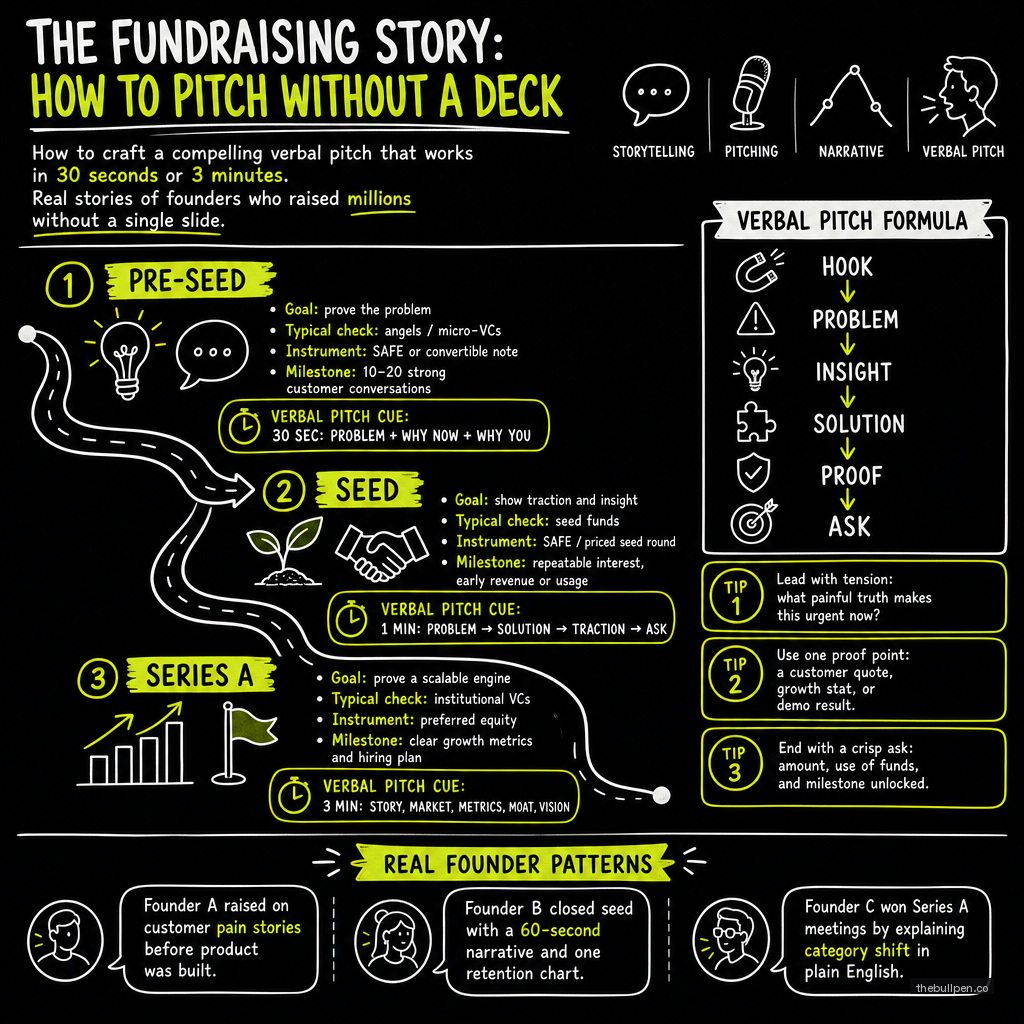
The best fundraising pitches in startup history have one thing in common: none of them started with a slide deck.
Robinhood raised $3 million from Index Ventures after its founder sketched a napkin with three lines and a fee structure. Stripe walked into their Y Combinator interview with a broken demo that crashed immediately. WhatsApp closed $250,000 from five ex-Yahoo colleagues over coffee at a Silicon Valley diner. Sara Blakely talked Oprah's team into a meeting with nothing but a pair of cut-up pantyhose.
The deck came later — or never came at all.
If you're raising capital in 2026, the ability to pitch without a deck isn't a party trick. It's a survival skill. Warm introductions, hallway conversations, demo day rapid-fire slots, and partner meetings that run short all demand a verbal pitch that lands in seconds. The investors who write the biggest checks often decide whether to lean in before a single slide loads.
Here's how to build that pitch.
The Napkin Didn't Need More Ink
When Vlad Tenev and Baiju Bhatt first pitched Robinhood to Index Ventures, there was no slideware, no market-sizing chart, no financial model. There was a napkin. On it: a sketch of how Robinhood would make money — zero commission trading subsidized by interest on customer cash balances and premium account fees. Three bullet points. That napkin earned a $3 million seed round.
The lesson isn't "draw on napkins." It's that a clear, simple economic story is far more persuasive than a dense deck. If you can't explain your business model on a napkin in sixty seconds, your deck won't fix it — it'll just bury the lack of clarity in formatting.
Related: Fundraising Strategy Overview
The Narrative Arc That Replaces Slides
A verbal pitch without a deck needs structure, because you lose the crutch of sequential slides. The most effective structure follows a narrative arc that mirrors how humans process stories:
| Section | Purpose | Ideal Duration |
|---|---|---|
| Hook | Grab attention with a surprising fact or vivid moment | 5 seconds |
| Problem | Name the pain, make it visceral | 15 seconds |
| Solution | How you solve it, why you uniquely can | 20 seconds |
| Traction | Real proof the model works | 15 seconds |
| Ask | What you need, what it unlocks | 5 seconds |
The total: roughly sixty seconds for an elevator version, three minutes for a fuller conversation. Every section earns the next. The hook makes them curious enough to hear the problem. The problem makes them uncomfortable enough to want the solution. The solution makes them skeptical enough to need traction. Traction makes them interested enough to hear the ask.
The Hook
"Every time a young professional buys a stock today, the person executing that trade loses money doing it. That makes no sense." That's Robinhood's hook — a structural absurdity that demands an explanation.
A good hook is a single sentence that creates a gap between what the listener knows and what they suspect. It doesn't need to be dramatic. It needs to be true and slightly unsettling.
The Problem
Make it personal. Investors invest in people who have felt the pain they're solving. If you're building for small business owners, describe the Sunday night anxiety of closing the books manually. If you're building developer tools, describe the exact moment a build fails and no one knows why.
Specificity is credibility. "Forty-three percent of small businesses spend more than eighty hours per month on compliance paperwork" lands harder than "paperwork is a problem."
The Solution
State your solution in one sentence using the formula: For [target customer] who [problem], [our product] is a [category] that [key benefit].
Example: "For freelancers who spend six hours a week on invoicing, Invoicy is an AI bookkeeper that cuts that to thirty seconds."
If the sentence feels long, it's too long. Shorten it until you could say it on a crowded elevator and the stranger next to you would nod.
The Traction
The best traction stories are concrete, specific, and recent. "We grew revenue 22% month over month for the last six quarters" with two specific customer logos is stronger than "we have great product-market fit."
If you're pre-revenue, traction can be a letter of intent from a potential customer, a waitlist number, or a technical milestone. The key is observable evidence that something is working.
The Ask
End with a specific, ask. "We're raising a $1.5 million seed round to hire three engineers and launch in two new cities. We're looking for a lead who brings fintech expertise." Don't trail off. Silence after the ask is powerful , let them respond.
When the Demo Breaks
Stripe's Y Combinator interview is legendary for all the wrong reasons. Patrick Collison sat down to demo their payment integration, and the product broke immediately. Nothing worked. The demigods on the other side of the table , Paul Graham, Jessica Livingston, Trevor Blackwell , watched the demo fail in real time.
It didn't matter. The Collison brothers were so clearly the right founders , so deeply technical, so obsessed with the problem, so articulate about why existing payment infrastructure was broken , that the failed demo became a detail. They got into YC.
The takeaway: the narrative is the asset. A deck and a demo are prosthetic supports for a weak story. If the story is strong enough, the prosthetics are optional. Patrick and John Collison didn't have slides to fall back on in that moment. They had conviction, clarity, and the ability to explain why Stripe mattered without showing a single working feature.
Related: The Warm Introduction Strategy
Michael Seibel's One Rule
YC's Michael Seibel has coached thousands of founders through fundraising, and his single most repeated piece of advice is this: "Don't pitch , have a conversation."
A pitch is a monologue. A conversation is a dialogue where you learn what the investor cares about and adjust in real time. The best fundraisers walk into a room with three stories ready , the origin story, the traction story, and the vision story , and deploy whichever one the conversation calls for.
If an investor asks about competition, you don't force them back to slide seven. You tell the story of why your approach is different. If they ask about unit economics, you don't defer to the financial model. You explain the math in your head, on a whiteboard, or on the back of a napkin.
The skill underneath all of this is deep fluency. You can't have a conversation about your business if you need a deck to remember your own numbers. Know your CAC, LTV, burn rate, and gross margin the way you know your phone number. Not in a spreadsheet , in your head.
The YC "No Deck" Philosophy
Y Combinator's application process has always prioritized the verbal pitch over the slide deck. The application asks for a two-minute video of the founders explaining their idea and a series of written answers that get to the heart of the business. No slide deck required.
Demo Day presentations at YC are famously minimal. Airbnb's first Demo Day pitch had one slide: a photograph of Brian Chesky's apartment with an air mattress on the floor. The entire pitch was two minutes of founders explaining why strangers would pay to stay in that room.
One photo. Two minutes. A $600,000 seed round that turned into the most valuable hospitality company on earth.
The YC model works because it forces founders to compress their story until only the essential remains. If you can't explain your business in two minutes on camera, you don't understand your business well enough yet. The constraint isn't a limitation , it's a diagnostic.
Related: An Efficient Fundraising Process
WhatsApp at the Diner
In early 2009, Jan Koum met five ex-Yahoo colleagues at a Santa Clara diner called Hobee's. Over coffee and California omelets, he explained what he was building: a messaging app that would replace SMS with an internet-based alternative, no ads, no games, no gimmicks.
No deck. No demo. No prototype that worked reliably on the spot.
The five colleagues invested $250,000. That investment bought them equity in a company that would sell to Facebook for $19 billion five years later.
What did they hear over coffee? A founder who understood the problem from the inside , Koum had grown up in Ukraine where keeping in touch with family was expensive and unreliable. A simple value proposition that anyone could repeat. And a level of conviction that didn't need PowerPoint to prove itself.
Sara Blakely's Five Minutes
Sara Blakely walked into Oprah Winfrey's Harpo Studios with a pair of footless pantyhose cut apart with scissors and a patent for a new shapewear category. She had no slides. She had no prototypes from a factory. She had cut the pantyhose herself in her apartment.
She had five minutes to pitch the most powerful media personality in America.
Blakely didn't explain the shapewear market. She didn't show a competitive landscape. She talked about the problem , pantyhose that ruined the line of white pants , and held up her solution. Oprah named Spanx her "Favorite Thing" of the year. The company's trajectory changed forever.
Five minutes. Cut pantyhose. No slides.
How to Practice
The verbal pitch is a skill, and like any skill, it improves with reps. Here's a practice regimen that works:
Record yourself. Watch your own pitch on video. Cut every hesitation, every filler word, every sentence that starts with "essentially" or "basically." Your listen's threshold for jargon and vagueness is lower than you think.
Pitch to non-experts. Your mother, your friend who works in a completely different industry, your old roommate. If they can repeat your one-sentence formula back to you after hearing it once, your pitch is clear enough. If they can't, simplify.
Prepare two versions. A thirty-second version for hallway conversations and crowded rooms. A three-minute version for coffee meetings and video calls. The thirty-second version is the three-minute version compressed , same arc, fewer details. If you can't do both, you don't know your story well enough.
Practice without notes. The goal is not to memorize a script. The goal is to know your business so deeply that the right story comes out naturally no matter which direction the conversation turns. That fluency only comes from dozens of reps in real conversations.
The Verbal Pitch Is the Real Pitch
Slides are a crutch that most founders lean on too heavily. A deck lets you hide behind bullet points and charts. A verbal pitch forces you to stand behind your conviction.
Robinhood's napkin. Stripe's broken demo. WhatsApp's diner conversation. Spanx's cut pantyhose. Airbnb's single photograph. None of these are stories about great presentations. They are stories about founders who understood their business so completely that they could communicate it with nothing at all.
If you're raising capital, invest your preparation time in the verbal pitch first. Build a deck if you must, but build it last. By the time you open Keynote, you should already know exactly what you'd say to an investor in an elevator, at a coffee shop, or across a table at Hobee's.
The deck is documentation. The story is the pitch.
Published on the Bullpen Blog. New articles every day at 9 AM UTC.
Get weekly pitch tips
One email a week. Actionable advice for founders.
See how investors will grade your pitch. Try now →